The Story Behind Red Bull and Verstappen’s Turnaround in Miami
A new Macarena wing in development since November, seven upgraded components, 6 kg less weight on the car — and a steering rack that finally works. Pierre Wache explains the full scope of Red Bull’s Miami transformation.
When Max Verstappen qualified second for the Miami Grand Prix — on the front row alongside championship leader Kimi Antonelli, ahead of McLaren, Ferrari, and George Russell’s Mercedes — the result sent a ripple of surprise through a paddock that had spent three race weekends writing Red Bull’s season off. Even Verstappen himself joked he had “bet on that” outcome himself. The turnaround was real, dramatic, and — as Pierre Wache’s post-race explanations revealed — the product of months of work that very nearly arrived three races earlier.
The story of Red Bull’s Miami upgrade is not a simple tale of new parts producing more pace. It is a story of a specific mechanical fault hidden beneath a general handling problem, a brand-new aerodynamic concept delayed from February to May, and a development programme fighting against weight, regulations, and time simultaneously. Wache, Red Bull’s technical director, provided the most detailed account yet of everything that went into Florida.
Seven Parts, One Massive Project
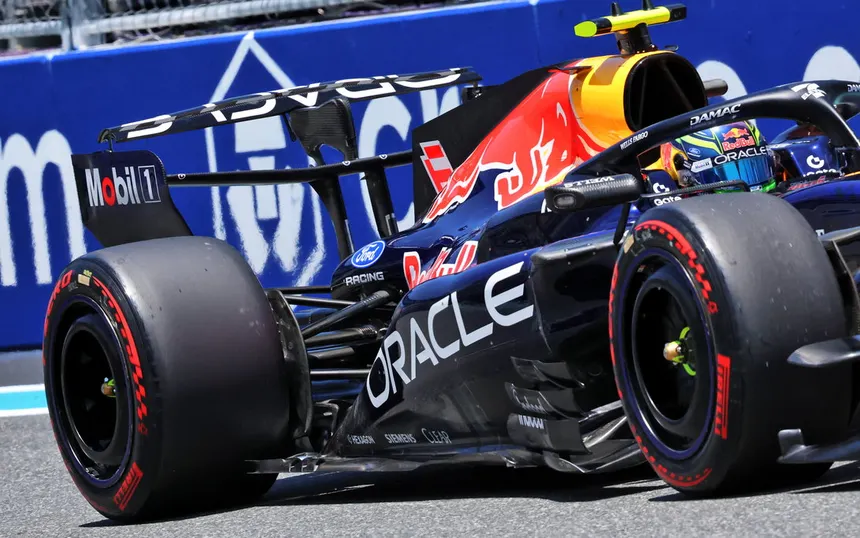
The Miami upgrade was the most comprehensive single development step of Red Bull’s 2026 season. Front wing, brake ducts, floor, sidepods, engine cover, diffuser and rear wing were all changed in what was a very major project — seven separate components listed in the FIA’s technical documentation. A filming day at Silverstone, held just before the Miami weekend, allowed Verstappen to evaluate the full package under controlled conditions before the competitive sessions began. The feedback was immediately encouraging.
“It’s not easy, but I’m for sure disappointed with the result. I think the result in Miami doesn’t show our pace. But it’s good for the team to show that the car has some pace on it and that we are in the mix again.”
— Pierre Wache, Red Bull Technical Director
The team closed the gap to the front of the field by around one second compared to the Japanese Grand Prix — all the more remarkable given that McLaren and Ferrari also introduced significant packages in Miami. The scale of the step surprised even those inside the team, who had expected the parts to deliver — but not at quite that magnitude.
The Macarena Wing: Six Months in the Making
The most visually striking element of the Miami upgrade was Red Bull’s own interpretation of the rotating rear wing concept that Ferrari pioneered earlier in 2026 — quickly dubbed the “Macarena wing” across the paddock. But while the label suggests imitation, the reality is more nuanced. Red Bull insists its wing was not inspired by Ferrari, pointing out that the team had already discussed the concept with the FIA before the season began — independently of Ferrari’s own discussions.
The wing’s journey to Miami was far from smooth. Wache confirmed the team began working on the concept in November 2025, attempted to introduce it in Bahrain, then Melbourne, struggled again in Suzuka, and only finally got it working correctly for Florida. The core challenge was regulatory compliance — specifically, the FIA’s constraints on how quickly the mechanism can open and close, combined with the fact that the distances involved in Red Bull’s design were different from anything the team had used before.
“We tried to introduce it in Bahrain, and then in Melbourne. But we had some issues to make it work. We tried again in Suzuka, but we were struggling a lot. And now it works. It’s a long process to make this type of device happen.”
— Pierre Wache
The Silverstone filming day proved decisive. With 200 km of running available, Verstappen was able to validate the wing in real-world conditions. The result was confirmation that the concept was ready for competition — the first time that had been true after three previous failed attempts to bring it to a race.
The Weight Journey: From 12 kg Over to the Minimum Weight Target
Alongside the aerodynamic step, Miami represented significant progress on one of the RB22’s most damaging underlying problems: excess weight. At the start of 2026, Red Bull’s car was approximately 12 kg above the regulated minimum of 768 kg — a deficit worth an estimated three to four tenths of a second per lap. The Miami upgrade package roughly halved that excess.
Wache confirmed that a further weight-reduction step is planned for the European season — currently targeting the Austrian Grand Prix as the point at which the RB22 should reach the minimum weight limit of 768 kg. Budget cap constraints mean Red Bull cannot accelerate development indefinitely, and Montreal will only bring a modest update. The bigger step is planned for the start of the European summer.
The Unexpected Bonus: Unlocking “Max Performance”
Perhaps the most striking element of Wache’s post-Miami debrief was not what the upgrade delivered — but what the steering fix unlocked on top of it. Wache acknowledged that correcting the long-standing steering rack issue (Verstappen had flagged the problem from his very first lap in Barcelona testing) produced performance gains that went beyond the parts themselves.
“It delivered what we expected. It’s just the package itself that has delivered. But after we fixed some other issues, that has also brought some Max performance that maybe we didn’t expect.”
— Pierre Wache
Verstappen had spent three race weekends driving a car that, as he put it, he “couldn’t steer normally.” The restoration of proper steering feel — combined with the aerodynamic gains — produced a compound effect that Wache describes as a pleasant surprise. A driver who can feel their car is a driver who can push to the limit. In Miami, for the first time in 2026, Verstappen could do both.
“Of course I didn’t expect this either. The goal for this weekend was to get a bit closer to the top three teams, but normally that would still mean P7 on the grid. So, it went a lot better than expected.”
— Max Verstappen, post-qualifying Miami
What Comes Next: Patience Under the Budget Cap
The Miami upgrade is Red Bull’s second development step of the season, but the development race is far from over. Mercedes has confirmed a significant package for Montreal. McLaren continues to evolve its car race by race. And Red Bull, constrained by budget cap realities, must be strategic about the timing and scope of its next steps.
- Japan: First upgrade package — Verstappen reported no improvement in feel
- Silverstone filming day: Full Miami package validated over 200 km; steering rack replaced; Macarena wing confirmed
- Miami: Seven components upgraded; ~6 kg weight reduction; ~1 second closed to the front of the field
- Montreal: “A little step” only — budget cap limits what is possible between Miami and Canada
- Austrian GP (target): Next major package, including further weight reduction to reach the 768 kg minimum
Wache was candid about the constraints: “We have to wait a little bit longer, just a little step for Montreal.” The budget cap means Red Bull cannot simply pour resources into back-to-back massive upgrades. The Austrian Grand Prix — the first home race for Red Bull, in Spielberg — is now the next meaningful development milestone on the team’s calendar.
The real significance of Miami for Red Bull is not fifth place for Verstappen. It is the proof of concept: that the team can diagnose its problems, design solutions, and make them work under competitive conditions. A Macarena wing six months in the making. A steering rack that finally lets Verstappen drive. A weight deficit cut in half. The turnaround in Miami was not an accident — it was the payoff on a very long, very difficult investment.
Sources
- Autosport — Exclusive: The story behind Red Bull and Verstappen’s turnaround in Miami
- Motorsport.com — Red Bull’s big upgrade package and its Macarena wing explained
- Motorsport.com — Verstappen reveals hidden factor behind Red Bull’s turnaround
- Formula1.com — Tech Weekly: Transformative upgrades behind Red Bull’s Miami turnaround
- RacingNews365 — Red Bull’s radical Miami upgrades revealed
- Speedcafe — Red Bull reveals reason behind Miami turnaround
- F1 Oversteer — Miami upgrades “halved” weight issues on RB22
- GPFans — Red Bull’s Macarena wing explained ahead of Miami GP
Discover more from f1liveupdates.com
Subscribe to get the latest posts sent to your email.