
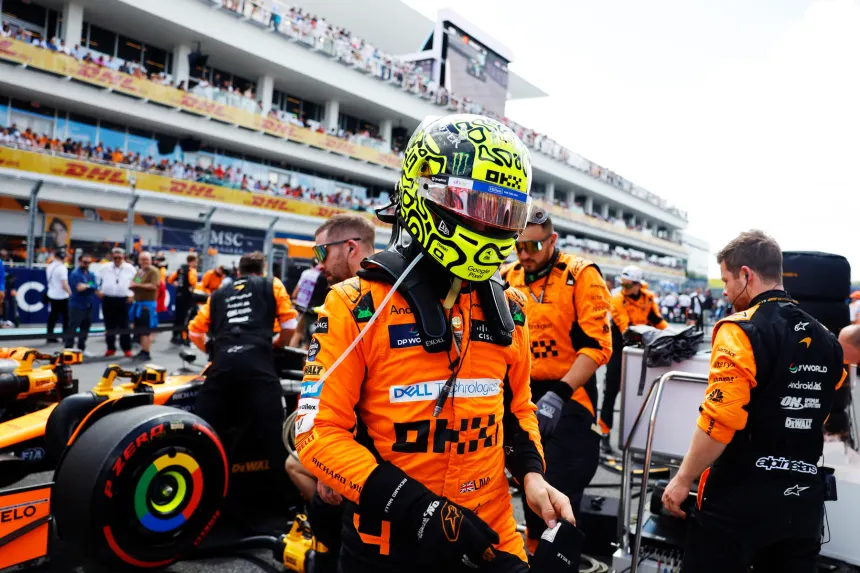
Norris on Fixing F1: “Get Rid of the Battery”
The Miami tweaks were a step in the right direction — but the reigning world champion believes they don’t come close to solving the fundamental problem. His solution is radical, and he knows it.
After four rounds of growing frustration, Formula 1 introduced its first package of energy management tweaks at the Miami Grand Prix. The changes were agreed following extensive consultation between the FIA, F1, teams, and drivers — and they were designed to do two things: let drivers push closer to flat-out in qualifying, and reduce the yo-yo closing speed differentials that had already produced a 50G crash in Japan. Lando Norris, who finished third on the road before being reclassified second after a Leclerc penalty, welcomed the effort. Then he explained why it wasn’t nearly enough — and what he actually thinks is needed.
“It’s a small step in the right direction, but it’s not to the level that Formula 1 should still be at yet. If you go flat out everywhere and you try pushing like you were in previous years, you still just get penalised for it. You still can’t be flat out everywhere. Honestly, I don’t really think you can fix that. You just have to get rid of the battery. Hopefully in a few years, that’s the case.”
— Lando Norris, McLaren, post-race Miami press conference
What Miami Actually Changed
The FIA’s Miami package was the product of the April meetings between teams, power unit manufacturers, and the governing body — the same process that culminated in the April 20 vote ahead of the race weekend. The changes were not cosmetic, but they were deliberately contained: designed to improve the immediate driver experience without requiring hardware modifications that would disadvantage manufacturers mid-season.
Norris was measured about the qualifying improvement. “Reducing the harvest limit in qualifying has helped a bit,” he acknowledged. But the race, by contrast, felt essentially unchanged to the drivers who experienced it most directly. The underlying physics of the 50/50 power split — half the car’s output derived from electrical energy that depletes, runs out, and must be harvested back — has not been altered by any of the Miami tweaks. It cannot be, without hardware changes that apply to the power units themselves.
Three Drivers, One Verdict
Norris was not alone. The top three finishers in Miami — Antonelli, Norris, and Piastri — all delivered post-race verdicts that pointed in the same direction: progress acknowledged, problem unresolved.
“The closing speeds are massive, and you also need to trust the guy who is defending because also with this active aero, the car is pretty lazy when you want to change direction, so you need to think in advance.”
On the continued challenge of racing with active aero and battery management“You should never get penalised for going flat out. And you still do. Honestly, I don’t really think you can fix that. You just have to get rid of the battery.”
The bluntest assessment of the three — and the most radical prescription“Today was my first proper experience of overtaking people and having to defend and it’s pretty crazy, to be honest. At one point George was one second behind me and managed to overtake me by the end of that straight.”
On the scale of closing speed differentials — Russell had closed 1 second and passed within a single straightThe 2027 Direction: 60/40 and Further
Norris’s frustration lands in a context where the conversation has already shifted. F1 stakeholders have agreed in principle to go further for 2027 — beyond what the Miami tweaks delivered. The plan, confirmed in the days surrounding Miami, involves increasing combustion engine power output by approximately 50kW through higher fuel flow rates, with an equal reduction in electric energy deployment. The net effect would shift the power split from the original 50/50 target closer to 60/40 in favour of the internal combustion engine.
- Miami 2026: Harvest limit cut (8MJ → 7MJ in qualifying), super-clipping limit raised (250kW → 350kW)
- 2027 hardware change (agreed in principle): +50kW from ICE via higher fuel flow; −50kW from electric deployment
- Result: Power split shifts from ~50/50 to ~60/40 ICE/electric
- Verstappen’s preference: 80/20 in favour of ICE — “return to proper F1”
- Norris’s endpoint: Remove the battery entirely — acknowledged as years away
Verstappen, who has compared the current formula to “Formula E on steroids” and called the Miami changes “a tickle,” would go further still — pushing for an 80/20 split that would essentially return the power architecture to something closer to the pre-2026 era. Norris’s position is more extreme: remove the battery entirely. He knows it won’t happen soon. “Hopefully in a few years, that’s the case” is not a demand — it is a direction of travel, stated clearly by the driver who currently holds the championship and knows the regulations better than almost anyone.
For now, Miami gave drivers a slightly better experience in qualifying. The race remained recognisably the same — battery management, yo-yo speeds, and the peculiar challenge of defending position against a car that can deploy a second’s worth of closing speed in a single straight. The sport has begun its journey away from the problem Norris identified. How long that journey takes will define Formula 1’s next chapter.
Discover more from f1liveupdates.com
Subscribe to get the latest posts sent to your email.