Did Ferrari Outsmart Mercedes? How Leclerc Won the Japan Podium Battle
Charles Leclerc kept George Russell behind him for an entire closing sequence at Suzuka — not through raw pace, but through a superior reading of 2026’s energy game and a psychological battle fought as much over the radio as on the track.
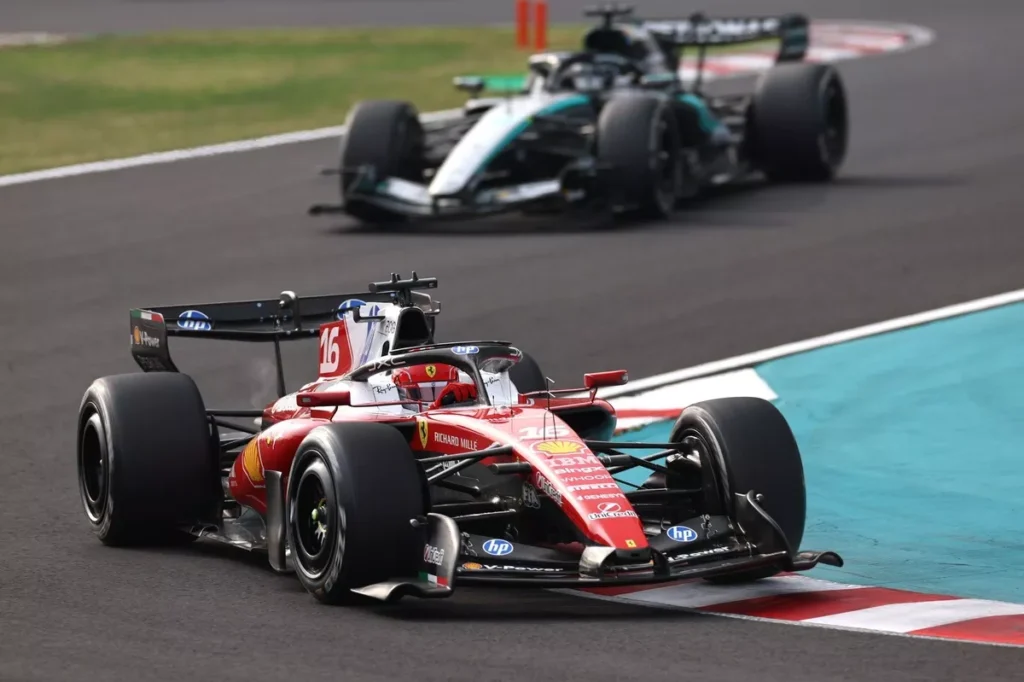
George Russell had the faster car. He had the stronger power unit. He had the motivation of a driver who had just lost the championship lead to his own team-mate. And yet, when the Japanese Grand Prix reached its decisive closing laps, it was Charles Leclerc who crossed the line third — 0.484 seconds ahead of the Mercedes — and claimed his second podium of the 2026 season. How Leclerc pulled it off is one of the most technically intricate stories of the Suzuka weekend: a combination of smarter energy deployment, a yo-yo defensive strategy, and a psychological duel conducted live over team radio.
A New Kind of Race — Where Energy Is the Weapon
Under the 2026 regulations, the old logic of overtaking has been fundamentally rewritten. DRS is gone, replaced by an active aerodynamic system, and the new 50/50 hybrid power units mean that energy deployment — when you use it, where you conserve it, and how you time the boost — has become the central strategic variable in wheel-to-wheel combat. Speed differences between cars on the same straight can reach close to 25mph depending on how each driver manages their battery state, creating dramatic yo-yo effects that would have been impossible under previous rules.
“Super-clipping” is what happens when a car’s battery is fully depleted and the driver is forced to harvest energy while staying flat on the throttle. The car remains at full throttle, but electrical power is cut off — creating a dramatic and visible speed drop. At Suzuka, speed reductions of up to 50 kph were recorded before the final chicane braking zone, even when drivers were not yet braking. It turns each straight into a calculated battle: who has battery power to deploy, and who has already spent it.
This dynamic shaped the entire closing battle at Suzuka between Leclerc and Russell. It was not simply a fight for the third-place trophy — it was a live experiment in energy interpretation, with the Ferrari and Mercedes pitwall strategies diverging significantly in their reading of where power was worth spending and where it was worth recovering.
Ferrari’s Deployment Strategy: The Yo-Yo Defence
Analysis of the closing laps reveals a clear and deliberate pattern from Ferrari’s side. Rather than conserving battery into the hairpin before Spoon, Leclerc deployed more aggressively out of the hairpin and onto the run towards Spoon Curve — immediately opening a small gap on the straight and forcing Russell to spend energy in the second half of the straight just to close it. By the time both cars reached the end-of-straight super-clipping zone approaching the final chicane, Russell had often already burned the energy he needed to make an overtake stick.
The approach created a defensive rhythm that repeated lap after lap. Ferrari would accelerate hard early on the straight, Russell would close late, enter clipping, and arrive at the braking zone with insufficient battery to sustain any position gained into the next straight. Leclerc was, in effect, baiting Russell into spending his energy at the wrong moment — then recovering enough of his own to defend on the following lap.
“I think it was a bit difficult to get by when I was behind Charles because we obviously had two completely different deployments. It was just hard to find the right place.”
— Kimi Antonelli, on the same issue earlier in the race
Antonelli had noticed precisely this phenomenon in the first stint, when he was trying to pass Leclerc and found the Ferrari’s deployment pattern made it extremely difficult to identify a viable attack window. The same difficulty returned in the closing stages when Russell pressed his case for the podium.
Lap 50: Russell Gets Through — and Immediately Loses It
On lap 50 of 53, Russell finally forced his way past Leclerc at the final chicane. But the manner of the pass illustrated exactly why Ferrari’s approach was so effective. To make the move work, Russell had to commit his overtake mode and battery boost into the chicane — which, under the 2026 regulations, continues to deploy even if the driver lifts briefly before the corner. The pass succeeded, but Russell emerged from it with a severely depleted battery state for the run down the start-finish straight.
Leclerc, reading the situation immediately, deployed on the main straight and reclaimed the position into Turn 1 at the start of lap 51. Russell had paid for the overtake with the energy he needed to defend. His race engineer Bryan Bozzi called the move “two balls of steel” over the radio. The podium was secured.
- Lap 50: Russell uses boost in overtake mode into final chicane — takes P3
- Exit of chicane: Russell’s battery severely depleted for the main straight
- Lap 51: Leclerc deploys full power down the start-finish straight
- Leclerc retakes P3 into Turn 1 — and never loses it again
- Final margin: Leclerc P3 ahead of Russell by 0.484 seconds
The Radio Mind Game — and How Ferrari Cracked It
But the battle was not fought only with energy. Leclerc revealed after the race that Mercedes had attempted a second front: psychological warfare through team radio. Russell’s race engineer Marcus Dudley was feeding information over the radio — information that Ferrari’s Bryan Bozzi was intercepting and relaying to Leclerc in real time. The problem was that Russell was consistently doing the exact opposite of what his engineer was broadcasting.
“It was quite tight at some points, and they were also being quite cheeky. I think his engineer was telling him things on the radio. My engineer was telling me what his engineer was saying on the radio, but he was doing the opposite. At one point, they told me he was being told to use everything in the back straight — and for four laps in a row, he did exactly the opposite of that.”
— Charles Leclerc, post-race press conference, Suzuka
The intention was clear: if Ferrari’s engineers were listening to and acting on Russell’s radio instructions, Mercedes could feed them false signals and provoke Leclerc into mis-deploying his battery at the wrong moment. For several laps, Leclerc absorbed the pressure while trying to decode what was genuine information and what was a bluff. Eventually, after recognising the pattern, he stopped reacting to the radio feed and returned to his own plan — which proved sufficient.
Vasseur: “Very Important to Keep Russell Behind”
Ferrari team principal Frédéric Vasseur acknowledged the significance of the result and the quality of Leclerc’s defence in his post-race comments, framing it as a crucial psychological and strategic win for the team against the championship favourite.
“We want to get more, but I think it was a very, very strong drive from Charles at the end with Russell. It was important for us to keep Mercedes behind — and Russell behind us.”
— Frédéric Vasseur, Ferrari Team Principal
For Leclerc, the result confirmed what Ferrari showed in the opening two races: that even in a car with a power unit disadvantage relative to Mercedes, intelligent energy management and strategic savvy can produce podiums. The SF-26 retains aerodynamic grip advantages in the corners — a factor that also allows it to recover battery energy more efficiently in certain sections of the lap — but on the straights, Ferrari remains behind. Understanding how to weaponise what it has, rather than lamenting what it lacks, is becoming Ferrari’s defining skill of the early 2026 season.
With a major upgrade package expected from all teams at Miami, the true competitive picture will clarify. But Suzuka’s closing stages made one thing plain: in 2026, the driver who best reads the energy game wins. And on Sunday, that was Leclerc.
Discover more from f1liveupdates.com
Subscribe to get the latest posts sent to your email.