Why the FIA Stewards Were Not Lenient with Charles Leclerc in Miami
Charles Leclerc argued his damaged Ferrari left him no choice but to cut multiple corners on the final lap. The stewards disagreed — and a drive-through penalty converted to 20 seconds dropped him from sixth to eighth.
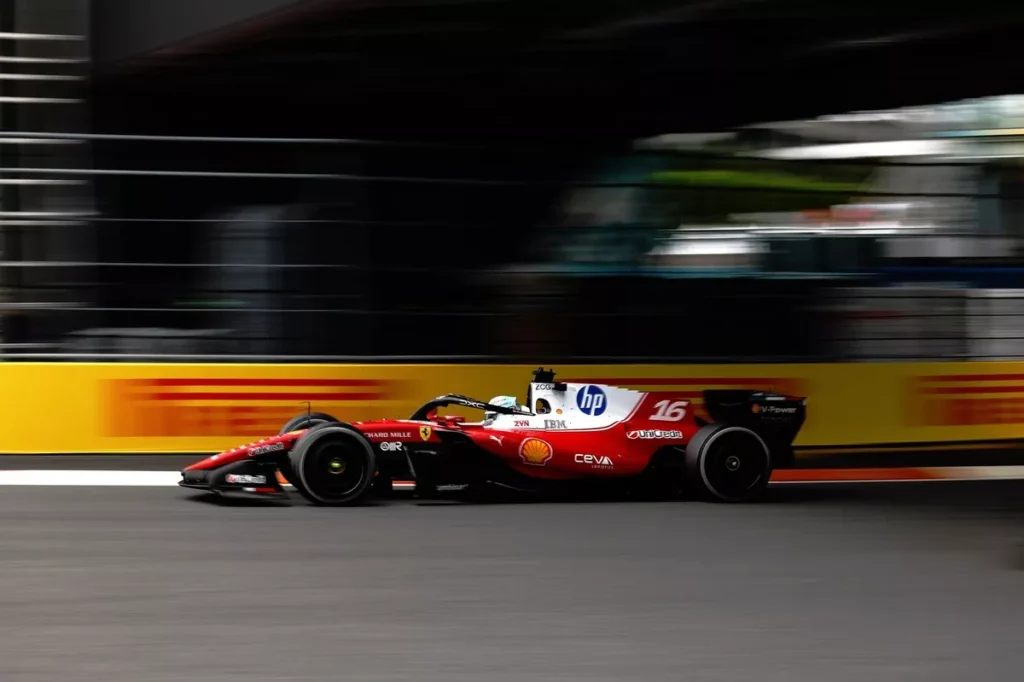
Few moments in the 2026 Miami Grand Prix were as dramatic as Charles Leclerc’s final lap. Running in a solid fourth place, with an outside chance of reclaiming third after Oscar Piastri had passed him on lap 56, the Ferrari driver lost the rear of his SF-26 through Turns 2 and 3, spun, and clipped the wall with his left front. He rejoined the circuit, finished the race — and then spent the next hour being investigated by the stewards. By the end of it, he had been dropped to eighth.
The penalty sparked immediate debate. Leclerc’s car was clearly damaged. He had no control over the spin that caused it. So why didn’t the stewards show any leniency? The answer lies in the specific nature of the offence — and a crucial distinction in how the FIA interprets the rules around leaving the track and gaining an advantage.
What Happened on the Final Lap
After his spin and contact with the Turn 3 wall, Leclerc’s Ferrari suffered steering arm damage that left him unable to negotiate right-hand corners properly. Rather than a straightforward limp to the finish, what followed was a series of track limit violations as Leclerc bypassed corners he could no longer physically drive through at speed.
According to the detailed post-race analysis published by The Race, Leclerc first went off attempting to navigate the Turn 5 and 6 Esses normally, then realised the scale of his problem. After that, he opted to deliberately cut several corners across the remainder of the lap — specifically using the run-off areas on the inside of Turns 8, 11 and the Turn 14/15 chicane, while crawling through the long Turn 12 right-hander. He also pushed the lapped car of Arvid Lindblad out of the way during the lap, and made slight contact with George Russell at the final hairpin.
- Turn 5–6 Esses — attempted to navigate normally, ran wide
- Turn 8 — used inside run-off to avoid the right-hand bend
- Turn 11 — cut inside run-off again
- Turn 14/15 chicane — deliberately bypassed
- Turn 12 — crawled through the long right-hander at minimal speed
Three Simultaneous Investigations
The stewards opened three separate inquiries against Leclerc almost immediately after the chequered flag. Each one addressed a different potential breach of the sporting regulations:
-
1
Investigation 1 — Leaving the track and gaining an advantage
The primary charge. Leclerc cut multiple chicanes on the final lap, which the stewards ruled gave him a lasting positional advantage — specifically, retaining places he would otherwise have lost had he attempted to drive through the corners normally.
-
2
Investigation 2 — Driving a damaged car in an unsafe condition
The stewards examined whether continuing to race with compromised steering constituted a safety breach. They concluded there was “no evidence of an obvious or discernible mechanical issue” visible from outside the car and took no further action on this charge.
-
3
Investigation 3 — Contact with George Russell at Turn 17
Both Leclerc and Russell described it as a minor racing incident. The stewards agreed and took no further action.
Leclerc’s Defence — and Why It Failed
Inside the stewards’ room, Leclerc and his Ferrari representative presented a clear argument: the damage to the car made it physically impossible to take the right-hand corners at any meaningful speed. Cutting them was not a tactical choice, but a necessity forced on him by circumstances beyond his control.
It was a reasonable defence — and one that the stewards acknowledged. They confirmed in their published verdict document that a mechanical issue had indeed occurred. But that acknowledgement was precisely where Leclerc’s argument unravelled.
“Car 16 spun on the last lap at Turn 3 and hit the wall but continued on track. The driver informed us that the car appeared fine save that the car would not negotiate the right-hand corners properly. Given this problem, he was forced to cut chicanes on the way to the chequered flag. We determined that the fact that he had to cut the chicanes meant that he gained a lasting advantage by leaving the track in that manner. The fact that he had a mechanical issue of some sort did not amount to a justifiable reason. We accordingly impose a Drive Through penalty on Car 16, given the number of times the car left the track and gained an advantage.”
The key phrase is this: “the fact that he had a mechanical issue of some sort did not amount to a justifiable reason.” In the stewards’ interpretation of the regulations, a mechanical failure does not automatically grant a driver permission to bypass track limits and retain positions. The offence is defined by the outcome — a lasting advantage was gained by leaving the track — not solely by the intent behind the action.
Put simply: even if the car damage was real and unintentional, the repeated cutting of corners still resulted in Leclerc holding positions he could not have maintained while staying on track. That, in the stewards’ view, is the definition of gaining a lasting advantage — and it carries a mandatory penalty regardless of the circumstances that led to it.
Why 20 Seconds — Not Five?
The severity of the sanction — a full drive-through, converted to 20 seconds post-race — reflects the number of separate violations rather than the nature of any single one. The stewards explicitly stated they imposed the drive-through “given the number of times the car left the track and gained an advantage.” This was not one accidental excursion; it was a series of deliberate cut-throughs across multiple corners on the final lap.
A five-second penalty — the standard punishment for a single track limits infringement — would not have changed Leclerc’s classified position relative to the other penalised drivers. Only the heavier drive-through sanction, worth 20 seconds when applied post-race, was sufficient to reflect the scale of the infringement. It dropped him behind both Lewis Hamilton and Franco Colapinto to eighth.
Leclerc’s Reaction: “All on Me”
“It’s all on me. I don’t have much to add other than that. I put a very strong race in the bin in the space of four corners.”
— Charles Leclerc, post-race
Notably, Leclerc did not publicly contest the penalty after it was confirmed. His post-race comments focused entirely on self-criticism for the spin itself — acknowledging that the decision to push hard while chasing Piastri on the penultimate lap was the root cause of everything that followed. The Ferrari driver had been running a strong race all afternoon, having led the early laps and fought back after the safety car reshuffled the field. The penalty was the final, decisive blow in what became a catastrophic closing ten minutes.
“I pushed very hard on the second to last lap. I thought it was a good idea to let Oscar go and try to get the overtake. But it was a very poor decision, and in the space of four corners I put a very strong race in the bin.”
— Charles Leclerc, Sky Sports F1
The stewards’ reasoning is legally consistent with how the FIA has applied track limits rules across multiple seasons: the advantage gained — not the reason for gaining it — is what triggers the penalty. Leclerc’s case adds a new layer of complexity to that precedent, raising the question of where the line sits between a forced mechanical deviation and an unacceptable competitive gain. For now, the stewards’ answer is unambiguous: there is no mechanical exemption when positions are at stake.
Sources
- Formula1.com — Explained: Why Leclerc was hit with a 20-second penalty
- Formula1.com — Leclerc penalised amid multiple post-race investigations
- The Race — Leclerc given 20-second penalty for repeated cuts after spin
- Sky Sports F1 — Leclerc demoted, chaotic finish: “all on me”
- Motorsport.com — Charles Leclerc penalised in Miami GP
- RacingNews365 — Leclerc slapped with massive time penalty after Miami GP
- PlanetF1 — Leclerc hit with 20-second penalty: FIA stewards’ verdict
Discover more from f1liveupdates.com
Subscribe to get the latest posts sent to your email.