A Quick Fix or Work to Be Done: How F1’s 2026 Rule Changes Went Down in Miami
Formula 1 rolled out four targeted regulation tweaks ahead of the Miami Grand Prix. Drivers welcomed the direction of travel — but many warned the sport still has a long road ahead.
Three races in, Formula 1 blinked. The 2026 regulations — built around a radical new hybrid power unit with a near 50:50 split between combustion and electrical power — had produced something that most people in the paddock agreed was wrong. Not the racing itself, which was competitive enough, but the feel of it: cars slowing inexplicably on straights, drivers lifting and coasting to recover energy, overtakes that looked artificial. Something had to change before the season went further off the rails.
So during the five-week forced break triggered by the cancellation of the Saudi Arabian and Bahrain Grands Prix, the FIA, Formula 1, all ten teams and the power unit manufacturers sat down together and agreed on a package of targeted modifications. The changes were applied for the first time in Miami, making Round 4 the first real test of whether the sport can course-correct mid-season.
The Four Changes: What Actually Changed
The headline issues with the 2026 regulations centred on two phenomena. First, super-clipping — a mapping technique where the car harvests energy from the internal combustion engine while the driver is flat on the throttle, causing the car to decelerate on a straight for no visible reason. Second, excessive lift-and-coast demands, which forced drivers to manage energy so aggressively that attacking a corner at full speed was often counterproductive. Together, they produced a formula that rewarded passivity and punished commitment.
All four changes were unanimously agreed upon — a significant signal. As Toto Wolff put it, the approach had to be handled with care: “act with a scalpel and not with a baseball bat.” The goal was to improve the product without punishing teams that had already invested heavily in interpreting the original rules correctly.
Did It Work? What Happened On Track
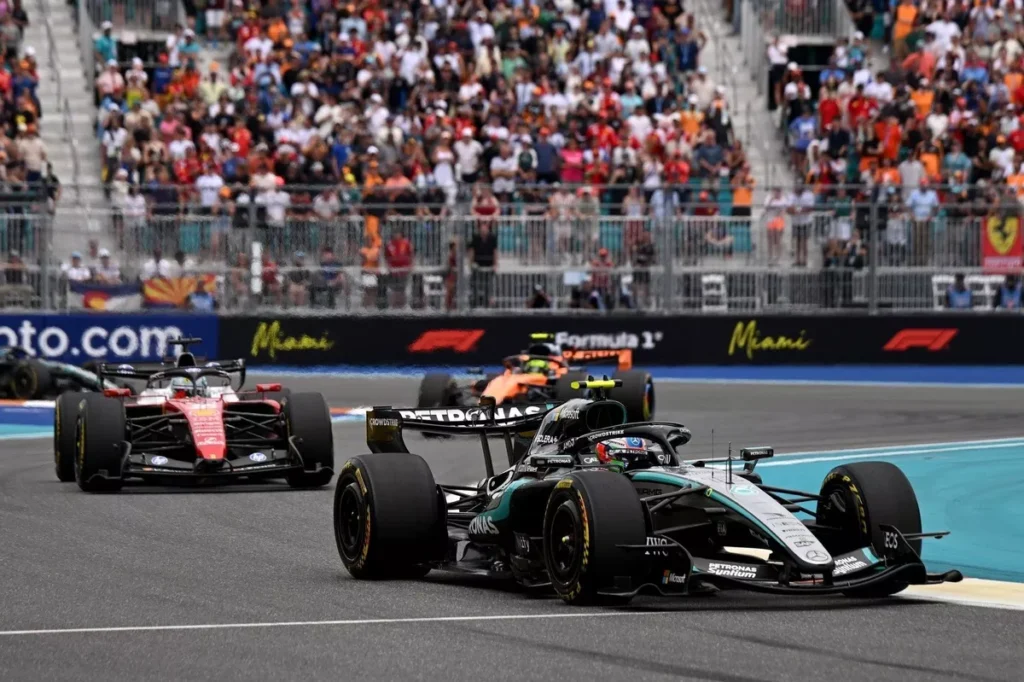
The results in Miami were encouraging but incomplete. The changes made qualifying more on the limit, as intended, with cars slightly slower but more committed through the lap. In the race, there were genuine wheel-to-wheel battles, with Verstappen and Hamilton exchanging positions on multiple occasions. The Sprint offered clean, direct racing from pole to flag for Norris.
But the ghost of 2026’s core problem hadn’t fully vanished. During the Grand Prix, a battle between Leclerc and eventual race winner Kimi Antonelli was described by Lando Norris’s race engineer Will Joseph as “yo-yo racing” — the two cars repeatedly swapping positions as their energy deployment profiles clashed. The symptom has eased; the underlying condition remains.
“It’s a small step in the right direction, but it’s not to the level that Formula 1 should still be at yet.”
— Lando Norris, after finishing second in Miami
The Paddock Speaks: Driver Verdicts
Thursday’s media day in Miami was dominated by drivers giving their assessments of the regulation package. The tone was broadly cautious optimism — appreciation that the FIA had listened, tempered by scepticism about whether the changes go far enough.
What Comes Next: 2027 in the Crosshairs
The Miami changes are now a permanent part of the 2026 regulations — they apply for the remainder of the season. But several drivers and team representatives made clear that attention is already shifting to 2027, where more fundamental modifications to the power unit framework could address the issues that a software patch cannot.
The FIA is reportedly working to finalise 2027 engine regulations within a matter of weeks, with a reduction in the reliance on electrical power under serious consideration. That would represent a more structural response to the complaints that have defined the 2026 season’s opening chapter.
“I think it improves some aspects. But there are still a few more steps to go. We need to see how these changes play out first of all — and then decide if further action is needed.”
— Alex Albon, Williams
For now, Miami has served as the first concrete test of the FIA’s willingness to listen and act in-season. The verdict from the drivers is clear: the direction is right, the magnitude is not yet enough. Whether that patience holds over the coming months — and whether the 2027 rules can deliver the reset the grid is quietly hoping for — will define how this chapter of Formula 1’s history is ultimately remembered.
The next round is the Canadian Grand Prix in Montreal, another Sprint weekend, scheduled for May 22–24. With McLaren’s upgrade package continuing to evolve and Mercedes under renewed pressure, the regulation changes will face another, more demanding examination under the lights of Circuit Gilles Villeneuve.
Sources
- Autosport — How F1’s rule changes went down in Miami
- Motorsport.com — FIA confirms 2026 rule changes ahead of Miami GP
- Motorsport.com — How drivers reacted to rule changes
- PlanetF1 — Verstappen calls changes “a tickle” as drivers react
- PlanetF1 — F1 2026 rules reaction: are the changes enough?
- Pit Debrief — Drivers react to revised 2026 F1 regulations
- Yahoo Sports — The 2026 F1 rule changes hit Miami first
Discover more from f1liveupdates.com
Subscribe to get the latest posts sent to your email.