A Blind Spot, a Broken System and a Burning Grudge: Piastri vs Sainz
One lap 38 collision, one malfunctioning blue-flag system, and two entirely incompatible versions of the truth. Oscar Piastri calls it “one of the dumbest things I’ve seen on a race track”; Carlos Sainz insists he has “a pretty good excuse.” As Formula 1 heads into the summer break, the row over what happened at Turn 3 in Budapest is only just getting started.
Formula 1’s new era has created a problem the sport thought it had engineered away: lapped traffic that matters. With the 2026 field spread over seconds rather than tenths, blue flags are back at the centre of racecraft — and on Sunday at the Hungaroring, the system designed to manage them chose the worst possible moment to break down. When Oscar Piastri, fighting his own team-mate for the lead of the Hungarian Grand Prix, met Carlos Sainz, fighting Fernando Alonso for 14th, the collision that followed cost one man a shot at victory, earned the other a penalty — and opened an argument about blame, mirrors and manners that will simmer all the way to Zandvoort.
The 38th lap, reconstructed
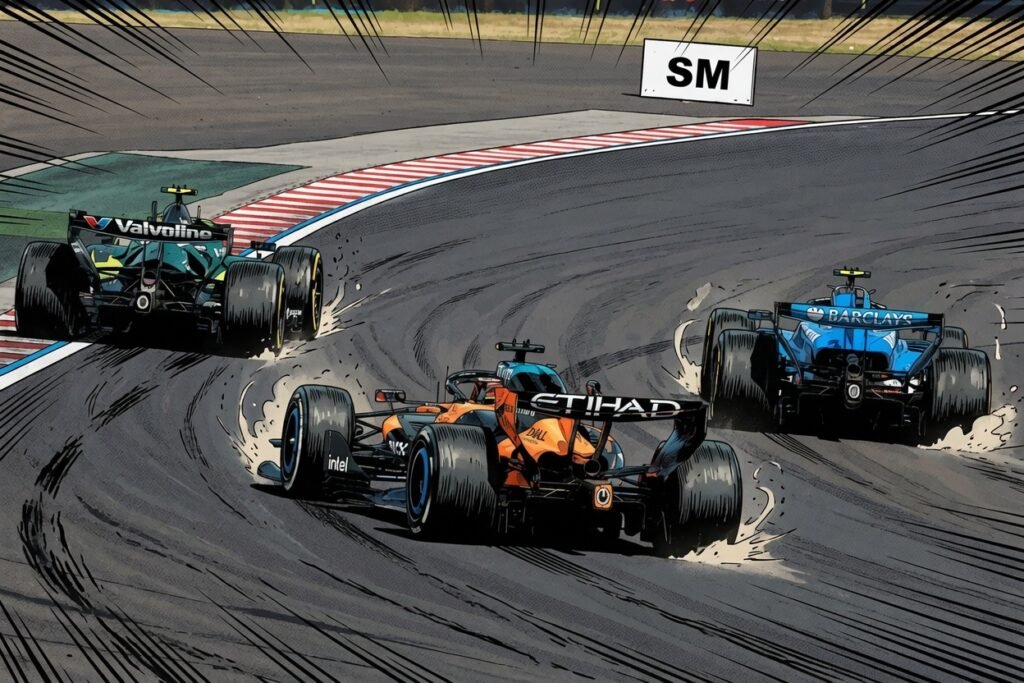
The anatomy is no longer in dispute. Piastri had led the race from the first corner, been undercut by events and pit strategy, and rejoined in traffic on lap 33 — a McLaren with the pace to win, suddenly swimming in the midfield. Five laps later he arrived at the battle between Sainz and Alonso. The Williams ran wide exiting Turn 2 attempting to undercut the Aston Martin; Piastri committed to the racing line around the outside; and Sainz, cutting back across the track to resume his own line, clipped the McLaren’s front end and shoved it off the circuit.
The stewards’ verdict was unambiguous on responsibility — and instructive on punishment. Sainz was found “wholly responsible for the collision,” yet the standard ten-second penalty was halved to five, the panel accepting that “Car 81 was not visible to the driver of Car 55 prior to the attempted overtake” and that “limited visibility reduced the degree of culpability.” A blind spot, in other words, bought him five seconds of mercy. Two details from the same document cut the other way: the Williams pit wall had warned Sainz that Piastri was coming, and physical blue flags were being shown at the marshal posts he passed.
Piastri’s rage
The cockpit fury was instantaneous and, by Piastri’s glacial standards, volcanic.
“Get out of the f***ing way you idiot! Oh my god.” Oscar Piastri · McLaren team radio
When his engineer Tom Stallard attempted to redirect his attention — “Oscar, that’s Sainz that cost us that. Target is to get to the end on this tyre” — the response stripped away whatever remained of the afternoon’s diplomacy: “Oh mate, it’s better you don’t f***ing talk to me right now. Nice of you guys to factor that one in, by the way. Thanks.” The sarcasm had a target beyond Sainz: Piastri had been pitted first, into the traffic, while Lando Norris — who had spent the stint pleading “I’m miles faster! I’ll put a 10-second gap with no tyres” — stayed out and emerged ahead after his own stop. Piastri, it should be noted, was racing without the upgrade package fitted to his team-mate’s car.
By the time he faced the media — his race already over, the gearbox gone 20 laps later — the Australian had cooled from incandescent to merely glacial, which for Piastri still reads as a declaration of war. “That’s got to be one of the dumbest things I’ve seen on a race track. I don’t really care what excuse he gave,” he said. “There were blue flags on all the marshal signals. I was right behind him for a sector. Getting crashed into by a lapped car is never one of the things you expect can go wrong in your race. The fact that he didn’t see me, and no one told him — or there was a lack of complete awareness — is unacceptable.”
And then the accusation that will outlive the incident: “He was fighting Fernando for last place like it was the world championship. It cost me the lead of the race. He’s quite critical of others, and others have given him some stick before for being frustrating on track. When you go and do something like that, maybe you should look in the mirror a bit.”
Sainz’s ‘good excuse’
Sainz’s defence rests on a genuine, documented failure. Around nine laps into the race, the FIA’s automatic blue-flag system began sending rogue warnings — some drivers were being told they were about to be lapped when nothing of the sort was happening. Once the malfunction was spotted, the automatic system was paused: steering-wheel blue lights were disabled, trackside panels stopped displaying car numbers, and marshalling reverted to physical flags and manual judgement. In that chaos, Sainz argues, he was driving blind in every sense.
“We didn’t have blue lights on the steering, which normally, when we are in fights like that one, helps us to understand whether we’re getting lapped or not,” he explained. “I had no idea I was about to get lapped. On top of that, I was in a big fight with Fernando, trying to undercut him into the corner, and I wouldn’t have expected Oscar to be there. And even if he was there, he was in my dead spot on the angle. It was impossible, honestly, from my side to avoid it.”
The contrition was real but carefully bounded: “I’m really sorry for Oscar. But I think I have a pretty good excuse for what happened. I don’t know if he could also have been a bit more careful, given that he’s the one fighting for podiums, and positioned himself a bit more cautiously, with all the issues we were all having with the blue flags. I took the five seconds. I’m OK with it. I don’t care when I’m fighting for P18.” He also pointed out — correctly — that Piastri’s retirement had nothing to do with the contact: “He didn’t retire due to me or my fault.” Asked whether the two had spoken, the answer was brisk: “No, no, I don’t need this. It’s a racing incident.”
And there was a final, self-aware twist of the knife, aimed at his own machinery: “There are very clear rules. If we were not so slow, there wouldn’t be so many blue flags. We know what the solution is. Last year there were almost no blue flags because the whole field was within half a second — and this year we were getting lapped twice. I never got lapped twice in my life.”
‘Teletubbies on the pit wall’
Piastri, it turns out, was not the only title contender inconvenienced by the new lapping reality. Late in the race, as Kimi Antonelli and Lewis Hamilton fought over the final podium place, they too found backmarkers reluctant to disappear — and Toto Wolff reached for the phrase that will define the weekend’s discourse.
“The marshalling system not functioning, and cars in the back defending on Lewis and Kimi’s fight, is just disgraceful from some of the Teletubbies engineers that sit on the pit walls of these teams, not telling the drivers what’s happening behind.” Toto Wolff · Mercedes Team Principal
Ollie Bearman, penalised five seconds for ignoring blue flags while being lapped by Isack Hadjar, offered the backmarker’s perspective: “At the start of the race I was getting blue flags after six laps, and I thought, wow, that’s strange — we’re not that slow. From lap six until lap 70 there were some blue flags every single lap. It was really tough to know what was real, what was fake, what was for me. Normally you have your number — this time it was just a blue.” Fans, watching a championship contender’s race decided by a lapped car, spent the evening demanding the rule itself be rewritten.
The verdict
So: dumb driving, or good excuse? The evidence points, unsatisfyingly, in both directions at once. Sainz was warned by his pit wall and passed flagged marshal posts; a driver of his intelligence should have known a lapping car was imminent, and “fighting Alonso” is a reason, not a defence — the rules require him to suspend that fight, not finish it. On that reading, Piastri’s fury is justified, and the five-second penalty lenient.
And yet the mitigations are not nothing. The safety net every driver relies on — the in-car blue lights — had been switched off precisely because it couldn’t be trusted. The stewards themselves accepted he couldn’t see the McLaren. His team had done its part. And the uncomfortable truth underneath it all is that the 2026 cars have recreated a problem the sport had outgrown: when some cars are lapped twice and others fight for titles, every malfunction becomes a championship incident. The system failed first; the humans merely inherited the failure.
What is certain is the cost. Piastri leaves Budapest seventh in the standings, 36 points behind the team-mate who won the race he briefly led, with a month of summer break to replay the moment. Sainz leaves it 18th, with a penalty he disputes and a rival advising him on mirror usage. Zandvoort, on August 23, will offer the first chance for a handshake — or for round two.
The incident, at a glance
- Lap 38, Turn 3 — Sainz cuts back across after running wide battling Alonso; contact shoves Piastri off track
- 10s → 5s — “wholly responsible,” but Piastri was in his blind spot: culpability reduced
- Lap ~9 — the automatic blue-flag system fails, sending rogue warnings; in-car blue lights disabled race-wide
- The catch — Williams’ pit wall had warned Sainz; physical flags were being shown at the posts
- The cost — Piastri loses the lead to Norris in the stops; retires lap 56 with a gearbox failure
- The quote — “one of the dumbest things I’ve seen on a race track” vs “a pretty good excuse”
- The chorus — Wolff’s “Teletubbies engineers”; Bearman also penalised; fans demand a rule change
Sources
- The Race — ‘Dumb’ driving or a ‘good excuse’? Piastri’s rage at Sainz
- Formula1.com — Sainz explains how blue light issue caught him out in Piastri collision
- Motorsport.com — Why Sainz only got a five-second penalty (stewards’ decision)
- Fox Sports — ‘Disgraceful’: why there’s no excuse for shocker on Piastri
- Nine — ‘Idiot’ rival costs ‘disappointed’ Piastri vital victory (full team radio)
- Yahoo News — Piastri lets rip after ‘dumb’ move as fans demand rule change
Discover more from f1liveupdates.com
Subscribe to get the latest posts sent to your email.