
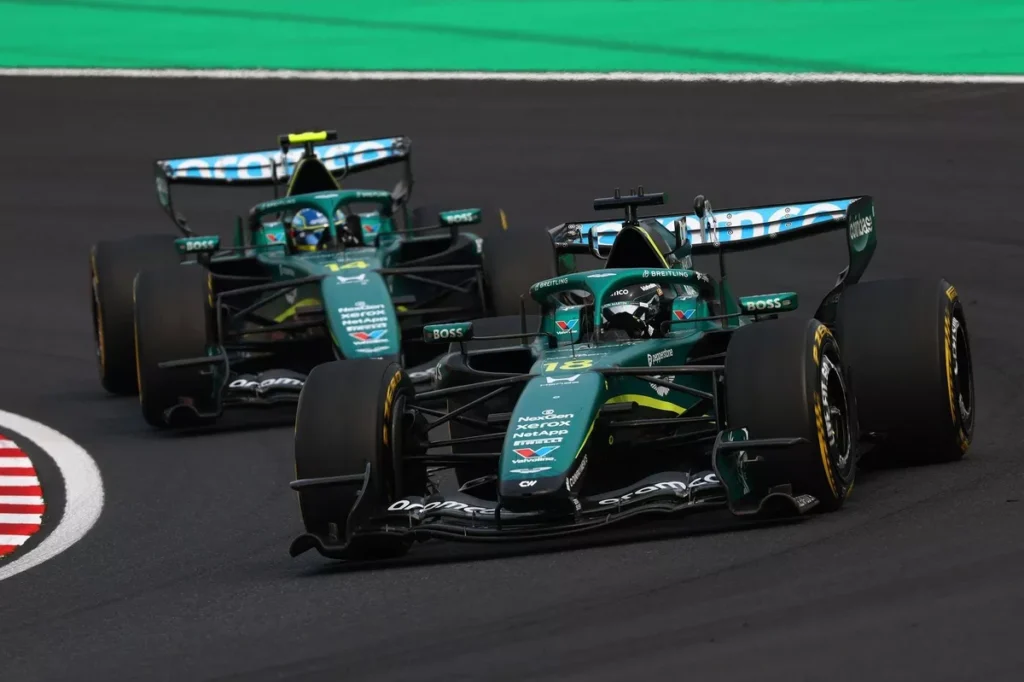
Steiner: Aston Martin Has “No Excuse” for Its Poor 2026 F1 Season Start
The former Haas team principal has been characteristically direct: a new headquarters, a new wind tunnel, Adrian Newey, and Lawrence Stroll’s billions add up to a situation where poor results cannot be explained away.
Guenther Steiner has never been known for diplomatic restraint, and his assessment of Aston Martin’s 2026 season made that clear once again. Speaking on The Red Flags Podcast, the former Haas team principal surveyed the wreckage of the Silverstone squad’s opening four races — zero points, last in the constructors’ standings, two cars that couldn’t complete race distance for the first three rounds — and delivered a verdict that was blunt, considered, and almost impossible to argue with. “There is no excuse for them to be in this position,” he said. “They’ve got the people, they’ve got the facility, they’ve got the money.”
The Case Against Aston Martin
Steiner’s argument rests on a straightforward premise: excuses are for teams that lack resources. Aston Martin lacks nothing except results. Since Lawrence Stroll acquired the team in 2018 and began his transformation project, the investment has been relentless and visible. The new campus at Silverstone, completed in stages since 2023, is one of the most modern Formula 1 facilities in the world. The wind tunnel that came online ahead of 2026 represents a significant capability upgrade. Adrian Newey’s arrival in 2025 as managing technical partner cost — by widespread industry estimates — somewhere in the region of £30 million per year. And all of it has produced, after four rounds, precisely zero championship points.
“Nobody expected them to come to this season as ill-prepared as they came. Because they’ve got everything in place. They’ve got the people, they’ve got the facility, they’ve got the money. So, there is no excuse for them to be in this position.”
— Guenther Steiner, The Red Flags Podcast
The April Break: An Opportunity — But How Big?
Steiner acknowledged the five-week break created by the cancellation of the Bahrain and Saudi Arabian Grands Prix as an unusually valuable opportunity for teams in difficulty — Aston Martin above all. But he was careful not to overstate what factory time alone can achieve. The Honda vibration problem that has plagued the team since pre-season testing is not the kind of issue that can be resolved by a few weeks of extra dyno work. It requires a fundamental understanding of the interaction between power unit and chassis that has so far eluded both parties.
“For sure, an opportunity. How big? We need to find out.”
— Guenther Steiner, on the April break’s value for Aston Martin
Miami ultimately bore out that caution. Aston Martin chose not to bring any performance upgrades to Florida — the only team on the grid to do so — and instead focused entirely on reliability. The result: a first double finish of the season, with Alonso 15th and Stroll 17th, both a lap or more down on the winner. Progress of a kind, but not the kind that generates points.
The Newey Question
Steiner also addressed a more pointed topic: whether Adrian Newey was right to take on such a broad role at Aston Martin. In a separate comment that has circulated widely, Steiner suggested Newey “should have never taken the role of Aston Martin team principal” — though Newey’s official title is Managing Technical Partner rather than team principal. The distinction matters: Newey was hired as a design genius, not an operational manager. But in a team where the AMR26 is fundamentally underperforming, the question of how much the car’s conception versus its execution is responsible becomes increasingly relevant.
- Execution failure: The Honda-chassis vibration issue is partly an integration problem — the car was packaged so tightly that the power unit cannot operate safely across its full performance range. This is a joint engineering failure, not purely Honda’s or Newey’s alone.
- Institutional failure: Despite world-class infrastructure and the most expensive technical hire in F1 history, Aston Martin arrived at the first race of 2026 unable to run at race pace without risking damage to batteries and driver safety. That speaks to a development process that did not catch problems early enough.
Verstappen — and a Warning
Steiner’s Red Flags appearance also produced a striking secondary verdict: a driver assessment that name-checked Aston Martin in an uncomfortable context. When ranking Max Verstappen in his personal tier list, Steiner dropped the four-time champion from his customary A-grade status — pointing to his qualifying performances in 2026 as evidence of a decline in output. His justification landed directly on Aston Martin.
“I think he falls out of A. I think we go to a solid B. Out in Q1 all the time. If Fernando Alonso and an Aston Martin can do it, there’s no excuse for it.”
— Guenther Steiner, on Max Verstappen’s 2026 qualifying performances
The logic is double-edged: it is simultaneously a criticism of Verstappen for being beaten in qualifying by a car as slow as the AMR26, and an inadvertent compliment to Alonso for extracting what he does from it. It also neatly captures why Steiner’s “no excuse” verdict lands so hard. If a car at the back of the grid can outqualify a four-time champion, something has gone wrong in Milton Keynes. But if zero points after four races is the return on the most lavish investment programme in the paddock, something has gone even more wrong in Silverstone.
Aston Martin has acknowledged as much, quietly. The post-summer upgrade package being developed by Newey is the team’s stated path back. Whether it arrives in time to salvage anything from 2026 — and whether it is large enough to actually matter — remains the defining question of their season.
Discover more from f1liveupdates.com
Subscribe to get the latest posts sent to your email.