
Toto Wolff: Mercedes Poor Starts “Not Acceptable” If We Want to Win F1 World Titles
The Mercedes boss absolved Kimi Antonelli of all blame after another difficult launch in Miami — but admitted the team is falling short in a critical area, with rivals closing in fast.
Formula 1 championships are rarely lost in a single moment. More often they are decided by a slow accumulation of small failures — the kind that stay invisible as long as the car is fast enough to compensate, and become critically visible the moment it is not. For Mercedes in 2026, that accumulation has a name: race starts. And in Miami, Toto Wolff finally said out loud what the data had been saying for four race weekends.
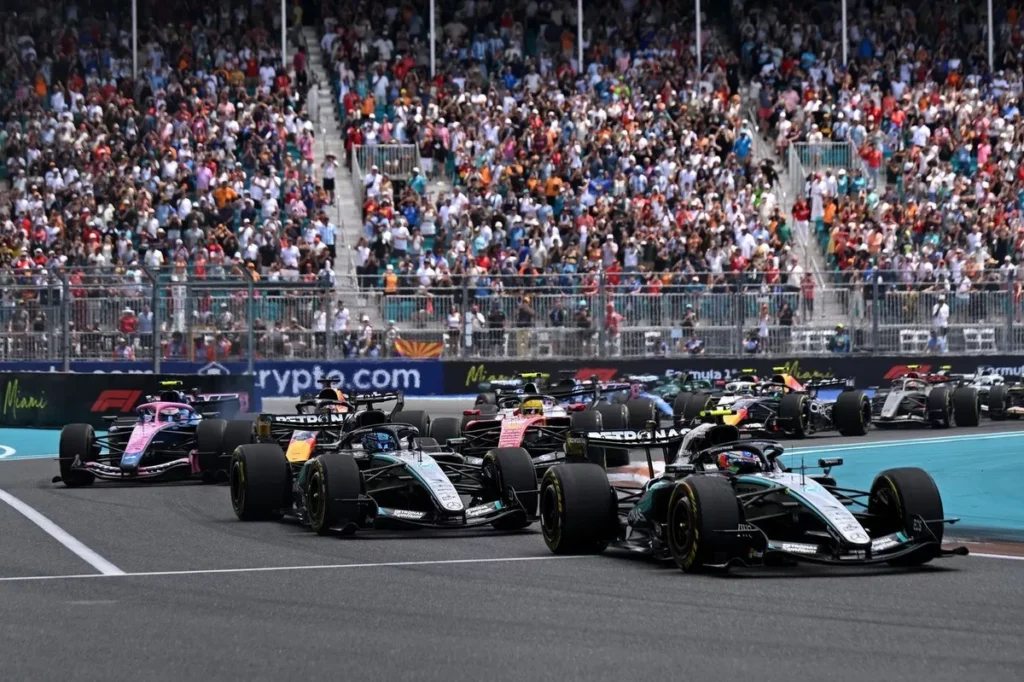
Despite winning three consecutive Grands Prix and leading both championship standings heading into Florida, Mercedes carries an Achilles’ heel that grows more dangerous as the competition closes in. By the time lights went out in Miami, championship leader Kimi Antonelli had already lost a total of 26 places across five standing starts in 2026 — 18 across the first three race weekends, six more in the Sprint, and two in the Grand Prix itself. He has started from pole position three times in a row and has not once led into Turn 1.
“It’s not at all on him. I think today and yesterday were team mistakes. We just know it’s not good enough. We’re not doing a good enough job in giving them a tool in their hands, whether it’s clutch or grip estimates. We are the only ones who, let’s say, don’t get that right now for a few races.”
— Toto Wolff, post-race Miami
The Numbers Tell the Story
The scale of the problem becomes stark when laid out in cold figures.
The paradox of Mercedes’ 2026 season in miniature: the fastest car in qualifying, the slowest off the line in the race. Despite a significant amount of homework done at Mercedes’ Brackley base during the five-week April break, there was no noticeable step forward in Miami. The Sprint saw Antonelli drop from the front row to fourth before the first corner. Twenty-four hours later, starting from pole for the Grand Prix, he lost two more places at the start before his recovery drive to victory.
A Team Mistake, Not a Driver Problem
Wolff was categorical on the question of responsibility. The issue does not lie with Antonelli’s execution — it lies with the information and tools the team provides him before the lights go out.
As part of normal F1 procedure, every driver is given a clutch release target based on the team’s best prediction of grip levels. Mercedes gave Antonelli a target, which he hit — but the actual grip on track was out of kilter with what the team had predicted. In other words, Antonelli did exactly what he was asked to do. The problem was that what he was asked to do was wrong.
“Kimi hit the targets we set — but those targets weren’t right.”
— Toto Wolff
Ahead of the weekend, Antonelli himself had described the issue as “fundamental” — something that required hardware changes and redesign on the W17, not a simple software tweak. The 2026 regulations removed the MGU-H from the new hybrid power units, making it significantly harder for drivers to spool up the turbo correctly at the start. Ferrari, widely understood to have benefited from a smaller turbo configuration that achieves optimal launch more easily, has dominated race starts all season. The extended break allowed McLaren and others to reach a similar launch level to Ferrari — while Mercedes found itself falling further behind.
Antonelli: “It’s Not Acceptable Either”
Crucially, it is not only Wolff who has acknowledged the problem. Antonelli himself, after his third consecutive Grand Prix victory, used the same language as his team principal — describing the start situation as “not acceptable.”
“Today, to be fair, was not as bad as the Sprint. I think I lost two places — Sprint I lost six, so a little bit better. But still, no, it’s not acceptable. Especially in a weekend like this, where the gaps are a lot closer, it can really change the race.”
— Kimi Antonelli, post-race Miami
The 19-year-old was also candid about his own contribution to the problem. Beyond the clutch grip estimates provided by the team, Antonelli acknowledged that he remains personally inconsistent with his clutch drop technique and does not yet have full confidence in the procedure. “I’m still a little bit inconsistent, especially on clutch drop,” he said. “I still don’t have that confidence. I still have a bit of uncertainty — it’s a big point that needs to be improved.”
Why This Matters More Than Ever
In the first three rounds, Mercedes could absorb the start losses because the W17’s pace advantage was simply too large. A botched launch was a nuisance; the car was quick enough to recover. Miami showed, for the first time, that this safety net is beginning to fray.
Wolff was direct: Mercedes cannot rely on its pace margin to overcome poor starts indefinitely, and the gaps between the top teams are no longer large enough to cruise to victory from the back of the top group. “The gaps are not big enough to cruise into the sunset,” he said. “And therefore you can’t be missing starts.”
- Improve grip level predictions for clutch release targets — the team’s estimate was wrong in both Miami sessions
- Address the underlying hardware limitation with the W17’s turbo spooling at standing starts
- Bring the planned major upgrade package to Montreal — the first significant aero development of the season
- Build Antonelli’s personal confidence and consistency in the clutch drop procedure
Mercedes’ first major upgrade package of the 2026 season is expected to arrive at the Canadian Grand Prix in Montreal, where it should bring additional performance for both Antonelli and George Russell. But upgrades address lap time, not launch procedure. The start problem demands a separate and more urgent fix.
“We just have to dig even deeper and try to understand how we can fix that. Because the gaps are not big enough to cruise into the sunset — and you can’t be missing starts.”
— Toto Wolff
Mercedes remains unbeaten in Grands Prix in 2026 and Antonelli leads the championship by 20 points. Those facts are important. But they have been earned in spite of a recurring, systematic problem that Toto Wolff himself now describes as “not acceptable” — and that the competition is learning to exploit. Montreal, in three weeks’ time, will be the first real test of whether the team’s self-diagnosis has translated into a cure.
Sources
- Motorsport.com — Toto Wolff: poor starts “not acceptable” if we want to win titles
- The Race — Why Mercedes keeps making “unacceptable” poor starts
- Formula1.com — Antonelli left to rue another slow start in Miami Sprint
- PlanetF1 — Toto Wolff says Mercedes “just not good enough” in key area
- RacingNews365 — Mercedes take blame for significant Antonelli blunder
- Crash.net — Mercedes reveal cause of dreadful Antonelli sprint start
- GrandPrix247 — Wolff says Mercedes have to dig deep to fix race starts
- Motorsport.com — Antonelli not at fault for poor Miami Sprint start
Discover more from f1liveupdates.com
Subscribe to get the latest posts sent to your email.