McLaren “Cost Themselves” the Miami Win with “Hesitant” Strategy, Says Palmer
Lando Norris led the Miami Grand Prix and had Antonelli well covered. One lap of hesitation over the threat of rain handed Mercedes the undercut — and the race.
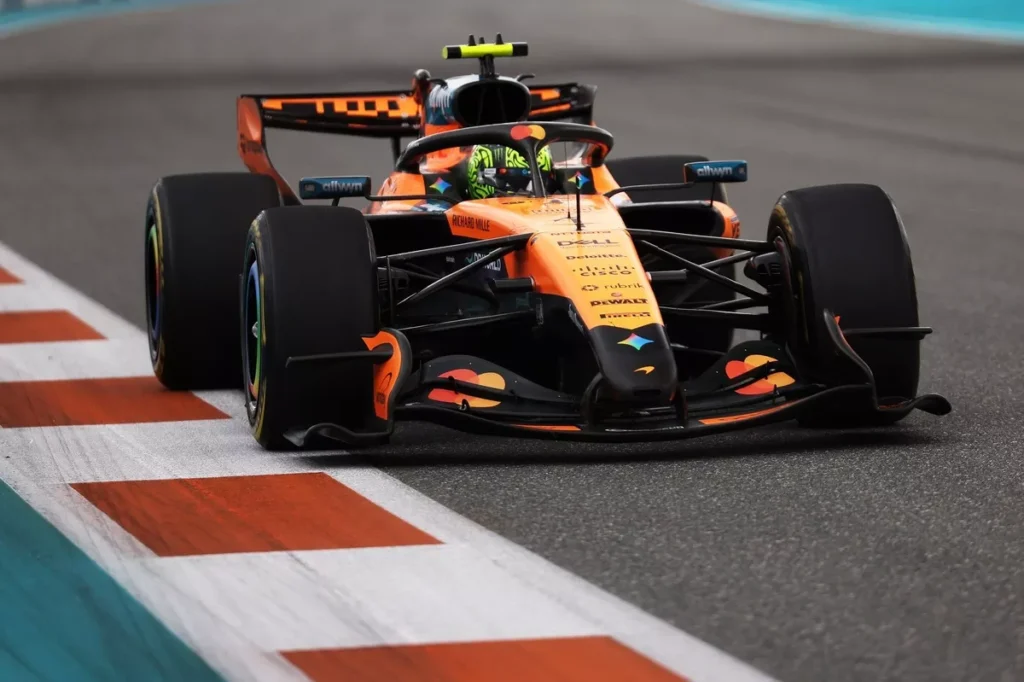
Lando Norris led the Miami Grand Prix. He had Antonelli boxed in behind him, managing a gap of one and a half to two seconds — comfortable, consistent, controlled. And then he didn’t pit. Mercedes did. One lap later, McLaren followed — and the race was gone. Kimi Antonelli won his third consecutive grand prix. Norris finished second. And former Formula 1 driver Jolyon Palmer had a clear explanation for why: McLaren hesitated when they should have acted, and Mercedes acted when McLaren hesitated.
The Undercut: Simple in Concept, Decisive in Execution
“Antonelli had the winning strategy and it was simple,” Palmer told F1 TV in the post-race show. “It was just an undercut. It was one lap, pitting earlier than the McLaren.” The mechanics of what happened are straightforward. Norris was leading, maintaining a margin of 1.5 to 2 seconds over Antonelli. In normal circumstances, that gap is sufficient protection against an undercut — you need more than a lap’s worth of time advantage to cover a rival pitting a lap earlier and then emerging ahead on fresh tyres. But the Miami circuit offered unusually strong tyre performance on the out-lap, and Antonelli converted the opportunity with a blistering exit from the pit lane. By the time McLaren reacted and pitted Norris on the very next lap, the gap had evaporated.
“Lando would be fuming because you’re out there, you’re just driving. You’re monotonously ticking through the laps, being consistent, being quick, making sure the guy behind is one-and-a-half, two seconds back out of range. They weren’t proactive and they cost themselves the race win. But on the flip side, Mercedes were proactive and they won the race because it wasn’t straightforward because of the rain.”
— Jolyon Palmer, F1 TV post-race show
The Rain That Never Came
The complicating factor in McLaren’s strategic calculation was the weather. Throughout the race, rain threatened. Team radio was alive with weather chatter as both engineers and drivers tried to read conditions that kept shifting without ever materialising into a genuine downpour. Palmer was pointed about how this uncertainty played out differently across the pit walls.
“The weather chatter was kind of laughable at times. But if you take the average of the communication, I think McLaren were more convinced that the rain was going to be a factor than other teams. And that’s why when Mercedes pitted George Russell, it was very early. And I think McLaren stayed out with Lando — they were thinking, ‘Hang on, you guys are really setting yourself up for it not to rain. It might still rain.’ And that would have really scuppered anyone that pitted early. Basically the weather forecast didn’t help McLaren. They sort of dithered. They weren’t sure. They were hesitant to pit early. But by the time Kimi pitted, it seemed more clear that the weather was just passing.”
— Jolyon Palmer, F1 TV post-race show
The logic is understandable. If rain had arrived, the team that stayed out longest on dry tyres and then switched to intermediates at the optimal moment would have benefited. McLaren’s hesitation was not random — it was a calculated bet that rain would come and justify the wait. It didn’t. And the window in which they could have covered Antonelli’s undercut closed before they were ready to act.
Norris’s Own View — and McLaren’s Counterpoint
Norris was measured in his post-race assessment. He acknowledged that McLaren had been weighing rain as a factor, and that the uncertainty made the call genuinely difficult in real time. He did not blame the pit wall publicly, though the frustration of leading a race and finishing second to a one-lap undercut is self-evident. For their part, McLaren could argue that the weather uncertainty was real, the downside risk of being caught on dry tyres in heavy rain was severe, and that the same logic that cost them the win would have won them a rain-affected race if conditions had broken differently.
- P1 Kimi Antonelli (Mercedes) — third consecutive win; championship lead extended
- P2 Lando Norris (McLaren) — led the race; lost position to undercut
- P3 Oscar Piastri (McLaren) — reclassified after Leclerc 20-second post-race penalty
Palmer’s critique lands because the outcome is clear in retrospect — but the decision was made under genuine uncertainty, in real time, with competing information. That is the nature of Formula 1 strategy. What he identifies correctly is a difference in character between the two pit walls: Mercedes, whose car was not the fastest on pure pace, chose to take the risk and force the issue. McLaren, whose car was faster, chose to wait for conditions that never arrived. One lap of hesitation was the difference between Antonelli’s third win and what would have been Norris’s first victory of 2026.
Discover more from f1liveupdates.com
Subscribe to get the latest posts sent to your email.