The Grim Start Warning Formula 1 Seems to Have Missed
Debate about the quality of F1’s 2026 racing has consumed the paddock. But a more urgent question is being drowned out — the new start procedure is generating genuinely dangerous near-misses, and nobody seems to be treating it as the emergency it could become.
The debate is about racing quality. The real issue is driver safety.
Formula 1 in 2026 has a debate it cannot stop having. Is the racing real? Is the overtaking artificial? Does the “yo-yo” style undermine the DNA of the sport? These are legitimate questions, and they have consumed an enormous amount of oxygen in the paddock, the press room and across social media since lights went out in Melbourne.
But underneath that noise, a different and arguably more pressing concern has been steadily accumulating evidence — and barely receiving the attention it warrants. The new 2026 start procedure, a direct consequence of the removal of the MGU-H from the power unit architecture, is generating dangerous situations at the moment cars leave the grid. Two race weekends in, the sport has been fortunate. That may not last.
The Near-Misses: A Running Log
⚠️ F1 2026 Start-Related Near-Misses — Rounds 1 & 2
Race Start
Race Start
Lap 1 — Race
Why the Start Procedure Has Become Dangerous
The root cause is technical and well understood — if not yet resolved. The removal of the MGU-H from the 2026 power unit package eliminated a device that had previously been used to pre-spool the turbocharger ahead of the launch, delivering near-instant peak power as drivers released the clutch. Without it, teams must rely on high engine revs to prime the turbo manually — a process that is both more complex and less consistent.
Why Starts Are More Dangerous in 2026
- MGU-H removed: The device that guaranteed consistent turbo spin-up at launch is gone. Teams now depend on manual rev-matching — a procedure that varies significantly between cars and drivers.
- Formation lap energy cap: Cars are limited to 8MJ of energy harvesting per lap, including the formation lap. Drivers who warm tyres aggressively or burn-out heavily can arrive at the grid with a depleted battery — producing a dramatically slower launch.
- MGU-K restriction at launch: The MGU-K (main electric motor) cannot be used until the car exceeds 50km/h. Any turbo lag that exists at the moment of clutch release cannot be corrected by electrical assistance until that speed threshold is reached.
- Closing speed differentials: A car that launches cleanly can be travelling at 80–100km/h or more by the time a stationary or slow-starting car still sits on the grid line. Lando Norris warned before Melbourne that closing speed differences of 30–50km/h are possible — enough to send a car airborne in a collision.
- Visibility: Cars in the middle of the pack have no direct sightline to a stricken car at the front once the field is in motion. The first warning is impact — or the fraction of a second before it.
The Warnings Were There Before Round One
This is not a problem that emerged from nowhere. The FIA identified concerns about the new start procedure during pre-season testing in Bahrain and implemented an extra five-second warning phase — signalled by blue flashing panels — to give drivers more time to prime their turbos. The measure helped, but did not eliminate the issue. Several teams, including McLaren, were warning about start safety before a single competitive lap had been completed.
“It’s just a matter of time before a massive shunt happens. These power units are very difficult to start. You can get anti-stalled, like what happened to Lawson, and then that can be very, very dangerous.”
— Sergio Perez, ahead of the Chinese Grand Prix
McLaren team principal Andrea Stella was equally blunt after Melbourne, where Colapinto’s reflexes alone prevented the season from beginning with a major accident. “We should not be happy because nothing happened,” Stella said. “We should always be on the forefoot when it has to do with safety.” His words did not generate the response they perhaps deserved.
“You can have a 30, 40, 50km/h speed difference. When someone hits someone at that speed, you’re going to fly, you’re going to go over the fence and you’re going to do a lot of damage to yourself and maybe others. That’s a pretty horrible thing to think about.”
— Lando Norris, on start closing speeds, Australian GP weekend
The Wider Warning China Delivered
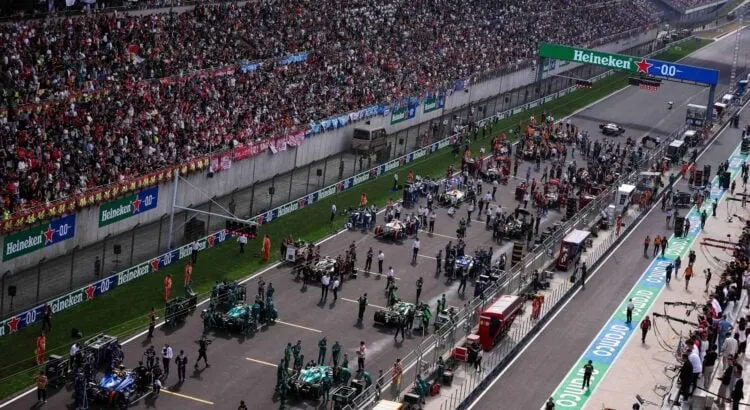
On Saturday in Shanghai — during qualifying weekend, largely after the media and broadcast coverage had moved on — the Porsche Carrera Cup Asia race at the circuit provided a chilling parallel. The pole-sitter’s car failed to launch cleanly, and the entire field was forced to take evasive action. As the article in Autosport noted, what saved the situation was that the drivers behind reacted in time — but the margin for error narrows dramatically as closing speeds increase.
Formula 1 cars are faster, the drivers are more skilled, and the circuits are prepared for these eventualities. But the physics are identical. Energy released by a car travelling at high speed into a stationary object does not simply disappear. It changes form. And the 2026 regulations have created a scenario where that energy differential at race starts is larger and less predictable than at any point in the sport’s recent history.
What Has Been Done — and What Has Not
The FIA’s post-season review process is focusing heavily on the deployment and harvesting balance — the “yo-yo” racing debate. The question of start safety has been acknowledged in general terms but has not emerged as a priority item for the rule modification discussions being scheduled for the window between Japan and Miami. That is a concern.
“The danger is that the risks associated with the start are being overlooked because of another attention-grabbing existential issue — the quality of the racing in F1’s new Mario Kart era.”
— Autosport analysis, March 2026
Racing is inherently dangerous. That is understood by everyone who participates in it. But F1’s safety record in the modern era has been built on a relentless commitment to identifying and eliminating avoidable risks — not waiting until an accident happens to prove the risk was real. Halo, SAFER barriers, helmet standards, pit lane speed limits: the precedents are a catalogue of pre-emptive action rather than reaction.
The 2026 start procedure may yet resolve itself as teams learn to manage the new power units more consistently. But two rounds in, three documented near-misses, and several drivers who have publicly stated they believe a major accident is coming, the sport would be unwise to treat the silence that followed the Chinese GP as evidence that the problem has passed.
It has not. It has just not yet arrived at its worst possible outcome.
Sources
- Autosport — The grim start warning Formula 1 seems to have missed
- The Race — Near-misses expose big safety concerns with F1 2026
- Motorsport.com — Start issues will soon cause “massive shunt” in F1 2026, warns Perez
- PlanetF1 — Bearman ‘almost killed’ in Chinese GP near-miss with Hadjar
- The Race — Why F1 race starts are so much more difficult in 2026
Discover more from f1liveupdates.com
Subscribe to get the latest posts sent to your email.