Ferrari’s Rotating Rear Wing: One Session, Then Gone
The Scuderia brought its groundbreaking ‘rotisserie’ rear wing to Shanghai — only to shelve it after a single practice session. A rushed timeline, limited units, and Hamilton’s dramatic spin explain the retreat.
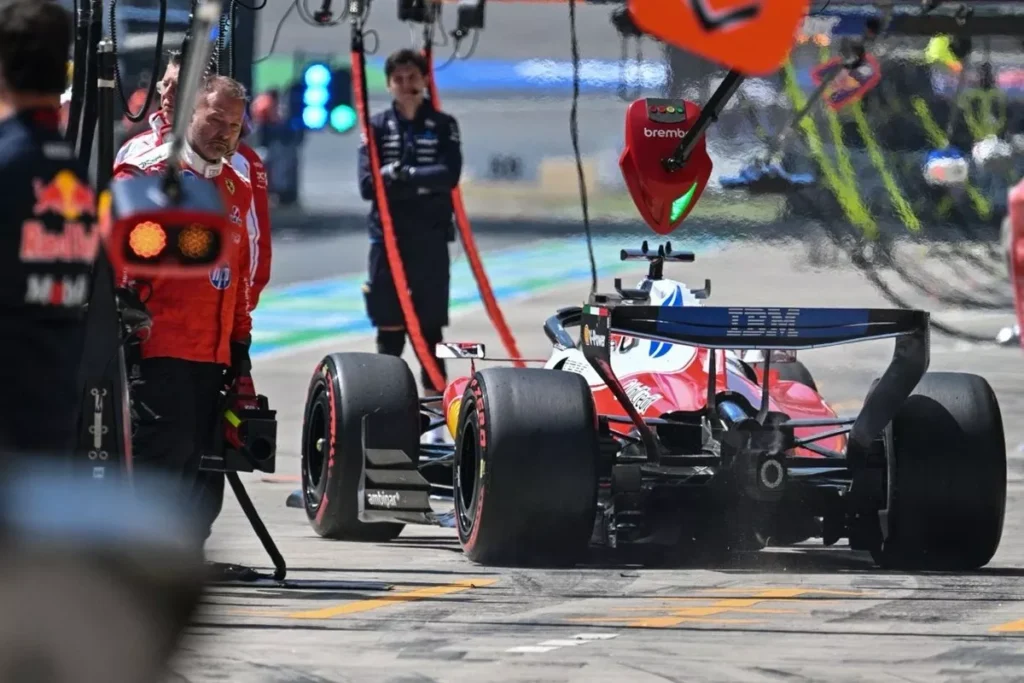
It was supposed to be one of the most exciting technical reveals of the 2026 Formula 1 season. Ferrari arrived in Shanghai with its much-discussed rotating rear wing — dubbed the ‘rotisserie’ or ‘Macarena’ wing — mounted on both the SF-26s of Lewis Hamilton and Charles Leclerc for the Chinese Grand Prix’s only free practice session. By the time sprint qualifying rolled around, it had quietly disappeared.
What Is the ‘Rotisserie’ Wing?
Ferrari’s innovation is a rear wing capable of rotating 180 degrees, a concept that turned heads when it first appeared during pre-season testing in Bahrain. The design aims to fundamentally alter aerodynamic behaviour across different phases of a lap — offering a new dimension of drag reduction beyond a conventional DRS system. It has already earned several nicknames in the paddock, from ‘rotisserie’ to ‘Macarena’, a nod to its distinctive movement.
The wing made its first competitive appearance in FP1 at Shanghai, and for a brief window, it looked like Ferrari might carry the experiment into the sprint weekend — until Hamilton’s session took an unexpected turn.
Hamilton’s Spin Sets the Tone
During the practice session, Hamilton lost the rear of his car at the Turn 6 braking zone when the wing snapped shut unexpectedly. His radio message was blunt: “Brakes locked up.” The incident — which also came close to involving Lando Norris, who was attempting to pass — underscored how much the team still had to learn about the wing’s behaviour under race conditions.
“I don’t really know why we went back on it. I think we rushed it to get it here — it was not supposed to be on the cards until race four or five or something like that.” — Lewis Hamilton, after sprint qualifying
Hamilton’s admission that the wing had been brought several races ahead of schedule was striking. The original plan, it seems, placed its proper debut considerably later in the calendar. Ferrari accelerated the timeline, but the Shanghai weekend quickly revealed the limits of that decision.
Why Ferrari Pulled the Wing
Key reasons behind the withdrawal
- Only two units of the wing existed — not enough to cover a full race weekend
- Insufficient data guarantees to manage race-distance risk
- The wing’s performance edge, while positive, would not be a decisive game changer
- Mercedes’ advantage at Shanghai made the risk less worth taking
According to reports from inside the paddock, Ferrari was broadly satisfied with the wing’s performance relative to the conventional version and encouraged by its reliability data — but ultimately felt it could not guarantee safe operation over a full race distance. With Mercedes dominating the Shanghai weekend, the calculus became straightforward: the risk outweighed the potential reward.
The fact that Ferrari only had two of the rotating wings also played a significant role. A failure in qualifying or the sprint race could have left the team scrambling, with no replacement available.
Sprint Qualifying Without It
Reverting to their Melbourne-spec rear wing, both drivers went on to complete sprint qualifying in respectable positions — Hamilton fourth, Leclerc sixth. The seven-time world champion finished 0.641 seconds off George Russell’s pole time, while Leclerc was further back after an issue on the back straight robbed him of a key deployment on his quickest lap. Fred Vasseur confirmed the team would investigate the matter.
Despite the setback, Hamilton found positives in how the car performed with the standard wing: “The car was still great. We’ll work to try and bring it back when it’s ready.” He also acknowledged a fundamental performance gap on the straights, highlighting the need for power unit improvements back in Maranello.
What Comes Next
Ferrari will now take the wing back to Maranello for further analysis ahead of the Japanese Grand Prix in two weeks. The intention is clear: return with the rotating wing when it is genuinely ready — not rushed. Hamilton put it plainly: “We only had two of them and it was maybe a little bit premature.”
The Shanghai weekend will likely be remembered as a brief, turbulent glimpse at what might be one of 2026’s most consequential aerodynamic innovations. Whether it lives up to its promise — and whether Ferrari can deploy it safely and consistently — remains one of the season’s most compelling open questions.
Sources
- Motorsport.com — Why Ferrari ditched its ‘rotisserie’ rear wing after FP1 at F1 Chinese GP
- The Race — Why Ferrari’s parked radical wing after ‘premature’ debut
- Motorsport Week — Lewis Hamilton admits Ferrari ‘rushed’ its radical rear wing
- Motorsport.com — F1 Chinese GP: Mercedes on top ahead of sprint qualifying (FP1 report)
- GPBlog — Ferrari fast-tracks striking ‘Macarena’ rear wing concept for Chinese GP
Discover more from f1liveupdates.com
Subscribe to get the latest posts sent to your email.