The Real Winners and Losers Behind Silverstone’s Shock Qualifying Order
A home pole nobody predicted, a midfield team quietly building a habit, and a championship contender left without answers — Friday at Silverstone had a story for almost everyone.
Sprint Qualifying at Silverstone delivered a grid that matched almost nobody’s pre-weekend expectations. Lewis Hamilton took pole in front of his own crowd, beating Mercedes at its own game for the first time all season. Behind him, the picture was messier: a rookie punished disproportionately for a tiny margin, a championship leader-in-waiting left without explanations, and a midfield team turning strong Friday form into a genuine habit. Here’s who left Silverstone smiling on Friday evening — and who didn’t.
Sprint grid, top five
- Lewis Hamilton (Ferrari)
- Kimi Antonelli (Mercedes)
- Max Verstappen (Red Bull)
- Charles Leclerc (Ferrari)
- George Russell (Mercedes)
Winners
Lewis Hamilton & Ferrari
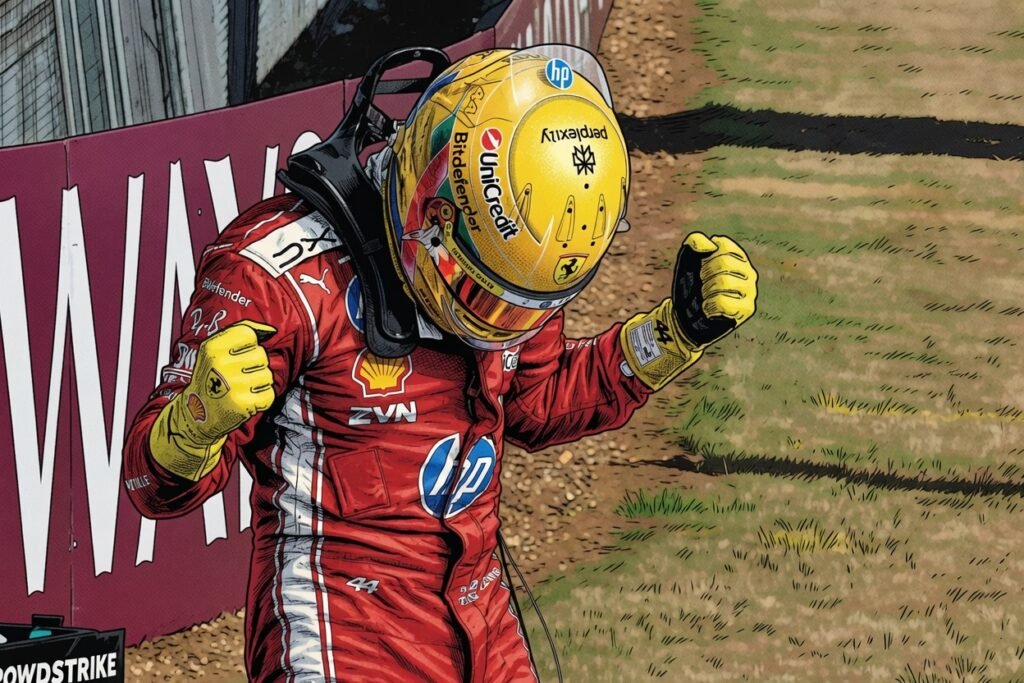
Nobody inside Ferrari, including Hamilton himself, expected this. Both driver and team had spent Thursday bracing for a deployment deficit potentially twice the size of Austria’s, given how energy-starved Silverstone’s characteristic corners are under the current regulations. Instead, Hamilton delivered the outright fastest lap of the session without topping a single individual sector, relying on a particularly strong run through Village to edge out Kimi Antonelli’s theoretically quicker Mercedes. Whether that pace translates into genuine race-day threat is a separate question, but as a pure qualifying story on home soil, Friday could hardly have gone better for the Scuderia.
Racing Bulls
Quietly, methodically, Racing Bulls has turned strong midfield form into a genuine pattern rather than a one-off. Liam Lawson and Arvid Lindblad locked out ninth and tenth on the Sprint grid, marking the team’s third consecutive midfield “one-two” finish in qualifying. Converting that into points on Saturday remains the harder task, but the consistency of the underlying pace is becoming difficult to ignore.
The car is really good; it’s been good all day. — Liam Lawson, Racing Bulls driver
Losers — or at least, not winners
George Russell
Of everyone left disappointed on Friday, Russell’s frustration cut the deepest. Fresh off reviving his own championship bid with victory in Austria, the Mercedes driver arrived at his home race and immediately found himself three tenths of a second behind teammate Antonelli — with no clear explanation for where the gap was coming from.
Story of the year, always on the back foot. Very much off the pace to Lewis and Kimi. — George Russell, Mercedes driver
Russell maintained the car itself felt reasonably good underneath him, which only made the deficit harder to explain. Some of it may simply be Ferrari performing far better than anticipated rather than Mercedes performing worse, but that logic doesn’t account for the gap to his own teammate — leaving Russell without answers just as the title fight intensifies around him.
Charles Leclerc
Leclerc’s Friday wasn’t a disaster by any measure — fourth on the grid, and firmly in Ferrari’s now-strong package — but the manner of it continued an uncomfortable pattern. He stayed within two tenths of Hamilton through SQ1 and SQ2, before slipping 0.321 seconds behind when the single decisive lap of SQ3 arrived. It’s a gap that’s becoming less the exception and more the rule: Leclerc held the upper hand over his teammate in qualifying and races last season, but in recent times, Hamilton increasingly looks like Ferrari’s most reliable source of a strong result.
Isack Hadjar
Few drivers had a session as cruelly disproportionate as Hadjar’s. He was genuinely quicker than Red Bull’s Max Verstappen through SQ1, and by SQ3 had shipped just 0.138 seconds to his more experienced rival — a margin that, on a normal midfield-packed Friday, might separate two cars by a single grid slot. Instead, that tiny gap was the difference between third and eighth. Hadjar said afterwards that tidying up a handful of corners would have found the missing time; the frustration was entirely justified given how little actually separated him from a podium-adjacent starting position.
- Hamilton’s pole lap was still 3.484 seconds slower than Max Verstappen’s 2025 benchmark at Silverstone.
- Around 1.7 seconds of that year-on-year drop came specifically between Copse and the entry to Stowe.
- Hamilton’s top speed through Maggotts and Becketts was roughly 28km/h down on last year’s comparable pace.
- Racing Bulls has now out-qualified the rest of the midfield for three consecutive race weekends.
The circuit itself, in a category of its own
Beyond individual drivers, Silverstone’s own high-speed identity was arguably the session’s biggest talking point. The energy-starved demands of 2026’s power units forced drivers below the limit of grip through Abbey, Copse and the Maggotts-Becketts sequence — corners that have historically defined the circuit’s character. Hamilton’s pole lap was roughly 34km/h slower through Abbey and 20km/h slower through Copse than Verstappen’s pace here just twelve months ago. However Saturday’s full qualifying and Sunday’s race unfold, Friday already delivered a clear verdict on how differently this generation of car handles Silverstone’s signature sequence — a storyline that may end up mattering as much as the grid order itself.
Discover more from f1liveupdates.com
Subscribe to get the latest posts sent to your email.