The Grid Penalty Sainz Wants to Stop Drivers Gaming Qualifying
A crash that handed George Russell pole position under the letter of the rules has reopened one of Formula 1’s oldest grey areas — and Carlos Sainz thinks he has a fix.
Max Verstappen’s Q3 crash at the Austrian Grand Prix lasted only a few seconds, but its consequences rippled through the entire session. The Red Bull driver went off at the penultimate corner on his final lap, triggering single-waved yellow flags. Under F1’s current rulebook, a single yellow only requires drivers to lift off the throttle through that zone — it doesn’t cancel their lap. George Russell, still on a flying lap behind him, did exactly that and still crossed the line fast enough to take pole. His teammate Kimi Antonelli, running under the same conditions, aborted his own lap believing — incorrectly — that a double yellow was in effect, and lost out as a result.
Nobody disputed that Russell had followed the regulations correctly. What the incident reignited instead was a much older argument: whether F1’s flag system creates a perverse incentive for a driver already in a strong position to simply go for broke, safe in the knowledge that even a wall-ending crash can lock out the rest of the field’s improving laps behind them.
Sainz’s proposal: a three-place penalty for causing a flag
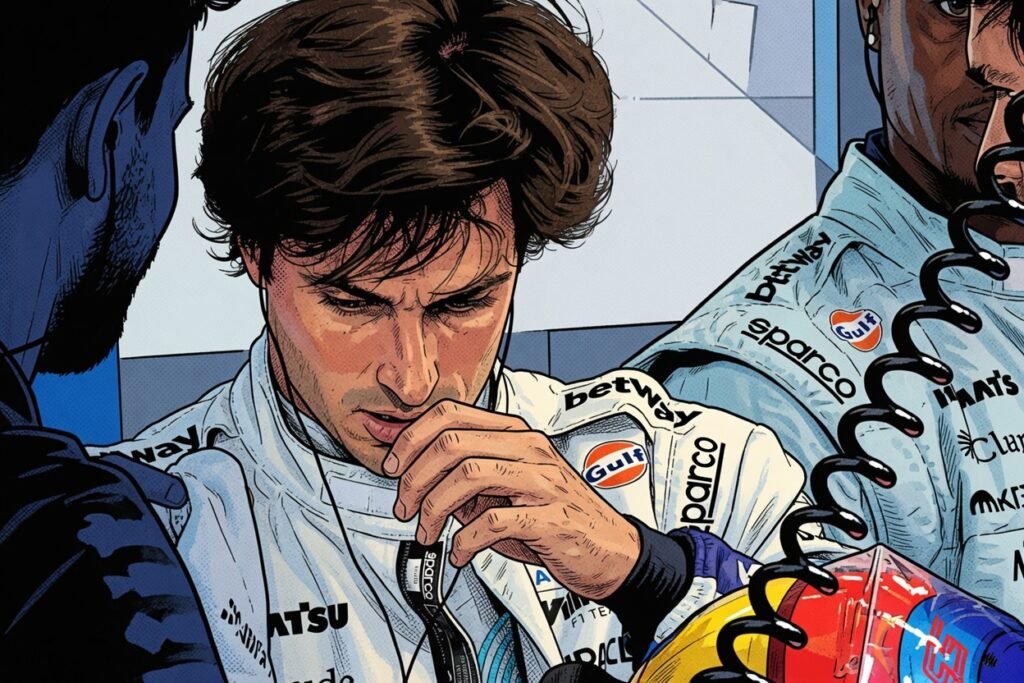
Carlos Sainz, now a director of the Grand Prix Drivers’ Association, used the aftermath of Austria to float a concrete fix. Speaking to media in the paddock, he confirmed he intends to bring the idea formally to his fellow GPDA members, even though the Austrian weekend’s sprint format meant there wasn’t time for a proper meeting on the subject there.
I think anyone who generates a yellow or a red flag in qualifying should receive a three-place grid drop. At least then you get penalised for it, and you get disincentivised to go flat out into something. — Carlos Sainz, Williams driver and GPDA director
Crucially, Sainz was careful to separate the proposal from any suggestion that Verstappen’s own crash was deliberate. He noted that Verstappen wasn’t even provisionally on pole at the time of his crash, appeared to have suffered a genuine rear-wing failure, and therefore had no obvious incentive to end the session early. The point of the rule, Sainz argued, isn’t to punish accidents — it’s to remove the temptation that exists whenever a driver already holding a strong position considers what happens if they simply don’t finish a lap cleanly.
The proposal at a glance
- A three-place grid penalty for any driver who triggers a yellow or red flag in qualifying.
- Intended to apply regardless of whether the flag was caused deliberately or accidentally.
- Not aimed at Verstappen’s Austria crash specifically, which Sainz attributes to a technical failure.
- To be formally raised within the Grand Prix Drivers’ Association for discussion among all drivers.
A temptation Sainz says he’s felt himself
What gives the proposal some weight is Sainz’s own admission that he’s been in exactly the position the rule is designed to discourage. Recalling a pole-position lap at a street circuit the previous year, he described the fleeting thought that crossed his mind as the first car out of the pits.
I could have done it last year in Baku, when I was on pole and I was the first car out of the pits. I said, ‘if I crash now I’m on pole.’ We all have these thoughts. We all know how the rulebook works. — Carlos Sainz, on the temptation created by F1’s current flag rules
Sainz stressed the pattern isn’t rare. He said he has repeatedly observed drivers appearing to force yellow flags at street circuits like Monaco and Baku across Q1, Q2 and Q3, situations he believes are almost impossible for stewards to police reliably without deep insider knowledge of how such incidents typically unfold.
Not everyone agrees it needs fixing everywhere
The proposal has divided opinion even among Sainz’s fellow drivers. Verstappen agreed that a genuinely deliberate flag-triggering incident should carry an even harsher penalty than three places, but argued his bigger concern lies elsewhere — in a rulebook that still allows a driver to complete a fast lap and take pole under a single-waved yellow at all, regardless of who caused it or why.
Charles Leclerc, who has his own history with high-stakes Monaco qualifying incidents, acknowledged that deliberate blocking has happened before and should be punished, but was more hesitant about applying a blanket rule across every circuit on the calendar. He suggested the issue is really concentrated at a handful of street tracks, rather than something that needs a season-wide fix.
- The most famous precedent remains Michael Schumacher’s deliberate 2006 Monaco stoppage, for which he was sent to the back of the grid.
- Formula 2 and Formula 3 already delete a driver’s fastest lap time as the penalty for causing a red flag.
- IndyCar uses a similar lap-deletion approach rather than a grid-position penalty.
- No standardised grid-penalty rule for causing a qualifying flag has ever been implemented in Formula 1.
Where the discussion goes from here
This isn’t the first time Sainz has raised the idea — he floated a similar concept back in 2022 following a Monaco qualifying incident, suggesting either lap deletion or a grid-position penalty as potential deterrents. That conversation went nowhere concrete at the time. Whether 2026’s version fares any better will depend on what happens when the GPDA actually sits down to debate it, and whether enough of the grid can agree on where genuine racing risk ends and calculated gamesmanship begins.
What’s clear is that Austria has given the argument fresh urgency. With a rookie losing a shot at pole through an overly cautious reaction to ambiguous flag rules, and a four-time champion’s genuine mechanical failure still reigniting a debate about intent, the pressure on Formula 1 to finally close the loophole looks harder to ignore than it has in years.
Discover more from f1liveupdates.com
Subscribe to get the latest posts sent to your email.