
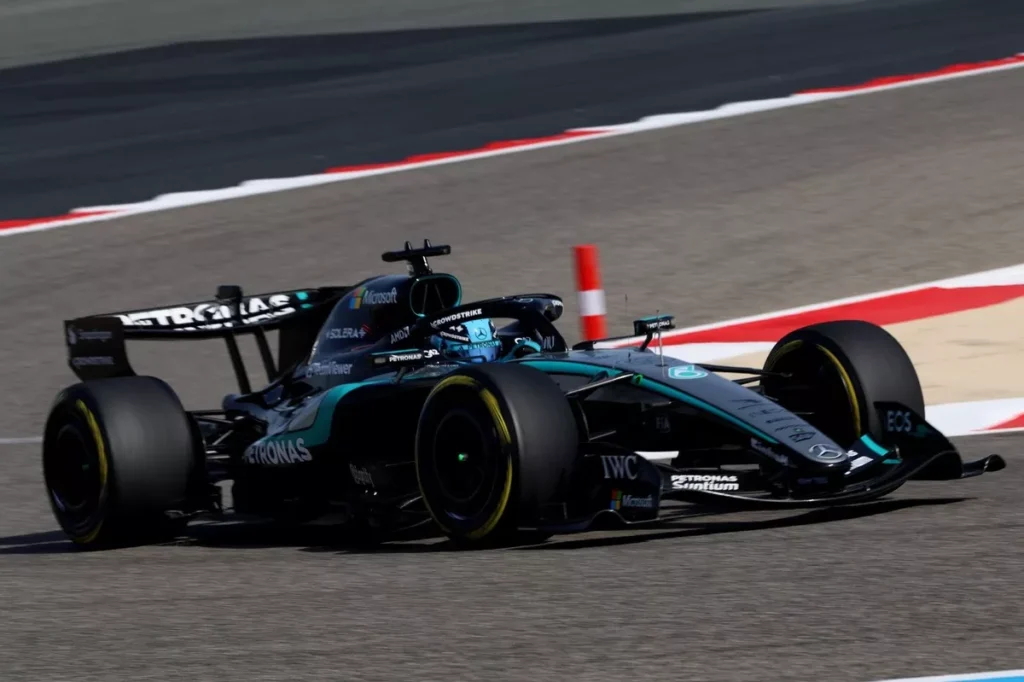
Mercedes’ Lead Won’t Last, Says Steiner — “The Development Rate Will Be Tremendous”
Two wins in two races. Russell and Antonelli looking untouchable. But Guenther Steiner has a warning for anyone who thinks the 2026 title is already decided.
On paper, it couldn’t look more comfortable for Mercedes. George Russell won the season opener in Australia. Kimi Antonelli followed it up with his maiden Formula 1 victory in China. With the two Silver Arrows drivers separated by just four points at the top of the standings entering the Japanese Grand Prix, the team’s start to the new 2026 era has been nothing short of commanding. The constructors’ championship gap — 31 points clear of Ferrari — only reinforces the impression of a team that arrived in the new regulations better prepared than everyone else.
Guenther Steiner is not impressed. Or rather, he’s not surprised — and he isn’t convinced that what we’ve seen in the first two rounds tells us much about where the season will end. The former Haas team principal, now a prominent pundit and voice in the paddock, issued a clear-eyed warning as the F1 circus arrived at Suzuka: rivals will come, and they will come fast.
Steiner’s Warning: Don’t Jump to Conclusions
Speaking ahead of the Japanese Grand Prix, Steiner was direct in his assessment. While acknowledging the quality of Mercedes’ early form, he cautioned against the kind of premature narrative-making that has tripped up observers in the opening rounds of previous seasons.
“The only thing that I would say is that we jump to the conclusion, ‘Oh, this will be now Mercedes until the end of the year.’ The development rate this year will be tremendous.” — Guenther Steiner
The word “tremendous” is not one Steiner uses carelessly. The 2026 regulations represent the most sweeping overhaul of Formula 1’s technical rules in years, with a dramatically revised power unit framework — boosting the role of hybrid energy recovery to a 50/50 split with the internal combustion engine — and an entirely new aerodynamic philosophy built around active aerodynamics. In any year of such radical change, the first teams to extract performance are rarely the ones who maintain the advantage longest. Understanding deepens over the course of a season, and the gap between the best and the rest tends to compress as everyone climbs the learning curve.
The Mercedes-Powered Threat: McLaren Above All
Steiner’s analysis pointed to a specific and somewhat ironic dynamic: the teams most likely to close on Mercedes in the near term are other Mercedes-powered outfits. McLaren, in particular, drew his attention.
“The other Mercedes-powered teams will learn more about their car and how to manage their power unit — McLaren more than anybody else.” — Guenther Steiner
McLaren’s own assessment of the gap is candid. Team principal Andrea Stella acknowledged that Mercedes has “clearly set the bar very high,” estimating the current deficit at somewhere between half a second and one second per lap. That is a significant margin — but not an insurmountable one over the course of a season, particularly given the pace at which teams typically find performance in a new regulatory cycle. Stella has confirmed that closing that gap will take time, but has not suggested it is beyond the team’s reach.
- George Russell leads the drivers’ championship with 51 points, Antonelli second with 47.
- Mercedes leads the constructors’ standings with 98 points — 31 ahead of Ferrari.
- McLaren estimates a 0.5–1 second gap to Mercedes per lap after two rounds.
- Red Bull admitted to “significant shortcomings” with their 2026 car after the Chinese GP.
- The 2026 regulations split power unit output 50/50 between ICE and hybrid systems — an unprecedented shift.
Red Bull’s Rocky Start
If McLaren’s situation offers a plausible recovery trajectory, the picture at Red Bull is more troubling. The team openly admitted to “significant shortcomings” with their RB22 following the Chinese Grand Prix, where both Max Verstappen and Isack Hadjar struggled to match the front-runners. The new regulations appear to have caught Red Bull in a particularly uncomfortable position, with the team’s aerodynamic philosophy — built around the unique relationship between Adrian Newey’s designs and Honda’s power units in the previous era — now requiring a fundamental rethink.
Newey’s departure to Aston Martin has left Red Bull without its most influential design mind precisely as the regulations demanded the greatest reinvention. The team retains deep technical talent, but the early evidence suggests they are further from the front than at any point in recent memory. Whether they can execute the kind of mid-season recovery that has defined their recent history remains to be seen.
Why Mercedes Started Ahead
Mercedes’ advantage at the start of 2026 is not accidental. The team began developing its 2026 power unit concept earlier than most of its rivals, and the decision to prioritise the new hybrid-heavy architecture proved prescient. The Silver Arrows’ W16 features an innovative front wing design that generated significant interest in pre-season testing, and the car’s energy management in race conditions has been notably superior to the competition.
But Steiner’s broader point stands: being first to unlock a new set of regulations is very different from being the best at developing within them. Teams that start behind often carry structural advantages — more obvious weaknesses to diagnose, more straightforward gains to unlock — that allow them to develop more aggressively in the months that follow. The team that wins in March is rarely the team that understands the regulations most deeply by October.
A Long Season Ahead
At Suzuka, Russell led Antonelli by just 0.026 seconds in Friday practice — the intra-team battle showing no signs of resolution. For Mercedes, managing that dynamic while holding off a closing pack will be the dual challenge of the coming months. Toto Wolff has long experience navigating both situations, but 2026 offers an unusually complex version of each.
Steiner’s prediction is not a slight against Mercedes. It is, if anything, a compliment to the depth of competition that the new regulations have the potential to produce. If his reading of the development rate is correct, the 2026 season has barely begun — and the title fight that emerges from the spring and summer upgrades could look very different from the opening chapter. Mercedes is ahead. But the pack is watching, learning, and coming.
Sources
- Mercedes warned of F1 threat as Steiner predicts “tremendous” development rate — Motorsport.com
- Guenther Steiner shares his one doubt about Mercedes in 2026 — F1 Oversteer
- McLaren offers frank summary of F1 2026 performance with 0.5–1s gap to Mercedes — Motorsport.com
- Red Bull admit to “significant shortcomings” after Chinese GP — Sky Sports F1
- Russell wins 2026 season opener in Australia — Sky Sports F1
- Antonelli wins first F1 race in China — Al Jazeera
- Russell leads Antonelli by 0.026s in Japanese GP FP1 — Autosport
- Mercedes faces unprecedented challenge as Steiner predicts explosive development — AutoGear
Discover more from f1liveupdates.com
Subscribe to get the latest posts sent to your email.