
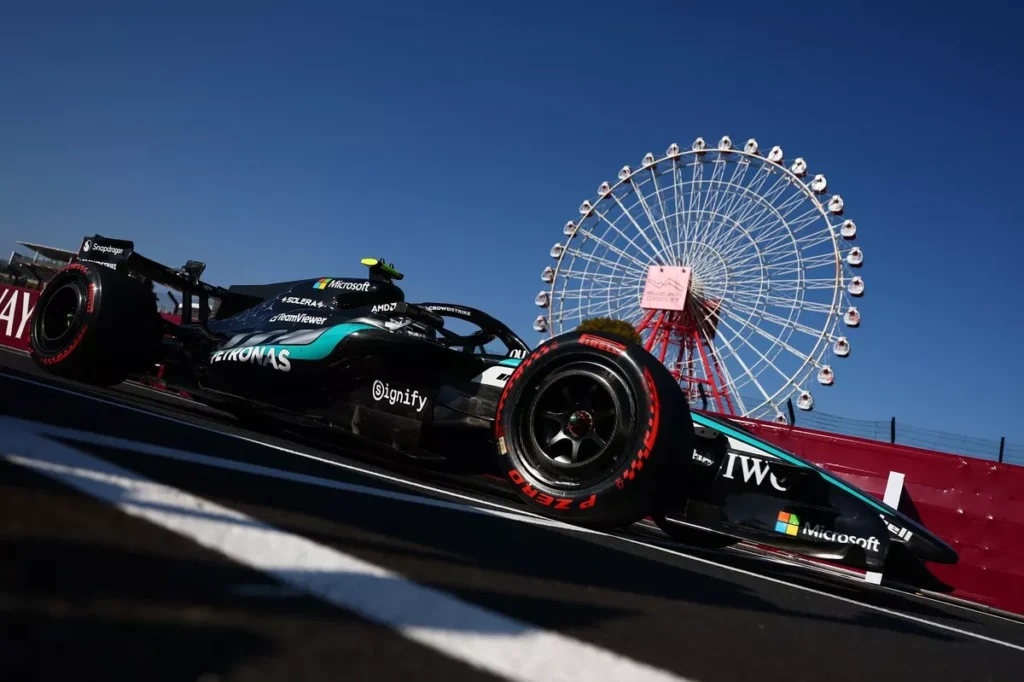
Is Mercedes Sandbagging at Suzuka? Long-Run Data Tells a Different Story
McLaren ended up with the quickest time overall on Friday — yet that doesn’t say much about the true pecking order in Japan. The long-run numbers may reveal who’s really holding back.
Oscar Piastri topped the timesheet in FP2 at Suzuka with a 1:30.133, edging out Kimi Antonelli and George Russell of Mercedes by just under a tenth. On paper, McLaren looks like the team to beat at the 2026 Japanese Grand Prix. But in Formula 1, Friday lap times — particularly soft-tyre qualifying simulations — can be deeply misleading. To understand who is genuinely quick, you need to look at the long runs.
And when you do, the picture changes dramatically.
Friday Results: The Numbers at Face Value
FP1 was a Mercedes one-two, with Russell leading Antonelli before Norris and Piastri slotted in third and fourth. Ferrari followed with Leclerc and Hamilton, while Verstappen languished in seventh, nearly eight tenths off the pace. FP2 saw McLaren hit back at the sharp end — Piastri fastest, Antonelli P2, Russell P3. Leclerc and Hamilton completed the top six for Ferrari, while Verstappen was a distant tenth, over 1.3 seconds adrift.
FP2 Classification — Top 6
- 1. Oscar Piastri (McLaren) — 1:30.133
- 2. Kimi Antonelli (Mercedes) — +0.092s
- 3. George Russell (Mercedes) — +0.113s
- 4. Lando Norris (McLaren) — +0.516s
- 5. Charles Leclerc (Ferrari) — +0.713s
- 6. Lewis Hamilton (Ferrari) — +0.847s
Norris was limited to just 17 laps after a hydraulics issue forced him to spend over 20 minutes in the garage, preventing McLaren from building a complete race picture. Verstappen, meanwhile, was disrupted by a power glitch — a new-era engine behaviour where, if revs drop too low, the car temporarily loses power entirely. He described waiting “10, 15, 20 seconds” for propulsion to return after slowing to let a car past.
The Long Runs: Where Mercedes Pulls Away
The true story of Friday unfolded on heavy fuel. Across extended stints on the medium compound, Mercedes demonstrated a level of race pace that was, in the words of long-run analysts, dominant. Kimi Antonelli emerged as the fastest driver in race simulation terms — and not by a small margin.
“Whilst we’re pleased with what we’ve accomplished, we’ve got work to do. McLaren in particular have looked very quick.”
— Kimi Antonelli, Mercedes, after FP2
The numbers tell a different story to his cautious words. Antonelli was posting laps averaging in the 1:34s with tanks still heavy — including a 1:34.150 on his seventh lap of a long stint. Mercedes held roughly a 0.96-second-per-lap advantage over McLaren in race simulations. The W16 showed particular strength in Sectors 1 and 3, reaching speeds up to 15 km/h higher heading into Turn 1 and approximately 10 km/h faster through the final sector. That kind of straight-line superiority is decisive at Suzuka, where traction and top speed out of the final chicane and down the pit straight can make all the difference.
McLaren’s Reality Check
McLaren’s headline result flatters what was a mixed day for the team. Piastri’s pace on a clean soft-tyre run was genuinely impressive, and the MCL40 showed real strength through the slow-speed corners and the final chicane complex. The car is well-suited to Suzuka’s technical demands in qualifying trim.
But race pace is a different matter. McLaren’s long-run average sat approximately 0.3 seconds per lap slower than Mercedes. Over a race distance of 53 laps, that compounds into an enormous gap. The MCL40’s relative lack of downforce creates a tyre management penalty over distance, and the gap to the Silver Arrows grows as laps accumulate and rubber degrades. McLaren sits ahead of Ferrari on race pace but is clearly behind Mercedes — at least on current evidence.
Red Bull: Alarming Friday
If McLaren’s Friday was deceptive, Red Bull’s was alarming. Verstappen ended FP2 tenth, 1.376 seconds behind Piastri. His teammate Isack Hadjar was fifteenth. The team brought four upgrades to Suzuka — including revised sidepod inlets, an adjusted engine cover, floor modifications, and updated brake duct geometry — but none of them translated into immediate pace improvement. Both drivers were on team radio from the very first lap complaining about downshifts, balance, and car responsiveness. The power glitch Verstappen suffered only compounded an already difficult session.
Red Bull’s deficit is not entirely unexpected on a high-downforce circuit like Suzuka given the challenges of the 2026 aerodynamic regulations, but the magnitude — nearly 1.4 seconds in a single session — raises serious questions about their race weekend prospects.
Ferrari: Consistent, But Not Close Enough
Ferrari brought two updates of their own — a smaller front brake duct exit and an evolved front floor stay fairing — and executed a cleaner Friday than Red Bull. Leclerc and Hamilton were consistently fifth and sixth across both sessions, approximately 0.7 to 0.8 seconds off the pace in qualifying trim. Their long-run pace was competitive but unable to match Mercedes. Solid, professional — but not championship-threatening over the course of a race weekend.
So, Is Mercedes Sandbagging?
The question is understandable. Mercedes finished FP1 one-two and was on the podium of FP2, yet allowed McLaren’s headline time to stand without a response. Is the Silver Arrow deliberately showing less than it has?
The long-run data suggests the opposite conclusion. Mercedes does not need to sandbag — they are already the fastest car over race distance by a significant margin. Their approach on Friday looked like a team focused entirely on race preparation: building tyre data, optimising fuel-heavy balance, and maximising the information available for their race engineers. The qualifying simulations they did run placed both cars in the top three. Their race pace put them in a class of their own.
Antonelli’s diplomatic tone post-session — crediting McLaren, flagging work to do — is a familiar Formula 1 ritual. The data underneath those polished words tells a far more confident story. Mercedes heads into Saturday knowing that if they execute cleanly, the race on Sunday is theirs to lose.
Discover more from f1liveupdates.com
Subscribe to get the latest posts sent to your email.