
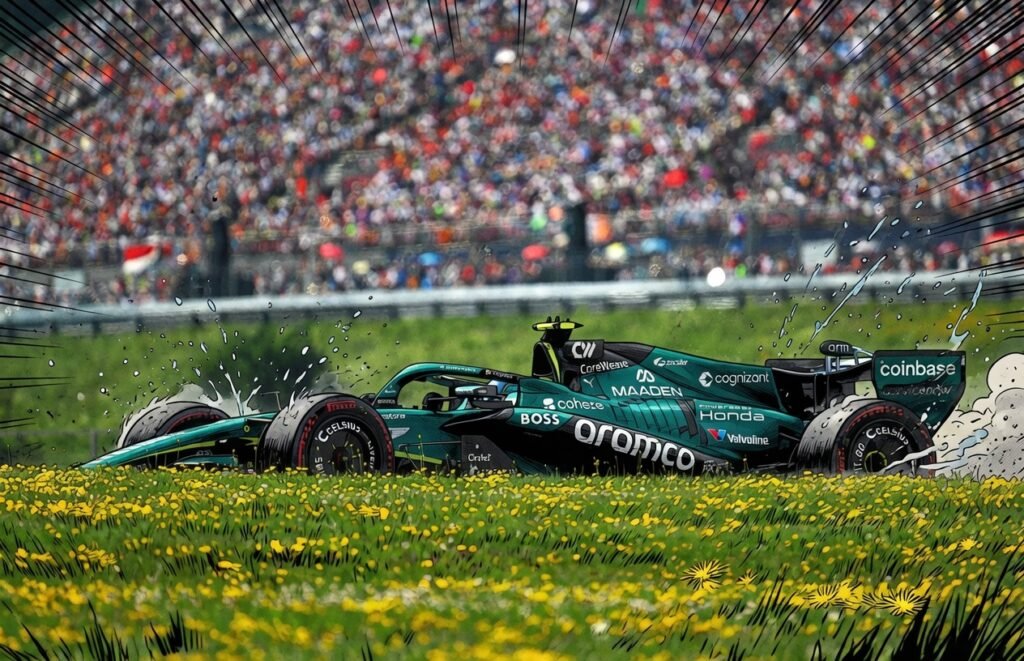
Newey’s Reckoning: Inside Aston Martin’s Lost Season
A works Honda deal, a Newey-designed chassis and championship ambition promised a breakthrough year. Eight races in, Aston Martin has one point and the slowest car on the grid.
Twelve months ago, the logic behind Aston Martin’s 2026 project looked almost unbeatable on paper. Adrian Newey, the most decorated designer in the sport’s history, had walked away from Red Bull to lead the technical department. Honda had committed to its first true works partnership, building a power unit around one team rather than supplying a customer. And the sport itself was resetting both chassis and engine regulations from scratch, theoretically levelling a field that had been dominated by the same names for years. Few teams entered the new era with more reason for optimism. Eight race weekends later, Aston Martin sits tenth in the constructors’ championship with a single point to its name, ahead of only debutant Cadillac, and has been comfortably the slowest car on the grid for most of the season.
A power unit that shook the car apart
The trouble started before a single competitive lap had been driven. Pre-season testing in Bahrain exposed severe vibrations originating from the new Honda power unit, damaging the battery to the point where it couldn’t sustain meaningful running. Aston Martin completed fewer laps than any other team across both tests, managing 334 in total against McLaren’s 821. The vibrations weren’t a minor irritant either — both Fernando Alonso and Lance Stroll later described the shaking as intense enough that they feared lasting physical effects if forced to drive through it for extended stints.
The knock-on consequences ran deeper than lost mileage. With so little clean running, the team went into the season with minimal data on both the chassis and the engine, forcing conservative stint lengths through the opening races purely to protect the hardware. Reliability slowly improved as the year progressed, but the early damage to the development timeline was already done.
A chassis with its own separate problems
Even once the power unit issues eased, the underlying car did the team no favours. Newey’s design turned out to be overweight and short on downforce, while a gearbox built in-house for the first time made the car difficult for both drivers to drive consistently. At one particularly diagnostic circuit, Barcelona, Alonso and Stroll were outpaced by a full second by the Cadillac of Valtteri Bottas — a debutant team with a fraction of Aston Martin’s resources and experience.
We knew we have the worst car and the worst engine. — Fernando Alonso, Aston Martin driver
That same Barcelona weekend produced arguably the low point of the season. Alonso’s power unit was changed overnight, forcing him to start from the pitlane rather than the grid, before a battery failure ended his race early — at the circuit he has called home for over two decades, on what he suggested publicly may have been his last visit there before it rotates off the calendar.
The season in numbers
- One point scored across the first eight race weekends of 2026.
- Tenth in the constructors’ championship, ahead of only Cadillac.
- 334 laps completed in pre-season testing, fewest of any team.
- Nearly a full second off the pace at the Austrian Grand Prix, the slowest car in qualifying.
Why Newey chose to wait rather than chase small gains
Rather than following the usual path of incremental upgrades race by race, Aston Martin made a deliberate decision early in the year to hold back and prepare one major overhaul instead. The reasoning was rooted in the cost cap: with the team so far off the pace, spending limited development budget on small in-season gains made little financial sense when a wholesale rework was ultimately required. Cutting the car’s weight — one of its central problems — is also an expensive, complex undertaking that doesn’t lend itself to piecemeal fixes.
That revised car, a lighter and reworked version of the AMR26, is now confirmed to debut at the Hungarian Grand Prix, the final race before the summer break. Notably, its introduction is no longer tied to Honda’s own engine upgrade timeline. The two had originally been expected to arrive together, but with Honda still working through its own development and unwilling to commit to a firm date, Aston Martin has decided the chassis update can’t afford to wait any longer — it needs to bank a development direction for the rest of the season regardless of when the engine catches up.
Newey’s own assessment
Speaking about the year so far, Newey acknowledged the scale of the challenge candidly, describing the team as having been on the back foot from the start on both the chassis and power unit sides. He pointed to the response inside the factory as a source of pride even amid the results, describing a team that pulled together around two priorities: surviving the immediate crisis, and building the technical foundations that would let Aston Martin compete properly rather than firefighting race to race.
- The revised AMR26 arrives at the Hungarian Grand Prix, decoupled from Honda’s engine timeline.
- Honda will introduce one engine homologation this year, with further development shifting to 2027.
- Cost-cap limitations shaped the decision to save resources for one major package rather than incremental steps.
- The team’s immediate target is simply reaching consistent points contention, with Audi the nearest rival above them.
None of this guarantees a turnaround. Newey himself has been reluctant to attach numbers to what the Hungarian update might deliver, citing simulation tools that aren’t yet correlating with the real car as precisely as the team needs. But after a season defined by vibrations, weight, and a gearbox fighting its own power unit, Aston Martin’s plan has narrowed to something simple: survive to the summer break, then find out whether the promise that justified signing Newey and Honda in the first place was ever really there.
Discover more from f1liveupdates.com
Subscribe to get the latest posts sent to your email.