FIA Fines Racing Bulls €30,000 After Lawson Breakdown Exposes Safety System Failure
A stinging rebuke from the FIA stewards reveals Racing Bulls had been previously warned about its dual-purpose Clutch Disengagement System, which failed during the Canadian Grand Prix practice session.
The FIA has fined Racing Bulls €30,000 after a technical failure on Liam Lawson’s car during Canadian Grand Prix practice exposed a critical safety system flaw — one that the governing body had already warned the team about in 2025. The incident forced the sole practice session to be red-flagged, disrupted valuable track time on a sprint weekend, and left the New Zealander unable to participate in Sprint Qualifying.
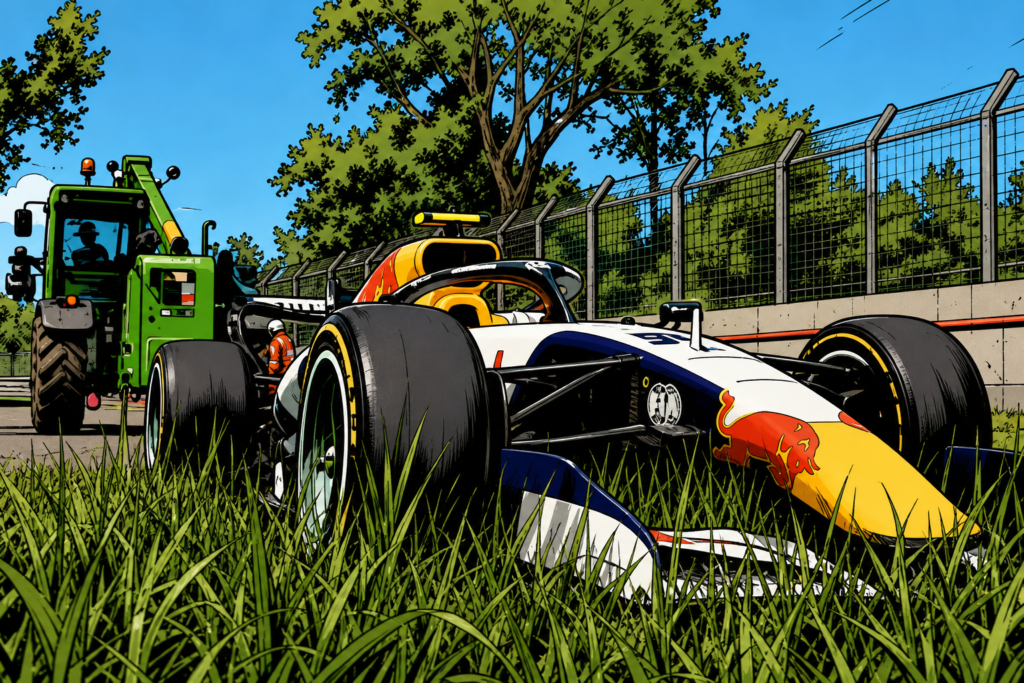
Lawson’s VCARB 03 ground to a halt just ten minutes into Friday’s opening session with a hydraulic failure. Under normal circumstances, such a stoppage should be manageable. All Formula 1 cars are mandated to carry a Clutch Disengagement System (CDS) — a fail-safe mechanism designed to allow marshals to push a stricken vehicle off the track even if the main hydraulic, pneumatic, or electrical systems have completely failed.
The System That Failed
Article C9.3 of the FIA F1 Regulations is unambiguous: “All cars must be fitted with a means of disengaging the clutch for a minimum of 15 minutes in the event of the car coming to rest with the engine stopped. This system must be in working order throughout the competition even if the main hydraulic, pneumatic or electrical systems on the car have failed.”
The purpose is clear. When a car stops on track, marshals activate the CDS via a clearly marked button on the monocoque, allowing the clutch to disengage so the car can be rolled to safety — typically behind a barrier gap — under Virtual Safety Car conditions. This avoids the more disruptive full red flag.
On this occasion, the system failed entirely. A ruptured joint had caused the hydraulic leak that stopped Lawson’s car. When the marshals attempted to activate the CDS, the clutch remained engaged. The car could not be moved. With the Circuit Gilles Villeneuve’s limited perimeter access — a characteristic of older venues — recovery became impossible without halting the session entirely.
Racing Bulls’ CDS performs two functions: its primary role of disengaging the clutch when the engine is stopped, and a secondary role servicing the car’s anti-stall system. This dual-purpose design, which the FIA technical delegate had previously warned the team about in 2025, created additional complexity that made the system more susceptible to failure. When the hydraulic leak occurred, both functions were compromised.
“This Is a Serious Matter”
The stewards’ official communication, typically dry and procedural, carried an unmistakable note of anger. Their assessment was blunt and unforgiving.
“This is a serious matter. It resulted in the session being red-flagged. Had the system worked as intended by the regulations, the incident could have been dealt with swiftly via deployment of the virtual safety car.” — FIA Stewards’ Statement
The penalty reflects the gravity of the breach. Racing Bulls was fined €30,000, but €20,000 of that amount has been suspended for 12 months — meaning the team must pay €10,000 immediately, with the remainder hanging over them like a sword of Damocles. Any further breach of Article C9.3 by either car will trigger the suspended portion.
A Prior Warning Ignored
Perhaps most damning for Racing Bulls is the revelation that this was not an unforeseen failure. FIA technical delegate Jo Bauer had already flagged concerns about the team’s CDS design during the 2025 season. The dual-purpose nature of the system — combining clutch disengagement with anti-stall functionality — was identified as problematic precisely because the additional complication increased the likelihood of failure.
The stewards’ report explicitly noted: “The stewards note the concern of the FIA technical delegate, over the dual purpose of the CDS on this car. The technical delegate advised that the team had, in 2025, been warned about the CDS system design for its cars.”
This raises uncomfortable questions about why the design persisted into 2026. While using a single component for multiple functions is a sound engineering principle in theory, the FIA’s concern was clearly that the added complexity compromised reliability in a safety-critical system.
Marshals Also at Fault
The investigation revealed a secondary issue that compounded the problem. Lawson himself brought two concerns to the stewards’ attention. First, marshals had attempted to push the stationary car contrary to standard procedure and the driver’s instructions. Second, the marshal who tried to activate the CDS was pressing a button on the onboard camera rather than the actual CDS button — suggesting confusion about the system’s location.
The stewards acknowledged that the FIA distributes detailed documentation on recovery procedures but concluded that “the distribution of such a document, although well detailed, probably needs supplementing with some form of practical training by the organisers.”
Consequences for Lawson
The fallout extended beyond the financial penalty. With the Canadian Grand Prix operating on a sprint format, teams had just one practice session before competitive action began. Lawson lost nearly the entire hour, and the damage to his car was significant enough that Racing Bulls could not repair it in time for Sprint Qualifying.
The New Zealander was forced to sit out the session, leaving him to start Saturday’s Sprint Race from the pit lane alongside Alex Albon — who was also sidelined after Williams could not repair his FW48 following a groundhog collision during practice.
For a driver already under pressure after a difficult start to the 2026 season, the setback is particularly unwelcome. Lawson has shown flashes of the pace that earned him his seat, but reliability issues and operational setbacks have repeatedly undermined his weekends.
A Design Dilemma
Racing Bulls now faces a strategic decision. The team must choose between redesigning the CDS to separate the clutch disengagement and anti-stall functions — if that is even feasible given the system’s integration into the car’s architecture — or risking another failure that would activate the suspended €20,000 fine.
The regulations do not explicitly prohibit dual-purpose systems, but the FIA’s warning and the stewards’ stern response send a clear message: safety-critical components should prioritize reliability over engineering elegance. For a team operating under the Red Bull umbrella, with access to considerable technical resources, the failure to address a known concern is all the more glaring.
As Formula 1 continues to push the boundaries of technology, this incident serves as a reminder that some systems demand absolute simplicity. When a car stops on track, there is no room for failure — and the FIA has made it abundantly clear that Racing Bulls’ compromise was one failure too many.
Sources
- Motorsport.com — “This is a serious matter” – why the FIA just fined Racing Bulls €30,000
- RacingNews365 — Racing Bulls issued significant fine for ‘serious’ rule breach
- Yahoo Sports — Racing Bulls hit with FIA fine after Lawson drama at Canadian GP
- PlanetF1 — Liam Lawson verdict issued following FIA investigation
Discover more from f1liveupdates.com
Subscribe to get the latest posts sent to your email.