Fernando Alonso: F1 Lost a Full Decade of “Pure Racing”
The two-time world champion dismisses the proposed 60-40 engine split for 2027 as insufficient, arguing that modern overtaking has devolved into mere “avoiding actions.”
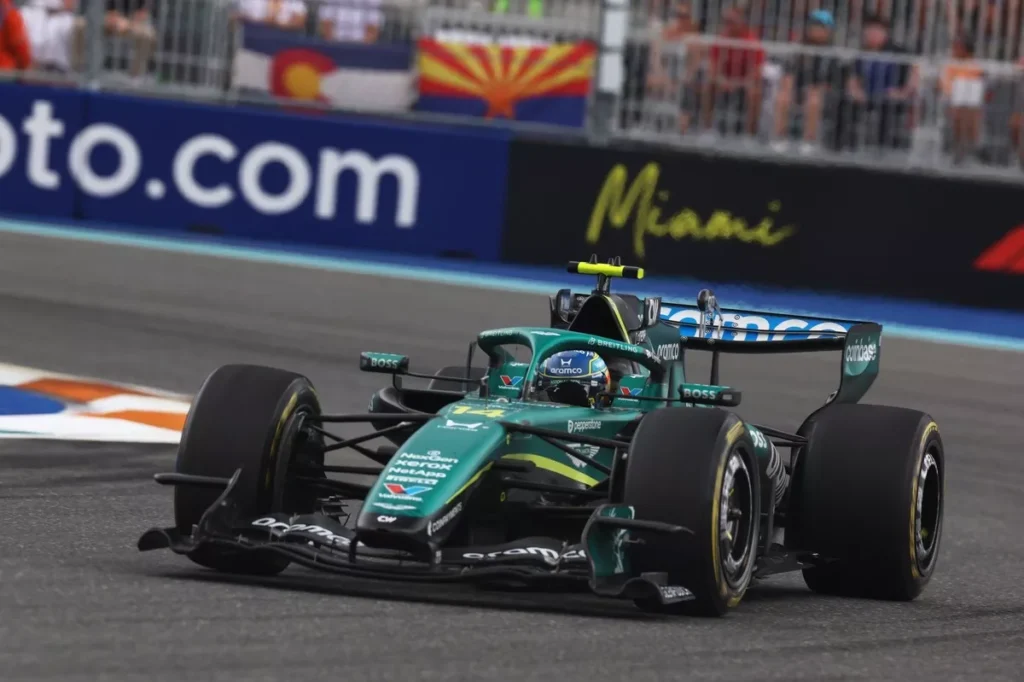
Fernando Alonso has delivered one of the most scathing assessments yet of Formula 1’s current era, declaring that the sport has lost nearly a decade of “pure racing” to the relentless pursuit of electrification. The Aston Martin driver, never one to mince words, argues that the 2026 regulations have fundamentally corrupted the DNA of grand prix racing — and that the proposed 60-40 engine split for 2027 will do little to reverse the damage.
The “Battery World Championship”
Since the introduction of the turbo-hybrid era in 2014, Formula 1 has increasingly prioritized energy management over raw racing instinct. But the 2026 regulations — featuring a near 50-50 split between internal combustion and electrical power — have pushed this philosophy to its breaking point. Alonso, who has rechristened the sport the “battery world championship,” believes the problem runs far deeper than any single regulatory tweak can fix.
Waiting. The DNA of these power units will always be the same. And it will always reward going slow in the corners. I don’t think [it will fundamentally change things].
— Fernando Alonso, on the proposed 2027 60-40 engine split
The Spaniard’s skepticism stems from a fundamental belief that racing and road-car electrification are incompatible beasts. While the world has charged headlong toward battery-powered mobility, Alonso argues that motorsport operates by different laws — laws that punish rather than reward conservation.
When Overtaking Becomes an “Avoiding Action”
Perhaps the most damning aspect of Alonso’s critique concerns the nature of modern overtaking. Where once a pass required millimetric precision, late braking, and calculated risk, the 2026 rules have reduced it to a mathematical exercise in energy deployment.
It will not be overtaking, it’s just an avoiding action. When you have more battery than the others, the other ones clip, so they reduce 500 horsepower. Then you have 500 horsepower more than the others, you take an avoiding action, and then you overtake a car.
— Fernando Alonso, describing modern F1 overtaking
This phenomenon — where a defending driver enters “clipping” mode (reducing power to recharge the battery) while an attacker deploys full electrical energy — creates speed differentials of up to 500 horsepower. The result, in Alonso’s eyes, is not racing but a crude game of energy arbitrage.
The 2027 Compromise: Too Little, Too Late?
In response to mounting driver criticism, Formula 1 bosses agreed in principle to shift the power balance to a 60-40 split in favor of the internal combustion engine (ICE) starting in 2027. The change, discussed in May 2026, aims to reduce the emphasis on battery management while maintaining road relevance.
Key Changes Under Discussion for 2027
- 60-40 power split favoring the internal combustion engine
- Reduction in electrical power output by approximately 50kW
- Hardware tweaks to existing power units
- Potential fuel flow limit adjustments to accommodate increased ICE power
- Requires ratification by the World Motorsport Council
However, Alonso views this as cosmetic surgery on a patient requiring structural reform. “Now, we go a little bit back to the 60-40, and then in the future to less and less,” he noted with characteristic fatalism. “Unfortunately, we had this period from 2014 with the turbo era, and now even more, that we lost nearly one decade or even more of pure racing.”
Driver Revolt: Not Just Alonso
The two-time champion is far from alone in his discontent. Max Verstappen has likened the 2026 cars to Mario Kart, labeling the battery-boosted passing style as “anti-racing.” Reigning world champion Lando Norris admitted during the Miami Grand Prix that he still did not believe any driver could genuinely enjoy the current machinery, even after the FIA introduced tweaks to improve qualifying.
The FIA’s short-term fixes, implemented ahead of the Miami Grand Prix, included reducing recoverable energy per lap to minimize lift-and-coast tactics in qualifying and capping electric deployment at 250kW in non-straight zones during races. McLaren’s technical director Mark Temple acknowledged these changes would make opportunistic overtakes in unusual places harder — a safety-driven compromise that Alonso and others see as further evidence of the regulations’ fundamental flaws.
Beyond F1: A Broader Motorsport Renaissance?
Interestingly, Alonso does not view the current discontent as purely negative. He sees it as an opportunity for fans — and drivers — to discover the rich tapestry of motorsport beyond Formula 1. With Max Verstappen recently competing in the Nürburgring 24 Hours and more drivers exploring endurance racing, Alonso believes top-tier talent can “open the eyes” of fans to series where pure racing still exists.
Formula 1 is the pinnacle and lovely, but also the other series are just as magic as Formula 1 in a sense.
— Fernando Alonso
The veteran driver points to his own Indianapolis 500 debut as proof — a test session that drew two million viewers on YouTube alone, sparking a surge of European interest in IndyCar that has seen the series’ grid become 80% European.
What Comes Next?
For Alonso, the path forward is clear: only a complete regulatory cycle change — not mid-cycle patches — can restore Formula 1’s racing soul. The 2027 adjustments, while symbolically significant, merely nudge the needle on a compass that he believes points in the wrong direction.
“The thing is that the world went or thought to go into the [direction of] electrification, that was thought to be the future,” Alonso reflected. “But that doesn’t apply to racing. Racing is a different animal.”
As Formula 1 stands at this crossroads, the question is no longer whether the regulations need changing — even the FIA has acknowledged as much. The real question is whether the sport’s stakeholders have the courage to prioritize racing purity over road-relevance rhetoric. For Fernando Alonso, the answer is already clear. The only uncertainty is how many more years of “avoiding actions” fans will tolerate before demanding the pure racing he believes has been lost.
Sources
- Yahoo Sports — “Fernando Alonso: F1 lost a full decade of ‘pure racing'” May 22, 2026
- ESPN — “F1 reveals latest tweaks to rules for 2027, moves away from 50-50 engine split” May 8, 2026
- Motorsport.com — “Qualifying closer to the limit and fewer opportunistic overtakes: How F1 will change from Miami” April 27, 2026
- Yahoo Sports — “F1’s 2027 engine rules to be decided by mid-May” May 1, 2026
- Formula1.com — “The beginner’s guide to the 2026 regulations” March 4, 2026
Discover more from f1liveupdates.com
Subscribe to get the latest posts sent to your email.