Lego’s British Grand Prix Sequel Puts Every Driver in Their Own Car
Last year’s Miami mayhem saw ten shared Lego cars turn into a viral pile-up of laughter. Silverstone’s answer is bigger: all 22 drivers, each in their own brick-built minicar.
Formula 1’s Drivers’ Parade has traditionally been a gentle, ceremonial affair — open-top classic cars, a slow lap, a wave to the crowd. That changed dramatically at the 2025 Miami Grand Prix, when Lego and F1 swapped the usual vehicles for ten oversized, fully drivable Lego cars shared between teammates. What followed was pure, unscripted chaos: drivers laughing, nudging rivals, and shedding bricks across the circuit in one of the most replayed moments of the entire season. For Silverstone, the sequel goes considerably bigger. This Sunday, every single driver on the 2026 grid — all 22 of them — will pilot an individual Lego minicar of their own.
From ten shared cars to twenty-two personal ones
The shift in format is the headline change. Where Miami paired teammates together in two-seater big-build cars, Silverstone’s version gives each driver a dedicated single-seater, styled in their own team’s 2026 livery and carrying their individual race number. Lego’s Chief Product and Marketing Officer, Julia Goldin, framed the expansion as a direct response to how enthusiastically both drivers and fans reacted the first time around.
We always listen to our fans, and it was clear from the 2025 Miami Grand Prix Drivers Parade that both fans and drivers wanted more. We’re back with a 2.0 version in a brand-new format, bringing even more fun and excitement to the parade. — Julia Goldin, Chief Product & Marketing Officer, The Lego Group
The build behind the spectacle
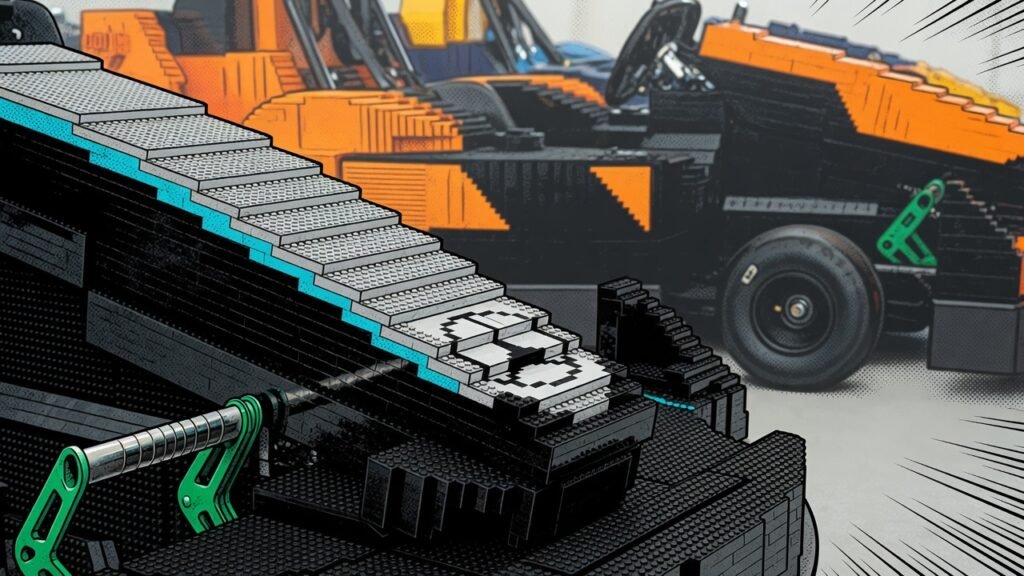
Behind the playful concept sits a genuinely substantial engineering effort. Each of the 22 minicars is built from more than 28,000 individual Lego bricks, and the full fleet took a combined 6,400-plus hours to design and construct at the Lego Group’s factory in Kladno, Czech Republic, by a team of 20 designers, engineers and specialist builders. Despite being made almost entirely of plastic bricks, the cars are far from static props — each one runs on standard go-kart wheels and an electric motor, capable of reaching speeds of up to 25km/h.
The Lego minicars, by the numbers
- 22 individual minicars — one for every driver on the current F1 grid.
- 28,000-plus Lego bricks used in each car’s construction.
- Approximately 280kg total weight per car, including roughly 65kg of bricks.
- Top speed of up to 25km/h, built by 20 specialists over 6,400-plus combined hours.
A growing partnership finding its rhythm
Silverstone’s parade is the latest, and most ambitious, chapter in a partnership between Formula 1 and Lego that has steadily expanded over the past two seasons. Previous activations have included specially designed Lego trophies at last year’s British Grand Prix and a Lego-built cooldown car at the Las Vegas Grand Prix, alongside the original Miami parade that started it all. Formula 1’s Chief Commercial Officer, Emily Prazer, described the Silverstone version as a deliberate attempt to build on that momentum.
Last year’s F1 Drivers’ Parade in Miami with the Lego big build cars was one of the most memorable and talked-about moments of the season. This year, we’re building on that moment to create an incredible spectacle for fans attending the British Grand Prix and those watching globally. — Emily Prazer, Chief Commercial Officer, Formula 1
Not every driver is equally thrilled
Reaction from the grid itself has been more mixed than the marketing suggests. Max Verstappen has been openly lukewarm about the format, suggesting he’d be just as happy with a conventional truck-led parade, while Lance Stroll offered a deadpan verdict of simple indifference in Thursday’s press conference. Given how enthusiastically several drivers embraced the chaos in Miami — deliberately barging into rivals’ cars once the cameras were rolling — the muted pre-event reaction may not survive first contact with the go-kart wheels once Sunday actually arrives.
- The parade takes place roughly 90 minutes before Sunday’s race start, at 1pm local time.
- It will be broadcast live on Formula 1’s YouTube channel, with extended build-up coverage on Sky Sports F1.
- Silverstone is expecting to break its own attendance record, with roughly 565,000 fans anticipated across the weekend.
- Each car’s livery reproduces its team’s actual 2026 colours, sponsor branding and driver number.
Whatever the drivers privately make of it, the format has proven itself as pure spectacle: a moment of unguarded fun squeezed in between the tension of qualifying and the seriousness of race day. With twenty-two cars instead of ten and every driver now solely responsible for their own bricks rather than sharing the blame with a teammate, Silverstone’s version has all the ingredients to outdo Miami’s viral moment — assuming the cars, and the rivalries behind the wheels, can survive a full lap intact.
Discover more from f1liveupdates.com
Subscribe to get the latest posts sent to your email.