
Why “Miracles Are Not Possible” to Quickly Fix Audi’s F1 Engine Problem
Audi has identified its power unit as its greatest weakness in 2026 — and team boss Mattia Binotto is being candid about why neither willpower nor a regulatory safety net can change that overnight.
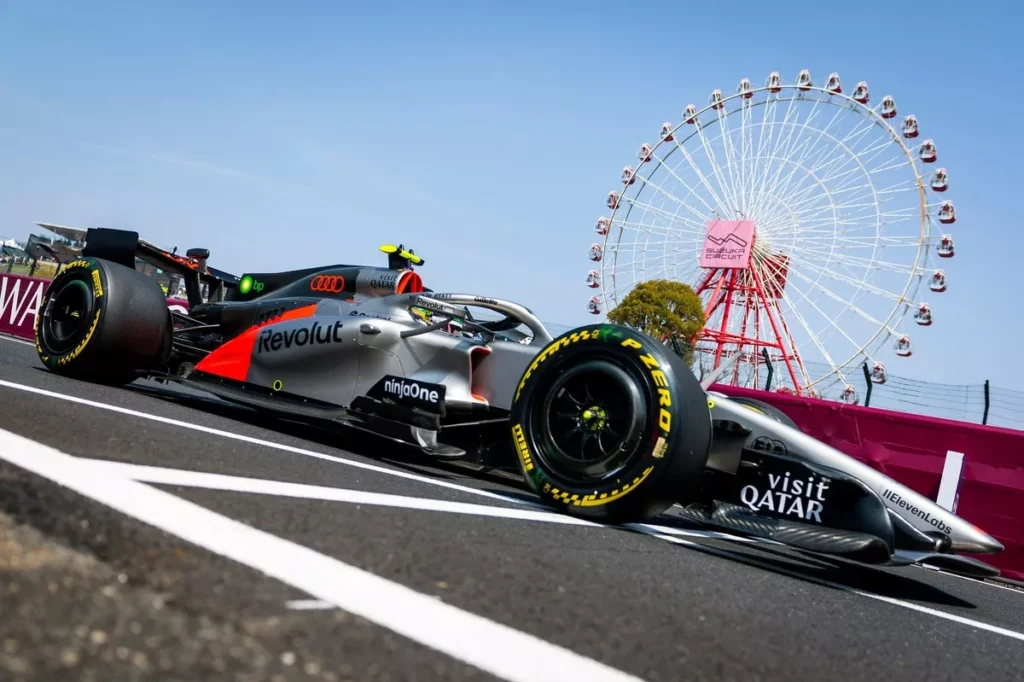
Three races into its debut Formula 1 season, Audi has produced a pattern that is becoming familiar: strong qualifying, poor race. At Suzuka, Gabriel Bortoleto and Nico Hülkenberg lined up eighth and 13th on the grid, then found themselves 13th and 19th by the end of the opening lap. It is not a coincidence. It is a symptom of a fundamental problem with the Audi power unit — and team principal Mattia Binotto has been unusually frank about the fact that the 2026 regulations’ built-in performance equalisation mechanism, known as ADUO, will not deliver a quick remedy.
What Is Going Wrong — and Why
The core issue is understood to stem from a design choice in Audi’s turbocharger. The power unit is believed to feature a relatively large compressor, which trades higher potential boost pressure for greater rotational inertia. The practical consequence is that boost arrives later — drivers request power and there is a lag before it materialises. This creates a particularly acute problem at race starts, where even a fraction of a second’s delay in power delivery can translate into multiple positions lost before the first corner. Bortoleto acknowledged the issue after Japan but placed it in the context of a team finding its feet.
“There are teams doing this for 15 years, and we are in the first year of building an engine. It’s not easy. But I have no doubt that we’re going to be one of the top engine manufacturers in the future.”
— Gabriel Bortoleto, Audi F1
Pre-season reports estimated Audi’s power unit to be as much as 31bhp down on Mercedes — a significant figure in a season where the near 50/50 split between internal combustion and electrical output makes raw engine performance more decisive than it has been in years. The new regulations amplify the consequences of any power unit deficit in ways that the previous formula did not.
ADUO: A Safety Net, Not a Quick Fix
The 2026 regulations include a framework specifically designed to prevent any manufacturer from falling irretrievably behind: ADUO, or Additional Development and Upgrade Opportunities. The mechanism provides structured pathways for under-performing power unit manufacturers to introduce upgrades outside the normal homologation cycle, assessed every six races. But Binotto was emphatic that ADUO is not the emergency lever some might imagine.
Every six races, the FIA calculates an ICE Performance Index using data submitted by each manufacturer. The gap to the benchmark engine determines what concessions a struggling supplier receives:
The first ADUO assessment threshold arrives after six races — currently scheduled to fall after Miami in early May, though the cancellation of Bahrain and Saudi Arabia has complicated the exact timing. Even once concessions are granted, development lead times mean hardware changes take months to arrive on the car.
“The lead times on engine development are very long. We have assessed that most of the gap we have to the top teams is from the power unit, which is not unexpected — we knew that would have been the biggest challenge. We have a plan to recover. But engine development, especially when it comes to some concepts, can take longer. It’s not by chance that we have set 2030 as our objective. We know that it will take long. And I think what we need now is to be patient as well. Because miracles are not possible.”
— Mattia Binotto, Audi F1 Team Principal
Even if Audi qualifies for additional ADUO concessions after the first assessment, the nature of engine development means any hardware changes would likely not reach the car until later in 2026 at the earliest — and more substantial changes would feed into the 2027 specification. The design choices made during Audi’s development programme, including the turbocharger architecture, are tightly integrated into the chassis and cannot be simply reversed mid-season.
A Double Problem: Engine and Leadership
Audi’s situation is further complicated by a sudden leadership change that shook the team just before the Japanese Grand Prix. Jonathan Wheatley — poached from Red Bull in April 2025 to serve as team principal for trackside operations — departed with immediate effect in late March, citing personal reasons after less than a year in the role. Binotto is absorbing the team principal responsibilities for now while a replacement is sought. The departure was, by Binotto’s own admission, unexpected.
- Power unit identified as “most of the gap” to frontrunners — Binotto
- Estimated 31bhp deficit to Mercedes reported pre-season
- Race start losses consistent across all three rounds so far
- Team principal Jonathan Wheatley departed before Japan
- Binotto currently holds both factory and TP responsibilities
- First ADUO assessment window: after Miami (Round 6)
- Championship target for title competition: 2030
Binotto: “Proper Plans, Not Miracles”
Despite the scale of the challenge, Binotto’s message was one of structured patience rather than alarm. He framed Audi’s situation as the expected reality of debuting an entirely new power unit programme in a year of sweeping regulatory change — and stressed that the team’s long-term ambitions remain intact.
“We are not here to create miracles. It’s not us. We cannot do that. But we are here to have proper plans to address and to improve in the future. And I think that is also possible.”
— Mattia Binotto, Audi F1 Team Principal
For all the difficulties, Audi’s chassis is not the source of its problems. Both Bortoleto and Hülkenberg have demonstrated genuine one-lap pace on Saturdays, confirming that the aero package is competitive. The power unit is the constraint — and unlocking it, through ADUO provisions, engineering development, and the gradual accumulation of operational data, is the multi-year project that the team’s 2030 target implicitly acknowledges. For now, Audi races with what it has. And what it has is not yet close to enough.
Discover more from f1liveupdates.com
Subscribe to get the latest posts sent to your email.