
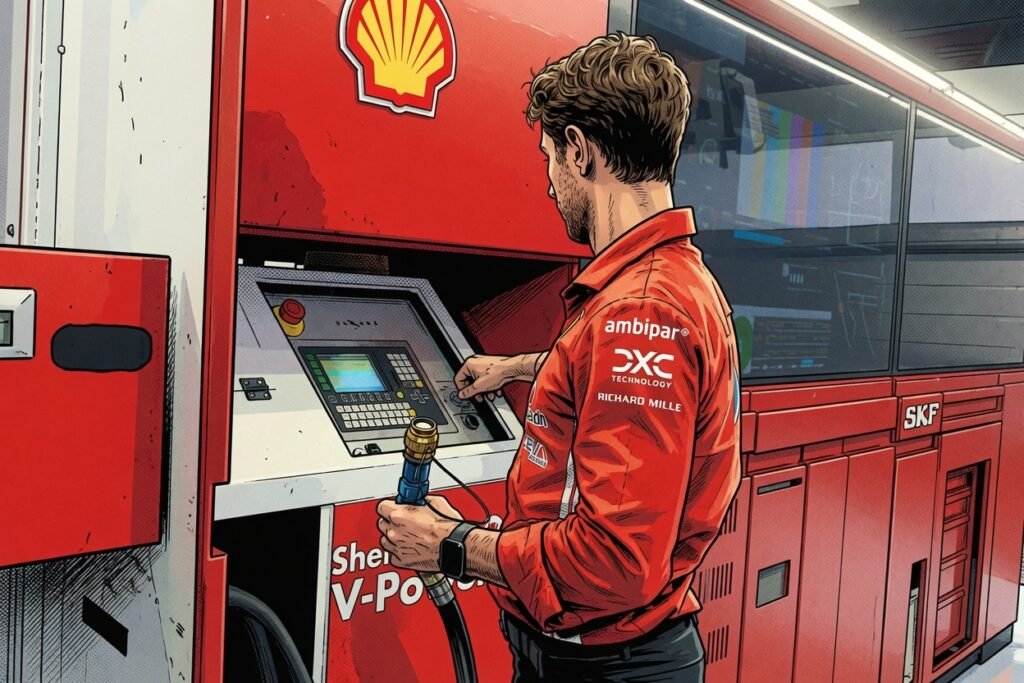
The Silent Engineering Partner Behind Every Ferrari Lap
The 2026 British Grand Prix marks 75 years since Shell and Scuderia Ferrari HP’s first win together. Behind the badge on the car sits a technical relationship far deeper than sponsorship.
Three-quarters of a century ago, at the 1951 British Grand Prix, Scuderia Ferrari secured its first Formula 1 World Championship victory running Shell fuel and lubricants. That result, at the same Silverstone circuit hosting this year’s British Grand Prix, marked the beginning of what has become one of motorsport’s longest-running technical alliances. Seventy-five years on, the Shell logo remains a fixture on the Ferrari livery — but reducing the relationship to branding misses what actually keeps it alive: a continuous exchange of data, formulation science and engineering effort that runs in both directions between the racetrack and the road.
More than a logo on the car
Shell frames its arrangement with Ferrari deliberately as an “Innovation Partnership” rather than a sponsorship, and the distinction is more than semantic. According to Valeria Loreti, Shell’s Principal Scientist of Motorsports, the value of the relationship has never really been about visibility.
While the Shell logo has been a familiar presence on Ferrari cars for generations, the real value of the relationship lies in the technical collaboration that happens behind the scenes. — Valeria Loreti, Shell Principal Scientist of Motorsports
That collaboration runs deep into Ferrari’s operational structure. Shell’s engineers and scientists, based primarily at its Technology Centre in Hamburg, work alongside Ferrari’s own engineers both in Maranello and trackside, running testing programmes, developing new fuel and lubricant formulations, and looking for incremental gains in performance, efficiency and reliability throughout the season.
What actually happens on a race weekend
The most visible evidence of that collaboration sits inside Ferrari’s own garage. Shell maintains a Trackside Laboratory at every Grand Prix, staffed by a minimum of two scientists who analyse fuel and lubricant samples in real time, checking both performance and regulatory compliance for Ferrari and its customer teams throughout the weekend. Across a full season, that effort translates into a significant volume of shared data — in 2025 alone, Shell provided its Ferrari counterparts with more than 50,000 individual data points, feeding directly into decisions on engine health monitoring, performance optimisation and reliability management.
The partnership in numbers
- 75 years since Shell and Ferrari’s first Formula 1 win together, at the 1951 British Grand Prix.
- 10 Constructors’ titles and 12 Drivers’ Championships won together across F1 history.
- Over 21,000 technical man-hours invested annually by more than 50 Shell specialists.
- More than 50,000 data points shared with Ferrari’s engineers during the 2025 season alone.
A live example: Austria’s engine upgrade
The 2026 season has already produced a concrete illustration of how the technical side of the partnership operates. When Ferrari qualified for a mid-season power unit upgrade under Formula 1’s new ADUO framework and brought a revised specification to the Austrian Grand Prix, that hardware change also became an opportunity for Shell to refine its own formulations around it. Both Shell V-Power race fuel and Shell Helix Ultra race lubricant are engineered specifically to match the precise requirements of Ferrari’s current power unit, and as that specification evolves, Shell adjusts its formulations in parallel to keep extracting maximum performance from the updated package.
That co-development cycle — hardware and fluids evolving together rather than one simply supplying the other — is, in Shell’s own framing, central to what separates this arrangement from a conventional supplier relationship.
Beyond Formula 1
The technical relationship isn’t confined to single-seater racing. Since Ferrari’s return to the FIA World Endurance Championship in 2023, Shell’s lubricants and coolants have supported the Hypercar programme through three consecutive overall victories at the Le Mans 24 Hours, in 2023, 2024 and 2025. The partnership additionally extends to the Ferrari Challenge Series and ongoing sustainability work at the Maranello factory itself, where Shell supplies certified renewable electricity and natural gas to support the site’s operations.
Where the benefit flows back
The relationship’s endurance owes as much to what Shell gets out of it as to what it gives. Tom Kassell, Shell’s Global Head of Motorsport Partnerships, has been direct about the underlying logic: unlike most sponsorship arrangements, which are primarily marketing exercises, this one is built around genuine technical collaboration that both organisations draw real value from. Formula 1’s extreme operating conditions function as an accelerated testing ground, and lessons learned developing Ferrari’s bespoke race fuel and lubricant formulations have historically fed into Shell’s commercial products, including Shell V-Power fuels and Shell Helix Ultra lubricants sold to everyday drivers.
- 2026’s new F1 fuel regulations require fully sustainable feedstocks, with no crude oil content permitted.
- Shell V-Power Advanced Sustainable Race Fuel is a bespoke formulation not sold at retail Shell stations.
- The partnership was recently renewed for several more years, extending into the new regulatory era.
- Track-to-road technology transfer remains, in Shell’s words, one of its central reasons for investing in motorsport.
Seventy-five years after that first win at Silverstone, the badge on the car tells only a fraction of the story. What has actually sustained the relationship, according to both organisations, is a shared belief that pushing performance to its limits on track produces genuine engineering knowledge — knowledge that neither side would generate quite as fast working alone.
Discover more from f1liveupdates.com
Subscribe to get the latest posts sent to your email.