Pirelli’s Plan to Combat Continuous One-Stop Races in F1 2026
Two races in, both won on a single pit stop. Pirelli motorsport boss Mario Isola explains why the 2026 regulations have produced such durable tyres — and what levers exist to bring strategic variety back to the season.
PIRELLI
One-stop races in Melbourne AND Shanghai. Is strategy variety under threat?
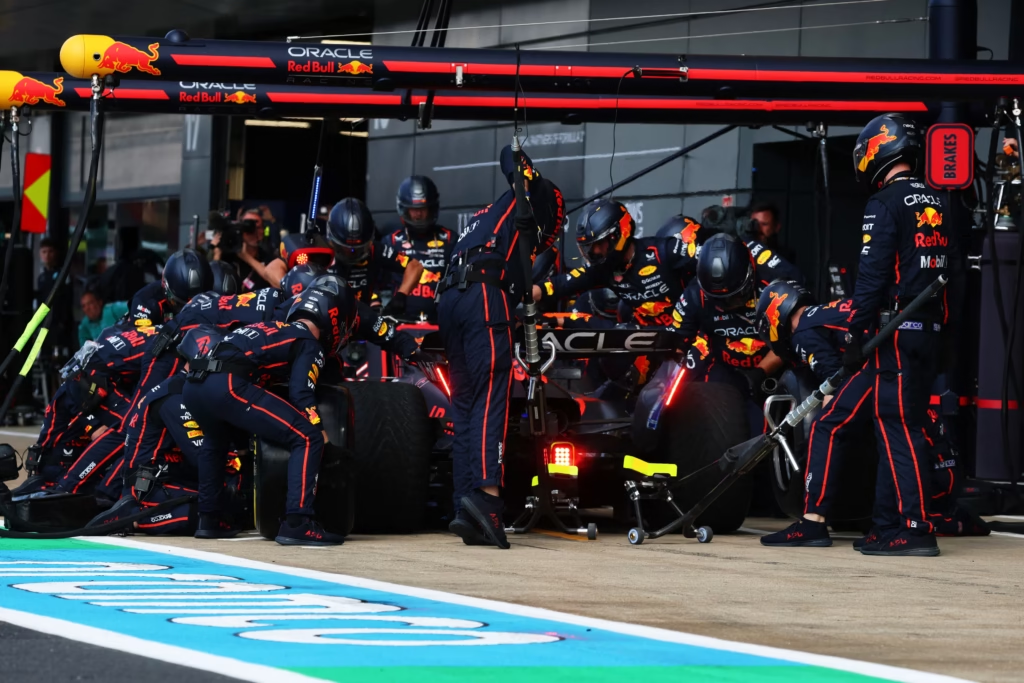
Two races into the 2026 Formula 1 season, a pattern has already emerged. In Melbourne, Kimi Antonelli and George Russell led a Mercedes 1-2 — both on a single pit stop. In Shanghai, the same story: Antonelli won again, Russell second, both on a one-stopper. The vast majority of frontrunners around them did the same. Strategy variety, for now, appears to have been quietly edited out of the 2026 season.
It is a concern Pirelli takes seriously. Mario Isola, the Italian manufacturer’s outgoing motorsport boss, has been candid about the challenge — and about what tools are available to address it.
Why Are Tyres Lasting So Much Longer in 2026?
The dominance of the one-stop in 2026 is not a failure of tyre design — it is an unintended consequence of the regulation overhaul itself. Several factors are combining to produce significantly more durable rubber than in previous seasons.
Cars are 32kg lighter
The new 2026 minimum weight drops to 768kg — down from 800kg. Less mass means less load through the tyres in corners, reducing thermal stress and extending their working life.
Lift and coast reduces tyre stress
Drivers must frequently lift and coast to manage battery energy. These moments of partial throttle are easier on the rubber compared to the relentless flat-out driving of the ground-effect era.
Significantly less downforce
The 2026 cars generate substantially less aerodynamic load than their predecessors. Lower cornering forces mean lower tyre temperatures and slower degradation — particularly on the front axle.
Slower lap times, more tyre life
Pole in China 2026 was 1.423 seconds slower than 2025. Slower cars work the rubber less aggressively, further extending stint lengths and making the one-stop the dominant rational choice.
Pirelli also made a deliberate choice for 2026: the removal of the C6 compound — the softest in their range — from the 2026 tyre selection. The manufacturer concluded that the C6 failed to deliver a meaningful lap time delta over the C5 in testing, which would have collapsed the strategic ladder rather than enriching it. The 2026 range runs from C1 to C5 across five slick compounds, with three selected for each race weekend.
“The target for the new tyres was similar to last year — to have a mix of one-stop, two-stop strategies with the three compounds suitable for the race. We were working around this concept, not knowing exactly how the new cars would operate the tyres.”
— Mario Isola, Pirelli Motorsport Director, Shanghai
The 2017 Parallel — And What Pirelli Did About It
Isola himself drew a parallel with 2017 — a season that became dominated by one-stop strategies after Pirelli introduced significantly wider tyres to improve mechanical grip. In that year, a driver won with the one-stop strategy on 13 of 20 occasions. Pirelli’s response for 2018 was to introduce the hypersoft compound — the softest rubber they had ever produced — to widen the strategic spread and create a genuine incentive to pit more.
The same tool is theoretically available for 2027. But Isola was cautious about drawing premature conclusions from just two races. Cars will develop dramatically through the season. As teams add downforce, reduce weight and find more pace, the load going through the tyres will increase — and with it, degradation rates.
“Cars that are running now are probably quite different from cars that are going to run in the second half of the season. If the cars are much quicker, the stress on the tyre is much higher and the selection could be ideal.”
— Mario Isola, Pirelli Motorsport Director
What Can Pirelli Do Right Now?
Pirelli has several mechanisms at its disposal to introduce more strategic variety without waiting for 2027. Some can be deployed this season, others require longer-term planning.
The 2027 Lever — A New Compound Range
If the situation persists into the second half of the season and cars remain as gentle on their rubber as they are today, Pirelli has the option of introducing a broader or softer compound range for 2027. Isola indicated this is very much on the table — but emphasised the importance of avoiding the trap of over-reacting to early-season data.
The 2025 season, after all, saw significant swing in tyre behaviour between the opening rounds and the European summer. Teams learn, cars evolve, and circuits bring different demands. Two races at Melbourne and Shanghai — both on the flatter end of the global circuit variety spectrum — do not define what Monza, Spa, or Suzuka will deliver.
2026 Tyre Compounds — Round by Round
- Australia (Melbourne): C3 (Hard) / C4 (Medium) / C5 (Soft) — both races won on a one-stop
- China (Shanghai): C2 (Hard) / C3 (Medium) / C4 (Soft) — one-stop dominant for the top runners
- Japan (Suzuka): C1 (Hard) / C2 (Medium) / C3 (Soft) — Pirelli’s hardest selection of the season so far. High energy demands and lateral loads at Suzuka could produce the first two-stop of 2026
- Miami onwards: Compound selections not yet confirmed — Pirelli monitoring car development data before nominating
“The best races are the ones in which the two-stop has an advantage, but someone brave can still try a different strategy.”
— Mario Isola, Pirelli Motorsport Director
Isola’s philosophy is clear: the ideal Formula 1 race is not one where everyone does the same thing, but one where a variety of strategies can genuinely threaten to win — and where the choice between them involves real risk and reward. Whether 2026’s unusually durable cars will allow that ideal to be reached, or whether Pirelli will need to intervene with softer compounds or tougher rules, will become clearer as the season progresses.
For now, the first definitive test comes this weekend at Suzuka. With Pirelli’s hardest compound selection of the season — C1, C2 and C3 — and one of the sport’s most physically demanding circuits, a different strategic picture may finally emerge. High-speed corners, significant lateral forces and challenging tyre conditions: exactly what is needed to push degradation up and pit stop windows open.
Sources
- Motorsport.com — Pirelli’s plan to combat continuous one-stop races in F1 2026
- Motorsport.com — Two mandatory pit stops in F1? Pirelli open-minded about rule change options
- The Race — Why F1’s softest tyre will change a lot in 2026
- Pirelli Press — Complete F1 tyre range for the first three Grands Prix of 2026
Discover more from f1liveupdates.com
Subscribe to get the latest posts sent to your email.