
Why Red Bull Isn’t Worried About Isack Hadjar’s Miami GP Disaster
A disqualification from qualifying, a straight-line speed deficit, and a race-ending crash on lap six. Isack Hadjar’s Miami weekend was a disaster — but team principal Laurent Mekies says both sides share the blame, and neither is giving up on the Frenchman.
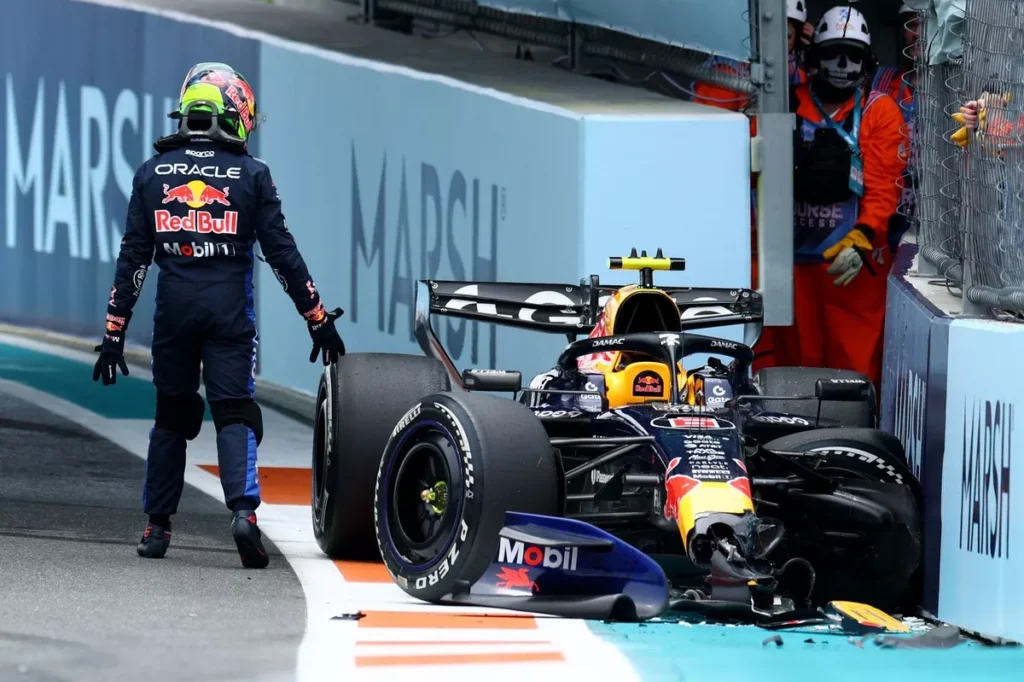
It is the kind of weekend that stays with a young driver. Isack Hadjar arrived in Miami for Round 4 of his debut season with the Red Bull senior squad carrying real momentum — a rookie campaign at Racing Bulls good enough to earn a promotion, and three solid if unspectacular rounds in the RB22 to start the year. By Sunday evening in Florida, he had been disqualified from qualifying, had suffered a straight-line speed deficit that crippled his entire weekend, and had crashed out of the race on lap six while running 15th and climbing. He was seen beating the steering wheel in frustration as the car came to a halt.
And yet Laurent Mekies, Red Bull’s team principal, sat in front of the media on Sunday evening and said, without hesitation: “I don’t think we are worried.” The calm was not performative. It was the measured response of a team that knows exactly how much of what happened in Miami was caused by circumstances outside Hadjar’s control — and is honest enough to say so.
A Disaster in Three Acts
-
1
Sprint — Pace Deficit
Hadjar qualified ninth for the Sprint — seven places behind Verstappen, who lined up second. He finished ninth, holding his starting position but unable to make any impression on the field. Verstappen finished fifth. Mekies later revealed the team had identified a straight-line speed deficit on Hadjar’s car that was present for most of the weekend.
-
2
Qualifying — Disqualified for a 2mm Floor Infringement
Hadjar qualified ninth in the Grand Prix session — again well adrift of Verstappen’s second place. During post-qualifying scrutineering, FIA technical delegate Jo Bauer found that the left and right-hand side floorboards were protruding 2mm outside the reference volume defined in Article C3.5.5 of the 2026 technical regulations. Hadjar was disqualified and forced to start the Grand Prix from the pit lane.
-
3
Race — Crash on Lap 6
Starting from the pit lane, Hadjar made an impressive recovery, climbing to 15th by lap five. Over-eager in his pursuit of more positions, he clipped the inside wall at Turn 14, breaking his front-left suspension. The car was launched into the barrier at Turn 15 and his race was over. The crash triggered the Safety Car that eventually bunched the field together for the restart.
The Floorboard Infringement: “We Should Have Spotted It”
Red Bull were unambiguous on the question of the qualifying exclusion: it was a team error, not a driver one. Mekies confirmed that both Hadjar and Verstappen were running identical floorboard specifications. The difference was that Verstappen’s car passed scrutineering; Hadjar’s did not.
What the FIA found: Hadjar’s RB22 floorboards protruded 2mm beyond the reference volume on both the left and right-hand sides — a breach of Article C3.5.5 of the 2026 F1 Technical Regulations.
Same spec as Verstappen: Mekies confirmed both cars were on identical specifications. Red Bull failed to catch the discrepancy during their own pre-parc ferme checks.
No performance gain: Red Bull stated explicitly that no performance advantage was sought or gained from the infringement.
Easy to fix: Mekies described the issue as “painful, but easy to fix” — a simple measurement error in a routine compliance check, not a fundamental design problem.
“We made a mistake and we respect the decision of the Stewards. No performance advantage was intended nor gained from this error. We apologise to Isack, and to our fans and partners. We learn the hard way today but we will move forward.”
— Laurent Mekies, Red Bull Team Principal
The Hidden Problem: A Straight-Line Speed Deficit
The disqualification and the crash dominated the headlines, but Mekies revealed a third factor that compounded Hadjar’s weekend without attracting nearly as much attention: a straight-line performance deficit specific to Hadjar’s car that was present for most of the Miami weekend.
“We know we haven’t done everything perfectly on our side. Without giving away too many secrets, you may find out for yourselves that we have had a straight-line performance deficit on his behalf for most of the weekend. This has not helped the overall performance.”
— Laurent Mekies
Hadjar himself had flagged his inability to match Verstappen on the straights during qualifying, without knowing the specific cause. “I’m missing on every straight,” he said after the session. With Miami characterised by three long straights where DRS and raw top speed are decisive, a power-related deficit — whatever its precise nature — made Hadjar’s weekend significantly harder than it needed to be, independent of anything he did or did not do behind the wheel.
Hadjar’s Part: Over-Eagerness at the Wrong Moment
None of this absolves Hadjar of the mistake that ended his race. He was climbing through the field from the pit lane, had just overtaken Arvid Lindblad for 15th on lap five, and was sensing a chance for genuine points. The momentum of the recovery lured him into trying to extract just a little more from the car than the situation required — and the lap five crash was the result.
“I was too eager and too excited about making those moves and just ruined myself. It was easy to overtake and I should have been more cautious. There was no point trying to flirt with the limit in this corner. So I’m really, really pissed off.”
— Isack Hadjar, post-race Miami
Hadjar was candid and self-critical in equal measure. He did not use the team’s disqualification as an excuse for the crash. And he was honest about his general pace struggles across the full weekend — separately from the power deficit.
“It’s the first time I really struggle with my overall pace. This is new and I really need to dig deep because I don’t want another weekend like this.”
— Isack Hadjar
He was also clear-eyed about where those struggles came from. Miami, with its low-grip resurfaced track, high temperatures and specific corner profile, played to Verstappen’s strengths and exposed a weakness in Hadjar’s current repertoire. “Max is very good at adapting to these conditions,” he said. “In the corners I’ve made big progress compared to yesterday. I just couldn’t tidy it up like he did.”
Why Mekies Is Not Worried — And Button Agrees
Mekies’ refusal to panic about Hadjar’s Miami results is rooted in context rather than complacency. The Red Bull team principal is well aware of the pressure that falls on second drivers in the senior Red Bull seat — a seat that has claimed multiple careers since Daniel Ricciardo left in 2019. He also knows the difference between a driver having a bad weekend and a driver being the wrong driver.
“I don’t think we should qualify that as a worry. We had a tough weekend. In terms of driving and rhythm, he still didn’t get into the right rhythm. I think he would have been strong in the race, and was strong for the little he could have shown. We certainly didn’t have a clean weekend. We didn’t help him either by sending him from the back of the grid after our mistake with the legality of the car. So no, not worried. Not a clean weekend, but there is every indication that we’ll be in the right speed again in Montreal.”
— Laurent Mekies
Former world champion Jenson Button, analysing the weekend for Sky Sports F1, echoed the same verdict. Button pointed to Hadjar’s debut season at Racing Bulls, which began with a crash during the formation lap before the Australian Grand Prix — a moment that reduced the then-rookie to tears — before producing one of the strongest rookie campaigns of recent years. “Before the first race of last season, he put it in the wall before the start of the race,” Button said. “He came back absolutely fine.”
- Shared responsibility: The disqualification was a team error. The straight-line deficit was a team problem. Only the crash itself was a driver mistake — and even that came in unusual circumstances from the pit lane.
- Track-specific context: Miami’s resurfaced, low-grip surface played to Verstappen’s specific strengths. Hadjar is acknowledged to struggle more with circuits that require this type of adaptation — it is a known developmental area, not an unknown weakness.
- Proven resilience: Hadjar’s career has already shown he can absorb disasters and respond. His debut season — which began with a pre-race crash in Australia — produced the performances that earned him this seat in the first place.
Hadjar himself was itching to find out where his true pace would have taken him in the race. “Honestly, I’m itching to get back to it right now,” he said. The raw speed shown in his opening laps from the pit lane — before concentration lapsed for one costly moment — suggested a driver genuinely on the edge of something more. Montreal, in three weeks, will offer the chance to find out what that looks like when everything goes right.
Sources
- Motorsport.com — Why Red Bull isn’t worried about Hadjar’s Miami disaster
- Motorsport.com — Hadjar explains how he went from “flying” to hitting the wall
- Formula1.com — Hadjar disqualified from Miami GP qualifying
- Formula1.com — “This one really hurts” — Hadjar laments very silly mistake
- Sky Sports F1 — Verstappen sees “light at end of tunnel” as Hadjar endures nightmare
- Pit Debrief — Mekies: Red Bull contributed to Hadjar’s difficult Miami weekend
- PlanetF1 — Hadjar “p*ssed off a lot” after Red Bull Miami “disaster”
- Crash.net — Should Hadjar’s Miami nightmare concern Red Bull?
Discover more from f1liveupdates.com
Subscribe to get the latest posts sent to your email.