Hamilton Embraces ‘Mario Kart’ F1 — and Explains Why It’s Working
As Max Verstappen continues to denounce the 2026 regulations as a joke, Lewis Hamilton is going the other way — insisting the back-and-forth, battery-powered racing is exactly what Formula 1 has been missing for years.
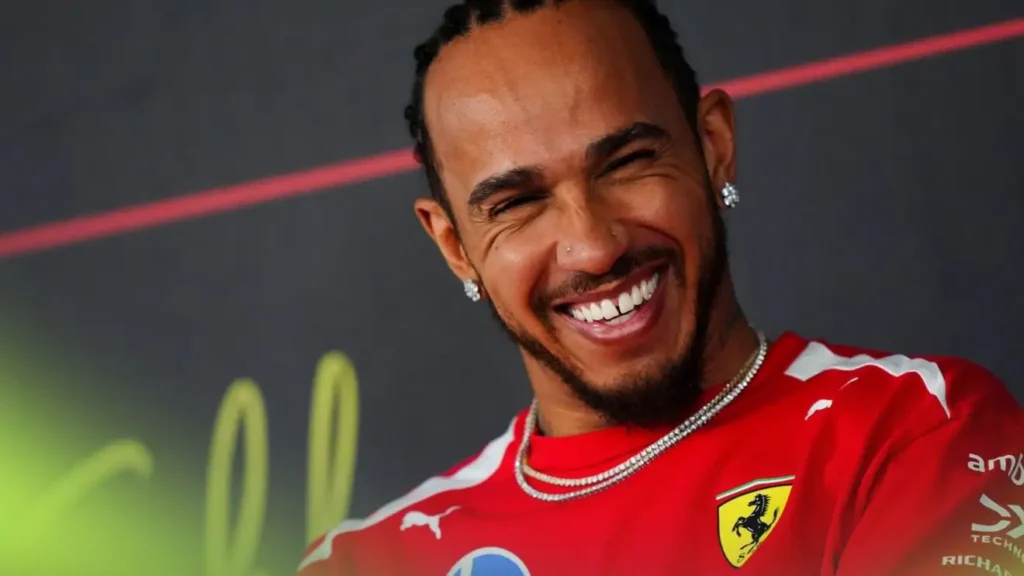
The phrase “Mario Kart” has become the defining insult of Formula 1’s new era. Coined by Max Verstappen at the Chinese Grand Prix to describe the battery-dependent, back-and-forth overtaking that has characterised the 2026 season’s opening rounds, it landed hard — and stuck. But at Suzuka on Thursday, ahead of the Japanese Grand Prix, Lewis Hamilton stepped forward with a very different verdict. For the seven-time world champion, what his critics call yo-yo racing is, in fact, the closest Formula 1 has come to real racing in a very long time.
Two Champions, Two Worlds Apart
The gap between Verstappen’s view and Hamilton’s could scarcely be wider. At the heart of the debate is the 2026 power unit architecture — a 50-50 split between internal combustion and electrical power that places unprecedented importance on battery deployment. When a driver activates Straight Mode (SM), the aggressive electrical boost propels their car past rivals on straights. But as the battery depletes, the advantage evaporates, and the car behind charges back. To Verstappen, that is anti-racing — a gimmick dressed up as competition.
Max Verstappen
“It’s not fun at all. It’s playing Mario Kart. You are boosting past, then you run out of battery the next straight, they boost past you again. For me, it’s just a joke.”
Lewis Hamilton
“People going back and forth — no one has ever referred to go-karting as yo-yo racing. It’s the best form of racing. Formula 1 has not been the best form of racing in a long time.”
Hamilton’s counter-argument is rooted in his decades at the wheel. Speaking in Suzuka, the Ferrari driver pointed to the fundamental problem of the preceding regulatory era: cars so aerodynamically sensitive that following another closely was all but impossible. The DRS drag reduction system was, in his view, a patch on a structural flaw — a manufactured overtaking mechanism for a category that had accidentally engineered real racing out of itself.
“Out of all the cars that I’ve driven in 20 years, this is the only car that you can actually follow through high speed and not completely lose everything that you have. You can stay behind it.”
— Lewis Hamilton, Suzuka, 26 March 2026
A Personal Context That Matters
It would be easy to dismiss the Hamilton-Verstappen divide as two drivers on opposite ends of the competitive spectrum finding ways to frame their circumstances. Verstappen’s Red Bull has struggled badly with the new regulations; the Dutchman is operating well outside his comfort zone. Hamilton, meanwhile, has had a hand in developing Ferrari’s SF-26 since arriving at Maranello — and it shows. After a career-worst 16-month podium drought that stretched through most of 2025, he ended the sequence in China with a third-place finish behind the two Mercedes drivers, his best result since joining Ferrari.
Yet Hamilton has been careful not to reduce his argument to a simple defence of his own position. He acknowledged that he initially had concerns about the complexity of the 2026 cars himself — comparing them, at one point during pre-season testing, to GP2-level machinery. His change of heart, he has suggested, came from actually racing wheel-to-wheel at the front again: the most overtaking, he said at Suzuka, and the best battles he has experienced since his early rivalry with Nico Rosberg at Mercedes.
“I personally find it much more fun. That’s the most overtaking and best battle I’ve had since Bahrain years and years ago with Nico. But that’s how racing should be.”
— Lewis Hamilton, Suzuka, 26 March 2026
Not Without Reservations
Hamilton was at pains to avoid painting an entirely rosy picture. His enthusiasm for the racing spectacle does not extend to every aspect of the new technical framework. He said he was “really disappointed” by the power deployment characteristics, and that he did not particularly enjoy the active aerodynamics Straight Mode system either. His endorsement is of the product — the racing that results — rather than a wholesale celebration of the engineering that produces it.
Hamilton’s 2026 season in context
- Australia: Fourth place — best Ferrari start since joining the team
- China Sprint: Competitive weekend, P3 finish in the Grand Prix — first Ferrari podium
- End to a 16-month podium drought, his longest since entering F1
- Already as many points after two rounds in 2026 as after five rounds in 2025
- Ferrari still trailing Mercedes significantly in both qualifying and race pace
What It Means Going Into Suzuka
The Japanese Grand Prix this weekend adds a new dimension to the debate. Suzuka features only two Straight Mode sections — compared to four in Australia — which is expected to reduce Mercedes’ power unit advantage on the straights. Hamilton noted that this could be a positive for Ferrari, though he was cautious about predicting an upset, acknowledging that Mercedes and Ferrari appear closely matched through high-speed corners. The FIA has also reduced the maximum energy recharge for qualifying at Suzuka to limit the impact of super clipping — an early energy harvesting tactic that has become a key strategic variable in the new era.
Verstappen, for his part, shows no sign of softening his position. Former drivers including Alex Wurz and Johnny Herbert have publicly suggested he adapt rather than agitate, noting that significant regulatory changes before 2027 are unlikely. The paddock remains split. But Hamilton’s voice — that of a driver in form, on a competitive car, who raced through the DRS era and the ground-effect era and now finds himself genuinely enjoying what comes next — carries a particular weight in the argument.
Discover more from f1liveupdates.com
Subscribe to get the latest posts sent to your email.