The FIA Steps In: Ferrari and Red Bull’s Rotating Wings Under Safety Scrutiny
Two Verstappen crashes in two weekends have done what rival protests couldn’t: dragged the sport’s most radical aerodynamic concept into formal safety talks with the governing body.
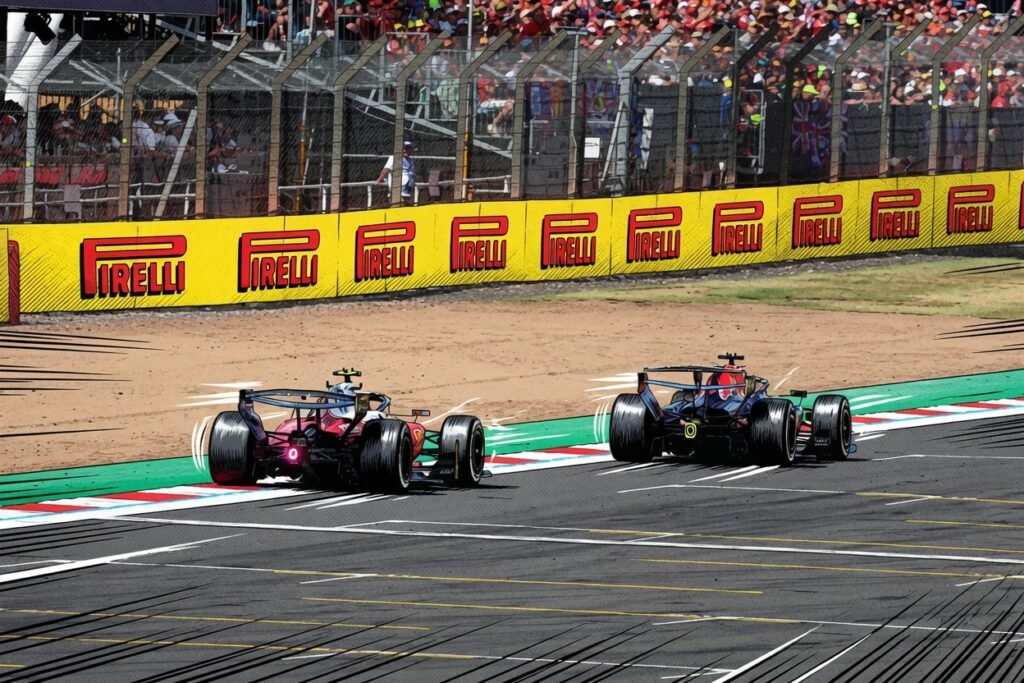
The ‘Macarena’ rear wing has spent 2026 as Formula 1’s most talked-about piece of engineering — admired, copied, and occasionally mocked for the dance-move rotation that earned it its nickname. As of this week, it’s also the subject of formal safety scrutiny. The Race has revealed that the FIA is now in talks with technical chiefs at both Red Bull and Ferrari — the only two teams currently racing revolving rear wing designs — after Max Verstappen’s second wing-related crash in as many race weekends convinced the governing body it needs a deeper understanding of how these systems behave, and whether intervention is required before anyone gets hurt.
What triggered the probe
The tipping point was Silverstone. Verstappen’s late-race spin into the Stowe gravel — while running third, four laps from home — was traced to his rear wing failing to fully reattach at the end of a straightline-mode zone. It came a week after a separate airflow reattachment problem pitched him off at the penultimate corner of Austrian GP qualifying. Two high-speed accidents, one component, and a driver publicly calling the situation “super dangerous” proved impossible for the governing body to leave solely in Red Bull’s hands.
Well, at that point it’s super dangerous, because you can really hurt yourself — two times! I was lucky in Austria, I was lucky here, but that’s why you get really fed up with it. — Max Verstappen, Red Bull driver
Notably, the talks encompass Ferrari as well — despite the Scuderia having suffered no major failure with its own version since introducing it. The logic is straightforward: the FIA isn’t investigating one team’s quality control, it’s evaluating a concept. And only two teams on the grid race wings whose upper flaps rotate this dramatically.
What makes these wings different
Under 2026’s active aerodynamics rules, every car switches between a high-downforce corner mode and a low-drag straightline mode. Most teams achieve this with relatively conventional flap movement. Ferrari and Red Bull went radically further: their upper flaps rotate through enormous sweeps — Ferrari’s is believed to turn roughly 270 degrees in one direction, Red Bull’s around 160 degrees the opposite way — effectively flipping the wing upside down. The payoff is a dramatic drag reduction, to the point of generating a small amount of lift that helps counteract rolling resistance on the straights.
The regulations impose two critical constraints. The transition between modes must complete within 400 milliseconds, and the rules explicitly require that “failure of the system will result in it returning to its corner mode position” — the safe, high-downforce state. Verstappen’s incidents suggest that on the Red Bull, at least, that guarantee hasn’t been holding in practice: twice, the wing has failed to properly return to corner mode exactly when the driver needed downforce most.
What the FIA can do
- The current talks are exploratory — reviewing wing behaviour data with both teams’ technical chiefs.
- The FIA could mandate extra safety measures, through mechanical changes or revised corner-entry behaviour.
- Article C1.2 of the technical regulations allows stewards to ban any car “whose construction is deemed to be dangerous” — with immediate effect if evidence emerges mid-session.
- Both designs were approved by the FIA before racing, including safety demonstrations.
An awkward asymmetry between the two teams
For Ferrari, the probe arrives as an unwelcome complication to a concept that has, by all outward evidence, worked flawlessly. The team was famously cautious with its introduction: the wing appeared in pre-season testing and Chinese GP practice, was shelved because Ferrari wasn’t completely certain it would run faultlessly, and only returned for good at Miami. That patience has paid off in reliability — no major failures since.
Red Bull’s version, developed from November 2025 and also delayed (from an intended Melbourne debut to Miami) over readiness concerns, has now produced two of the season’s scariest moments. Team principal Laurent Mekies has already conceded that reverting to a conventional wing for Spa is among the options being weighed, while stressing it’s too early to conclude whether the concept itself or its execution is at fault. The FIA’s involvement adds a new dimension to that decision: even if Red Bull satisfies itself, it must now satisfy the regulator too.
The stakes stretch beyond two teams
Hovering over the talks is a third party: McLaren, which has built its own rotating wing, brought it to Austria without racing it, and had been eyeing a debut potentially as soon as Spa. Any FIA intervention aimed at the concept rather than one team’s implementation would land on three championship-contending aerodynamic programmes at once — in the middle of a title fight spanning three drivers from two teams. Formula 1’s history with clever aerodynamic ideas is consistent on this point: they tend to survive until they produce a visible, television-friendly failure, and then get legislated quickly regardless of who engineered them best.
- The FIA has been involved with both designs since their inception, making this a review of real-world behaviour rather than initial legality.
- The 400-millisecond transition requirement and mandatory fail-safe return to corner mode are the rules under the microscope.
- McLaren’s own rotating wing has yet to race; Spa could mark its debut — or its indefinite postponement.
- The Belgian Grand Prix, F1’s most demanding high-speed test, runs July 17-19.
The most likely outcome remains a quiet one: reinforced components, adjusted transition behaviour, and racing resuming as normal. But the mere existence of formal safety talks changes the calculus for everyone involved. A concept that began the season as 2026’s great engineering flex now has eleven days to convince the governing body it deserves to survive contact with Eau Rouge.
Discover more from f1liveupdates.com
Subscribe to get the latest posts sent to your email.