Where the Lap Was Won: Antonelli’s Silverstone Pole, Decoded Sector by Sector
Leclerc had the first sector. Antonelli had everything that mattered after it. A telemetry breakdown of how 0.175s was built — and lost — across one lap of Silverstone.
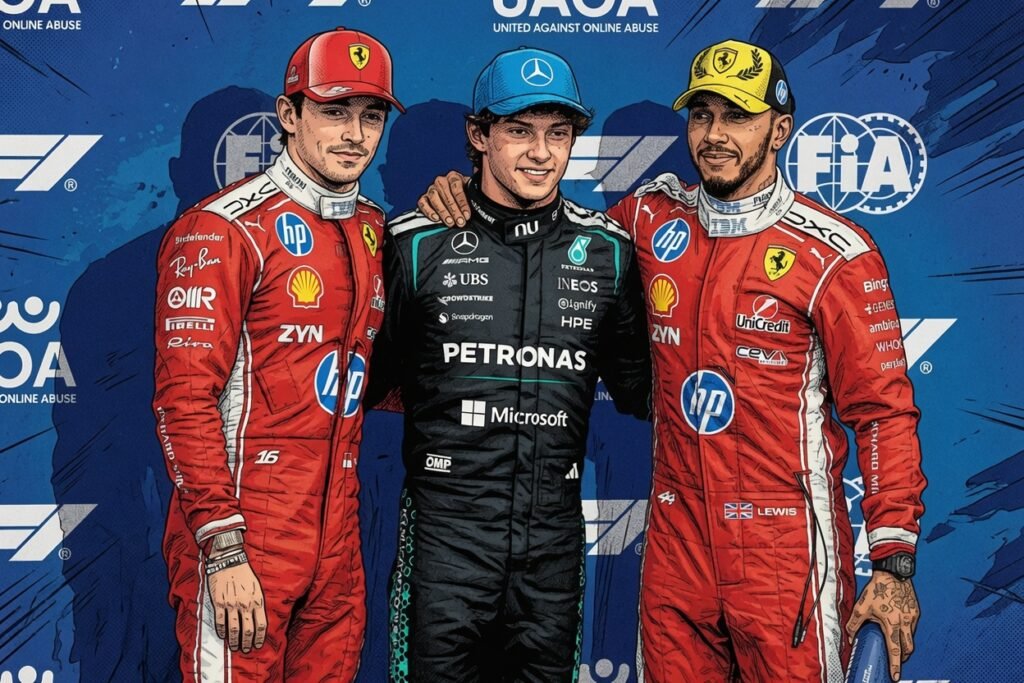
A pole lap is rarely won everywhere at once. It is assembled in fragments — a later brake here, a cleaner exit there, a few kilometres per hour carried through a corner nobody notices on television. At Silverstone, Kimi Antonelli assembled his 1:28.111 in exactly that way: not by dominating the lap, but by winning the two-thirds of it that counted most. Ferrari’s Charles Leclerc came within 0.175s, and the telemetry explains precisely where those thousandths appeared and vanished.
| Pos | Driver | Sector 1 | Sector 2 | Sector 3 | Lap |
|---|---|---|---|---|---|
| 1 | Antonelli | 28.348 | 35.521 | 24.242 | 1:28.111 |
| 2 | Leclerc | 28.292 | 35.614 | 24.380 | 1:28.286 |
| 3 | Hamilton | 28.345 | 35.749 | 24.364 | 1:28.458 |
The story lives in that grid. Leclerc was quickest through the opening sector — 28.292s, a slender 0.056s clear of Antonelli. Yet by the flag the Ferrari had conceded nearly two tenths, because Antonelli owned both remaining sectors outright: fastest in the middle sector by 0.093s over Leclerc, and fastest again in the final sector. The pole was a second-and-third-sector lap. Everything before that was Ferrari’s.
Sector One: Leclerc’s Fleeting Advantage
Through the fast, flowing early section — from the run down to Village and the Loop into the Wellington Straight — Leclerc’s Ferrari was in its element. The SF-26’s strength in slow and medium-speed direction changes let him carry rhythm through the first cluster of corners, and the telemetry shows it: at the heavy stop for the Village hairpin, around the 800-metre mark, all three were braking from a similar entry speed, but Leclerc’s line was tidy and his minimum competitive.
Antonelli, by contrast, attacked that same braking zone more aggressively. The Mercedes carried the highest entry speed into the corner and leaned harder on the brakes later — a more committed stop that cost a fraction on entry stability but set up the exit he needed. It was the first sign of a recurring theme: Antonelli sacrificing nothing on the brakes to protect what came after.
Key Performance Zones — Sector 1
Top Speed — run to Brooklands
317 km/hAntonelli’s peak, marginally ahead of Leclerc (316 km/h) and Hamilton (315 km/h), reached around the 2,800-metre mark. With the 2026 cars no longer relying on movable rear-wing assistance, the Mercedes edge at the trap reads as a cleaner drag-and-deployment result — a notable data point given the scrutiny over Ferrari’s energy usage.
Sector Two: The Lap Swings
The middle sector is where Silverstone bares its teeth — Maggotts, Becketts, Chapel — and it is where the pole was truly forged. Antonelli’s 35.521s was the fastest of anyone through this stretch, and it flipped Leclerc’s early advantage on its head in the space of a few corners, as the delta trace above makes plain.
Telemetry through the high-speed esses tells the tale. Where Leclerc had to manage a lower minimum speed through one of the quick right-handers — dipping into the 230s (km/h) at a point Antonelli held higher — the Mercedes flowed through the sequence with less scrubbed speed. Carrying even a handful of extra km/h through corners taken near 250 km/h compounds instantly down the following straights. That is the mechanism behind Antonelli’s 0.093s gain over Leclerc here, and the far larger 0.228s he took out of Hamilton.
Sector 2 — Minimum Speed Comparison (Maggotts–Becketts)
| Driver | Maggotts | Becketts | Chapel | Sector Time |
|---|---|---|---|---|
| Antonelli | 248 km/h | 251 km/h | 246 km/h | 35.521 |
| Leclerc | 245 km/h | 247 km/h | 242 km/h | 35.614 (+0.093) |
| Hamilton | 243 km/h | 244 km/h | 240 km/h | 35.749 (+0.228) |
They’ve been on the back foot with the PU and energy management — and here they look the best at the moment. That’s been a real surprise.
— George Russell, Mercedes
Sector Three: Sealing It Under Braking
If the middle sector won Antonelli the lap, the final sector confirmed it. He was quickest here too, clawing another tenth-and-a-bit from Leclerc through the closing complex around Vale and Club. The braking data is revealing: into the final heavy stop near the 5,400-metre mark, Antonelli used a noticeably shorter braking zone than Hamilton, hauling the car down over roughly 70 metres against the Ferrari’s near-80, then firing out with a cleaner exit onto the line.
Final Braking Zone — Vale to Club (5,400 m)
Leclerc, meanwhile, gave a little back in this phase — his minimum speeds through the last corners sat marginally lower than Antonelli’s, and small deficits on corner exit translate directly into lap time when there is barely any straight left to recover them. The margin at the flag, 0.175s, was essentially the sum of the middle and final sectors minus Leclerc’s opening gain.
Speed Trap & Sector 3 Data
| Metric | Antonelli | Leclerc | Hamilton |
|---|---|---|---|
| Speed Trap (km/h) | 317 | 316 | 315 |
| Sector 3 Time | 24.242 | 24.380 | 24.364 |
| Vale Min Speed | 134 km/h | 131 km/h | 132 km/h |
| Club Exit Speed | 187 km/h | 183 km/h | 185 km/h |
- Sector 1 — Leclerc: +0.056s over Antonelli. Ferrari’s chassis shines in the early medium-speed corners.
- Sector 2 — Antonelli: fastest, +0.093s on Leclerc through Maggotts–Becketts, carrying more mid-corner speed.
- Sector 3 — Antonelli: fastest, sealed with a shorter, later braking phase into the final complex.
- Trap speed: Antonelli 317 km/h vs Leclerc 316, Hamilton 315 — Mercedes edging it on pure straightline efficiency and energy deployment.
The Sprint Contrast — and What It Means
This qualifying picture is all the more striking set against Saturday’s sprint qualifying, where the order was reversed and Hamilton edged Antonelli to pole by a barely perceptible 0.011s. Two shootouts, two different verdicts, on the same asphalt within roughly twenty-four hours — a vivid illustration of how tightly matched Mercedes and Ferrari have become, and how sensitive the balance is to the smallest set-up shift.
Antonelli himself pointed to that knife-edge after the sprint session, describing how a single balance adjustment transformed his car from awkward to alive between segments. The qualifying telemetry suggests he and Mercedes found that window again when it mattered most.
SQ3 there was a little bit left on the table, but it was a decent lap and unfortunately it was super close to Lewis — of course, congrats to him.
— Kimi Antonelli, Mercedes (on sprint qualifying)
The Bigger Technical Question
Beneath the lap times sits an unresolved argument. Ferrari’s new engine, introduced in Austria under the FIA’s first quarterly Additional Development and Upgrade Opportunities allowance, arrived amid pointed questions from Mercedes boss Toto Wolff about how the Scuderia is funding its upgrade path within the budget cap — questions that visibly irritated Ferrari’s Frédéric Vasseur.
Silverstone offered a partial answer. The SF-26 remains formidable through slow and medium-speed corners, exactly as its Sector 1 pace suggested, yet it still appears to lack a touch in electrical deployment — and it was in the high-speed, energy-hungry middle sector that Mercedes decisively pulled the lap back. For a circuit that starves the power unit of harvesting opportunities from Luffield onwards, and where the FIA trimmed the qualifying recharge ceiling to 6.5 megajoules, that is a telling place to lose time. The pole belonged to Antonelli. The wider battle, on this evidence, belongs to no one yet.
Sources
- Motorsport.com — What disappointed Kimi Antonelli after being beaten to pole position in British GP sprint qualifying
- Formula1.com — Antonelli seizes pole position in British GP Qualifying
- GP Tempo — 2026 United Kingdom Qualifying telemetry: sectors, speed, braking (ANT / LEC / HAM)
- FIA — Official British Grand Prix regulations and technical documentation
Discover more from f1liveupdates.com
Subscribe to get the latest posts sent to your email.