“It’s Gone“: Alonso Says 2026 Regulations Have Killed the Suzuka Challenge
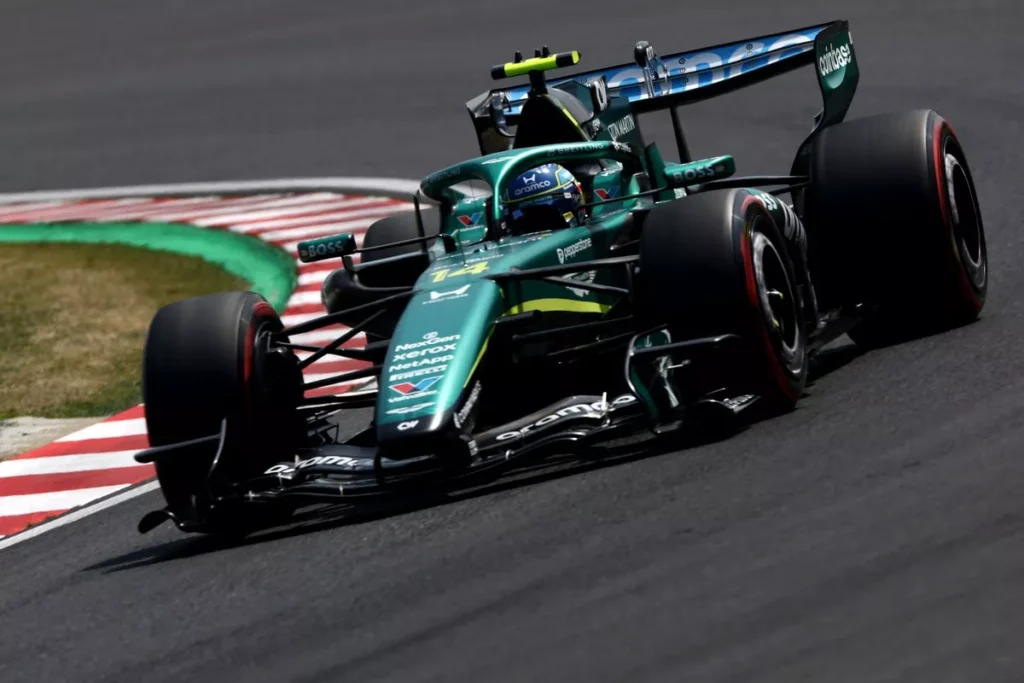
After qualifying 21st at the Japanese Grand Prix, Fernando Alonso delivered one of the most withering verdicts on F1’s new era: Suzuka’s iconic high-speed corners no longer test driver skill — they are simply charging stations for the battery.
For decades, Suzuka has been regarded as Formula 1’s ultimate driver’s circuit. The Esses, Dunlop, Degner, the fearsome 130R — a sequence of high-speed corners that demands commitment, precision, and a willingness to trust the car at speeds that leave no margin for error. Ask any driver across any generation which circuit they love most, and the same name comes back. It is the place where champions are made and reputations cemented. After Saturday’s qualifying session at the 2026 Japanese Grand Prix, Fernando Alonso had two words for all of that. “It’s gone.”
Corners as Charging Zones
The root of the problem lies in how the 2026 power unit architecture interacts with circuit layout. Under the new regulations, cars operate with a 50-50 split between internal combustion and electrical power, with electrical energy harvested through braking and deceleration. At Suzuka, a circuit defined by flowing high-speed sweeps rather than heavy braking zones, there are simply not enough opportunities to replenish the battery through conventional means. The consequence is that drivers are forced to harvest energy in the worst possible place — the fast corners themselves — by lifting off the throttle and coasting rather than pushing flat to the limit of grip.
“High-speed corners now became the charging station for the car. You go slower, you charge the battery in the high-speed, and then you have the full power on the straight. Driver skill is not really needed anymore.”
— Fernando Alonso, Suzuka, 28 March 2026
Alonso had flagged this problem as early as pre-season testing in Bahrain, where he joked that Aston Martin’s team chef could drive the car through the high-speed Turn 10/11 complex given how far below the limit of grip drivers were forced to operate. At Suzuka, the joke became something grimmer. Qualifying 21st — almost 2.8 seconds behind pole-sitter Kimi Antonelli — the double world champion arrived at the post-qualifying media pen with nothing left to soften.
“Maybe not the chef, but 50% of the team members, I think, at least can drive in Suzuka. So, yeah, no more challenge in the high-speed.”
— Fernando Alonso
A Paddock-Wide Complaint
Alonso was not alone. The post-qualifying press pen was filled with drivers from across the grid lamenting the same paradox: the faster you push through corners at Suzuka, the more battery energy you consume, and the slower you go on the straights that follow. Reigning champion Lando Norris, who has generally been more measured in his criticism of the 2026 rules, described watching his McLaren’s top speed drop dramatically as his battery depleted as something that “hurts your soul.” Carlos Sainz went further, saying that on his qualifying lap, pushing harder in corners had actually made him slower overall — a fundamental inversion of how racing lap times are supposed to work.
Lando Norris (#1 — McLaren)
“It still hurts your soul when you see your speed dropping so much — 56 km/h down the straight.”
Carlos Sainz — Williams
“Super clipping, lift and coast — overall not good enough for F1. I went faster in the corners and finished the lap slower.”
Alex Albon — Williams
“You can be quicker in every corner and finish the lap slower because obviously there’s a penalty to be applied. It is frustrating.”
Ollie Bearman — Haas
“It’s a lot less rewarding to do a good lap in Suzuka than it was last year. The amount of management is a bit frustrating.”
The FIA’s Response — and Its Limits
Ahead of the Suzuka weekend, the FIA attempted to partially address the issue by reducing the maximum energy available in qualifying from 9MJ to 8MJ, aiming to limit the most extreme instances of coasting and so-called super clipping — the technique of harvesting energy while nominally on the throttle. Ferrari’s Charles Leclerc acknowledged the intervention had helped at the margins. But as Alonso noted, it was nowhere near enough. The underlying problem — that the regulation architecture inherently rewards energy conservation over flat-out commitment in high-speed sections — cannot be solved by adjusting a single harvesting parameter.
Japanese GP 2026 — Qualifying Results (selected)
| Pos. | Driver | Team | Gap to pole |
|---|---|---|---|
| 1 | Kimi Antonelli | Mercedes | 1:28.778 |
| 2 | George Russell | Mercedes | +0.298s |
| 3 | Oscar Piastri | McLaren | — |
| 4 | Charles Leclerc | Ferrari | — |
| 5 | Lando Norris | McLaren | — |
| 6 | Lewis Hamilton | Ferrari | — |
| 11 | Max Verstappen | Red Bull | — |
| 21 | Fernando Alonso | Aston Martin | 1:32.646 |
A Systemic Problem Without a Quick Fix
Alonso was pessimistic about whether the situation could be corrected through regulation. The architecture, he suggested, will always favour straight-line energy economy over corner-speed commitment. Lewis Hamilton, when asked about the prospects for improvement ahead of the Miami Grand Prix, was equally downbeat: too many teams now have vested interests in keeping the current formula intact — particularly those, like Mercedes, who have built a dominant advantage around it.
The irony of Suzuka hosting this particular crisis was not lost on the paddock. A circuit specifically designed to be the ultimate test of driving skill and mechanical grip — one that Alonso himself has described as his favourite — laid bare, more clearly than any previous round, the tension at the heart of Formula 1’s new era. The racing has been more exciting. The qualifying laps have been less so. And for a driver of Alonso’s vintage, watching one of the sport’s most sacred challenges reduced to an exercise in battery management is, by his own admission, a loss the sport may struggle to recover.
Discover more from f1liveupdates.com
Subscribe to get the latest posts sent to your email.