
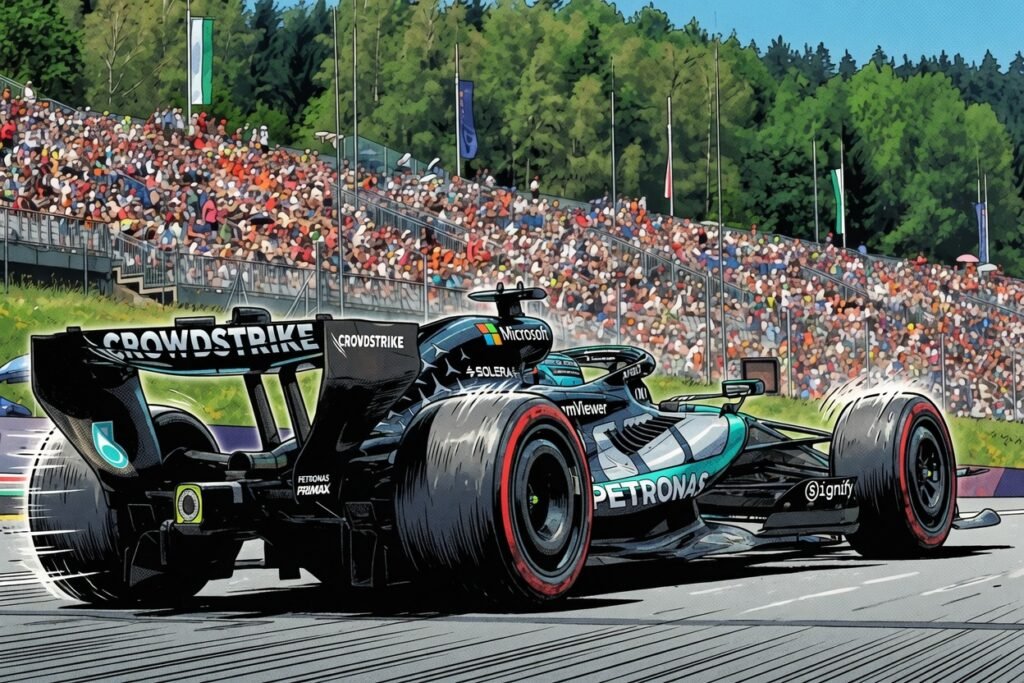
Mercedes Found More Power Without Even Touching Its Engine Upgrade
Mercedes qualified for a mid-season engine upgrade under F1’s new catch-up system. It chose not to use it — and still arrived in Austria with a sharper power unit than before.
When the FIA ruled that Mercedes’ internal combustion engine was more than two percent adrift of Red Bull’s benchmark, it handed Toto Wolff’s team a genuine prize: one homologated engine upgrade for 2026, and another banked for 2027. Ferrari, Audi and Honda received two apiece, judged to be even further behind. For a team that has dominated the opening half of the season, the temptation to bank the allowance and move straight to closing out the championship would have been understandable. Instead, at the Red Bull Ring, George Russell and Andrea Kimi Antonelli were given fresh internal combustion engines, turbochargers, batteries and control electronics — and none of it was the upgrade Mercedes is entitled to.
That distinction matters more than it might first appear. What arrived in Austria wasn’t a new specification chasing extra horsepower; it was simply new hardware, built to the same design Mercedes has run all season. The team is, for now, sitting on its ADUO token entirely untouched.
New parts, same performance envelope — officially
Asked directly whether the components introduced in Austria carried any performance development, team principal Toto Wolff was unambiguous.
No, they were just new power units. With that comes less mileage, comes a little bit more spiciness. — Toto Wolff, Mercedes Team Principal
The phrase is telling. Fresh components without the accumulated wear of a power unit run deep into its life cycle naturally deliver a touch more performance, even with zero specification change. Layer in a program of reliability revisions — particularly around the battery, which had been a recurring point of vulnerability earlier in the season — and Mercedes arrives at a power unit that behaves a little better without officially becoming a different one. It is, in effect, gaining ground while the regulations still class it as standing still.
Why Mercedes is in no hurry to spend its upgrade
The logic behind holding back is partly strategic and partly a question of where Mercedes believes its real advantage lives. The ADUO Performance Index that determines these rankings looks exclusively at the internal combustion engine — torque, engine speed, MGU-K power and lap-time sensitivity. It does not account for the battery, the energy recovery system, or how effectively a team deploys stored electrical power, even though those elements make up close to half of a 2026 power unit’s total output.
By most outside assessments, that electrical half is precisely where Mercedes has built its cushion. Having won the majority of races so far this season, the team’s advantage appears to sit less in raw combustion output and more in how intelligently it manages deployment lap after lap — an area the current ADUO framework doesn’t measure at all.
The numbers behind the ruling
- Red Bull was rated Formula 1’s benchmark engine and receives no ADUO allowance.
- Mercedes was judged over 2% adrift, earning one 2026 upgrade and one for 2027.
- Ferrari, Audi and Honda were judged over 4% adrift, each earning two upgrades across 2026 and 2027.
- ADUO grants are not cumulative — each manufacturer qualifies only once per assessment window.
A ranking that surprised the paddock
The finding itself raised eyebrows before the strategic implications even entered the conversation. Red Bull, making its first power unit in-house, emerged as the top-rated internal combustion engine — ahead of a Mercedes that had won every race until Barcelona. Red Bull team principal Laurent Mekies has voiced concern about what that ranking could mean long-term: if his engine is judged best on paper but the car keeps losing on Sunday, Red Bull risks being locked out of any development opportunity while rivals continue to close the on-track gap through means the index doesn’t capture.
Red Bull has since sought clarification from the FIA and is understood to be contesting the Monaco-derived data, with the governing body expected to talk the team through its methodology. The underlying finding, however, is expected to stand.
What this means for the rest of the season
Mercedes’ patience carries a clear calculation. Every upgrade a rival introduces under ADUO is measured only against Red Bull’s combustion benchmark — it says nothing about whether that rival can actually close the deployment gap to Mercedes on track. Ferrari’s engine upgrade at the very same Austrian weekend produced a difficult, underwhelming race, a reminder that ADUO gains on paper don’t automatically translate into pace on Sunday.
For Mercedes, holding the token back keeps options open. The next assessment window runs through to the Hungarian Grand Prix at the end of July, and a further one follows later in the year. Should a rival genuinely close the ICE gap, Mercedes retains the flexibility to respond. Should nobody manage it, the team simply carries its allowance forward, banking reliability gains in the meantime without ever touching its frozen specification.
- Mercedes remains the only front-running manufacturer yet to use its 2026 ADUO allowance.
- Fresh, low-mileage components delivered a small performance gain without any specification change.
- Battery reliability revisions target the issues that cost Mercedes results earlier in the season.
- The next ADUO assessment window closes after the Hungarian Grand Prix in late July.
It is an unusual position for a manufacturer to be in: eligible for a regulatory boost, and choosing to sit on it. But with the championship largely running Mercedes’ way and its true advantage sitting somewhere the rulebook doesn’t measure, there is little reason for Wolff’s team to rush a card it may not need to play at all.
Discover more from f1liveupdates.com
Subscribe to get the latest posts sent to your email.