
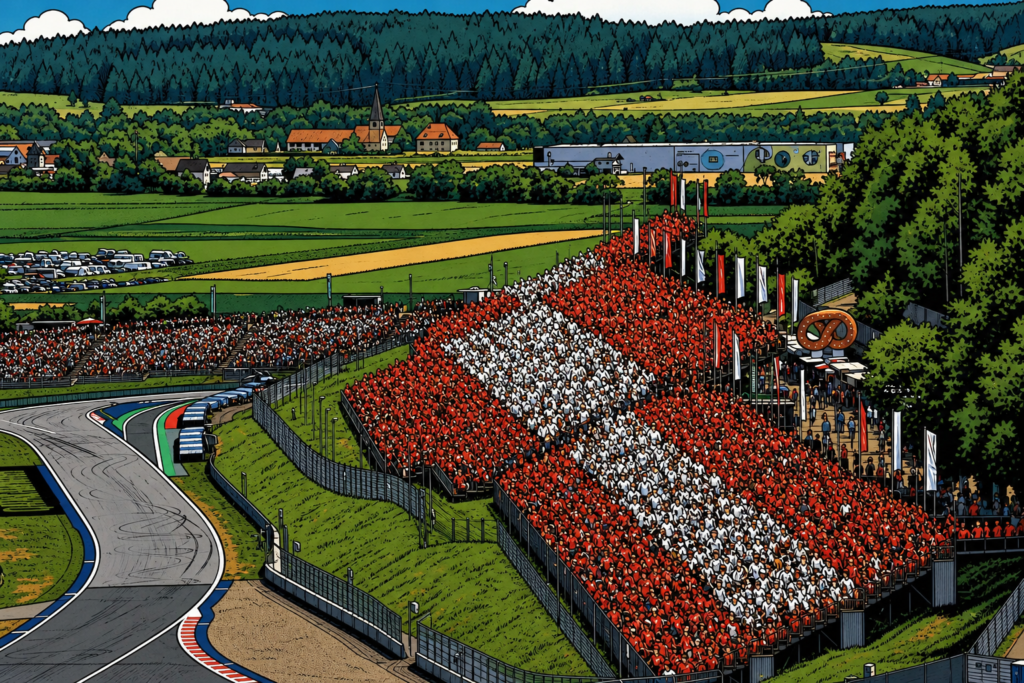
Austria’s High-Altitude Unknown Could Shake Up F1’s 2026 Engine War
The Austrian Grand Prix will give Formula 1’s new 2026 power units their first major high-altitude test, adding a fresh unknown to a weekend already shaped by engine upgrades, active aero and Red Bull Ring efficiency demands.
Formula 1’s 2026 Austrian Grand Prix already looked like an important performance test. Ferrari is chasing an ADUO-assisted engine step, McLaren is preparing a radical rear wing, and the Red Bull Ring’s short, power-sensitive layout gives teams little room to hide.
But there is another variable that may matter just as much: altitude. The Red Bull Ring sits 678 metres above sea level, and that thinner air will give the new 2026 power units a challenge they have not yet faced in race conditions.
Key unknown: First high-altitude race test for the 2026 power units.
Circuit: Red Bull Ring, Spielberg.
Altitude: 678 metres above sea level.
Air effect: Around 7.5–8.5% thinner than sea-level conditions.
Technical concern: Turbo response, heat, battery use and energy deployment.
Why Austria Is Different in 2026
The Red Bull Ring has always been a power-sensitive circuit, but the 2026 regulations make its altitude more significant. With thinner air, there are fewer oxygen molecules entering the engine for the same volume of air. That means turbochargers must work harder to compress enough air into the combustion engine.
In previous hybrid seasons, the MGU-H helped manage turbo response and reduce lag. That component has disappeared under the 2026 rules, creating a new challenge for manufacturers trying to maintain driveability and efficiency at altitude.
Austria is not only a power test. In 2026, it becomes a test of how well each manufacturer can make its turbo system behave without the MGU-H safety net. F1LiveUpdates analysis
The MGU-H Absence Changes the Equation
Honda’s trackside general Shintaro Orihara explained to The Race that the lack of MGU-H assistance could make it more difficult to operate the turbocharger and engine correctly at high altitude. That is a major technical shift.
Without the MGU-H, teams may need to use some of their limited battery power to cover turbo lag when drivers accelerate out of slow corners. That can help traction and response, but it risks draining energy before the end of the straights.
The Core Trade-Off
Teams can use battery energy to mask turbo lag out of corners, but doing so may leave them short of deployment later in the lap. At Austria, that compromise could decide qualifying and race pace.
Austria Is Already Energy-Starved
The Red Bull Ring’s lap is short, but it contains several heavy acceleration zones. That makes energy management crucial. According to The Race, Austria is already one of the more energy-starved tracks of the season, with only 6MJ allowed to be used in qualifying.
That means the altitude problem is not isolated. It interacts with deployment limits, turbo response and straight-line efficiency. A car that feels strong out of Turn 3 may pay the price later if it runs out of electrical support before the end of the lap.
- Thinner air reduces the oxygen available for combustion.
- Turbos must work harder and may run hotter.
- The loss of the MGU-H makes turbo response harder to manage.
- Battery deployment may be used to cover lag out of corners.
- Using more energy early can leave cars weaker down the straights.
Why Turbo Size Could Split the Grid
The high-altitude test may not affect every manufacturer equally. The Race notes that smaller turbos, such as those understood to be used by Ferrari, may spool up faster and suffer less lag. That could help corner exit performance at the Red Bull Ring.
But smaller turbos can also reach their flow limit sooner. If they cannot force enough air into the engine at altitude, they may “run out of puff” and lose power. Larger turbos may take longer to respond, but once fully spooled they can deliver a bigger air volume and potentially stronger top-end performance.
Austria could reveal whether quick turbo response or greater peak flow matters more under the 2026 engine formula. F1LiveUpdates analysis
Ferrari’s ADUO Step Adds Another Layer
The altitude unknown arrives at the same time as Ferrari tries to introduce an ADUO-assisted engine step. If approved in time, that could be a major factor on a circuit where power and efficiency are central.
The timing is fascinating. Ferrari has momentum after Lewis Hamilton’s Barcelona victory, but Austria will not simply reward the strongest car from Spain. It will reward the manufacturer that best handles a new engine environment and a very specific deployment puzzle.
Ferrari’s Opportunity
If Ferrari combines its upgrade push with strong turbo response at altitude, Austria could become a key chance to pressure Mercedes. But if the smaller turbo reaches its limit too early, the same weekend could expose a weakness.
Mercedes, Red Bull and Audi Face Different Questions
Mercedes arrives with championship strength but recent reliability concerns. Austria will test whether its power unit remains the most complete package when the air gets thinner and the turbo has to work harder.
Red Bull will face the challenge at its home circuit, where straight-line efficiency, traction and energy deployment are always important. Audi, meanwhile, is one of the manufacturers The Race links with a larger turbo approach, which could create a different balance of strengths and weaknesses at altitude.
The midfield may be just as affected as the front. If turbo architecture creates big differences in response and deployment, Austria could reshuffle the order beyond the usual top-team fight.
Why Friday Practice Will Matter More Than Usual
Teams will enter the weekend with simulation data, but this is the first time the 2026 power units will run at high altitude in a competitive Grand Prix environment. That makes Friday especially valuable.
Engineers will be watching turbo temperatures, deployment profiles, corner-exit response, battery state and how quickly the cars recover energy across a lap. Drivers will feel the result immediately through throttle response and straight-line pull.
The first practice sessions may tell teams more about their power units than any race weekend so far in 2026. F1LiveUpdates analysis
Active Aero and Rear Wings Add More Complexity
The power-unit unknown will not exist in isolation. Austria also arrives as teams continue refining their active-aero solutions. McLaren is expected to test its own “upside-down” rear wing, following Ferrari and Red Bull’s earlier concepts.
That means teams must balance engine deployment, turbo response and aerodynamic efficiency at the same time. At a circuit as short as the Red Bull Ring, any weakness will be visible quickly on the timing screens.
The Austria Puzzle
The winning package may not be the car with the strongest engine or the lowest drag alone. It may be the one that best combines turbo response, battery deployment and active-aero efficiency across a short, demanding lap.
A Weekend That Could Reset Assumptions
The 2026 season has already produced uncertainty through ADUO, reliability swings and rapid aero development. Austria adds a new unknown because no team has yet proven its power unit in these exact conditions.
That makes the Red Bull Ring more than another stop on the calendar. It is the first altitude exam of the new rules era, and the result could reveal strengths and weaknesses that were hidden at lower-altitude circuits.
Ferrari may arrive chasing momentum. Mercedes may arrive defending its benchmark status. Red Bull may arrive hoping home ground brings answers. But Austria’s thinner air could give Formula 1 a curveball no one can fully model until the cars leave the garage.
Sources
→ The Race — New 2026 unknown will be a curveball at F1’s Austrian GP
→ Formula1.com — 2026 Austrian Grand Prix race information
→ Red Bull Ring — 2026 Austrian Grand Prix date and event information
→ The Race — McLaren to debut its own upside-down rear wing in Austria
Discover more from f1liveupdates.com
Subscribe to get the latest posts sent to your email.