
Why McLaren’s Customer Status Is Finally Hurting Under F1’s New Rules
McLaren’s Mercedes partnership has powered title success before, but Formula 1’s new 2026 engine era is exposing the limits of being a customer team when reliability, integration and information flow matter more than ever.
McLaren has spent recent seasons proving that a Formula 1 customer team can still fight at the very front. But the 2026 rules have changed the equation. For the first time in this Mercedes-powered era, McLaren is openly feeling the disadvantage of not being the works team.
The issue is not raw engine parity in the traditional sense. McLaren still receives Mercedes power units under its long-term supply agreement, which runs until at least 2030. The problem is subtler and more damaging: under the new regulations, power unit integration, reliability understanding and real-time technical information have become more decisive than ever.
McLaren’s customer status is no longer just a political talking point. In the 2026 rules era, it is becoming a practical limitation. F1LiveUpdates analysis
A New Engine Era Changes the Customer Equation
The 2026 power unit regulations are the biggest reset since the start of the hybrid era. The MGU-H has been removed, the MGU-K is far more powerful, and Formula 1 has moved much closer to a 50/50 split between combustion and electric power.
That makes the power unit more than an engine bolted into the back of the car. Energy deployment, harvesting, cooling, packaging, software behaviour and chassis integration are all central to performance and reliability.
The Core Problem
Under the old rules, a customer team could be highly competitive with a strong supplied engine. Under the 2026 rules, the winning package depends much more on how deeply the power unit is integrated into the car.
Why McLaren Is Feeling It More Now
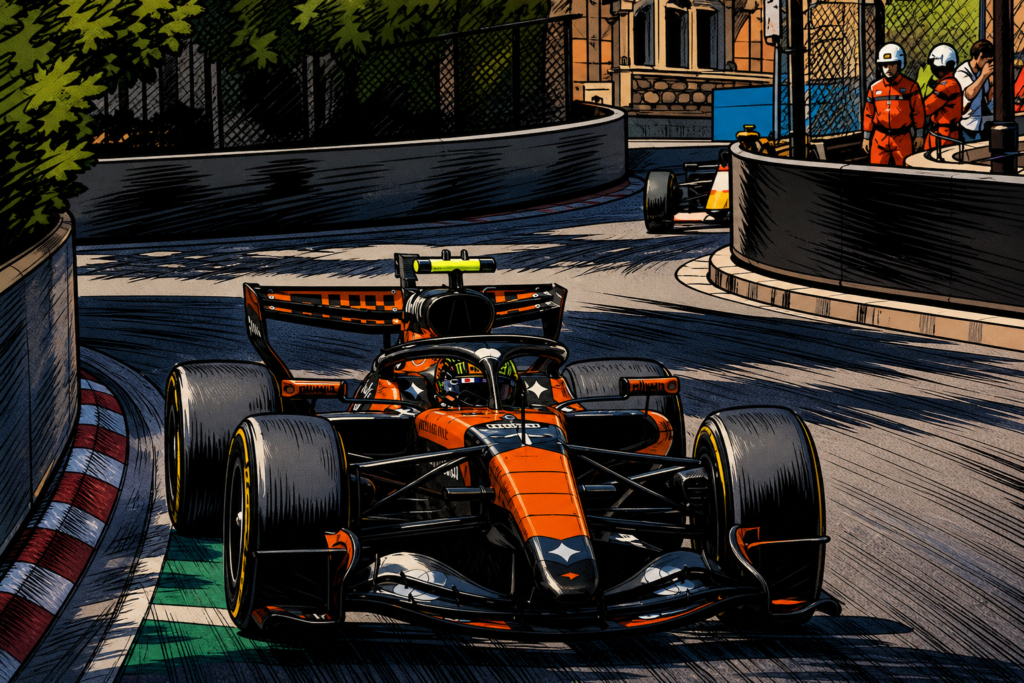
McLaren’s 2026 campaign has been hit by a series of technical problems, including Lando Norris’ retirement from the Monaco Grand Prix with a power unit-related issue. Andrea Stella has suggested that, while each reliability issue can be understood individually, the number of problems may point to the relative youth of the new project.
That matters because Mercedes, as the works team, has a deeper and more immediate relationship with its own power unit programme. It can shape car concept, cooling layout, gearbox integration and operational decisions around information McLaren may receive later or in less complete form.
- McLaren uses Mercedes power units but is not the works Mercedes team.
- The 2026 regulations make energy deployment and integration more important.
- Reliability issues have hit McLaren’s season, including Norris’ Monaco retirement.
- Mercedes has greater direct control over power unit information and packaging choices.
- McLaren now feels its customer status more clearly than in previous seasons.
The Information Gap Matters
In Formula 1, information is performance. A works team can align its chassis and power unit departments from the earliest concept phase. A customer team works with supplied data, agreed interfaces and contractual boundaries.
That distinction becomes more important when the technology is new. Early in a regulation cycle, unknowns are everywhere: thermal behaviour, energy recovery patterns, reliability margins and how the power unit reacts under different track conditions.
In a mature engine era, customers can close the gap through chassis excellence. In a new engine era, the first advantage often belongs to the team that understands the power unit deepest. F1LiveUpdates analysis
McLaren’s Own Choices Still Matter
McLaren is not blaming everything on Mercedes. Some issues remain fully on the McLaren side, including car-side reliability and gearbox-related problems. That nuance matters. Being a customer team may create a disadvantage, but it does not remove responsibility from McLaren’s own engineering operation.
The team has built an elite technical structure and remains one of the strongest organisations on the grid. But in the 2026 era, the margin between a works and customer operation may be larger than McLaren expected.
Not an Excuse, But a Constraint
McLaren’s customer status does not explain every problem. But it does create a structural limitation when power unit knowledge, software behaviour and packaging integration are central to reliability.
Why This Is Different From Previous McLaren Success
McLaren’s recent championship-winning form proved that a customer team could still fight for the biggest prizes. That success was built on chassis performance, operational sharpness and a Mercedes power unit that was already a mature known quantity.
The 2026 reset has changed that. The new power units are still being understood, and the teams with the closest engine integration have an early advantage. McLaren can still win races, but the path is more complicated when reliability and energy management become moving targets.
The Bigger Question: Can a Customer Team Still Win?
The answer is still yes — but it may now be harder. McLaren has the aerodynamic depth, driver quality and operational standards to remain a contender. However, the 2026 regulations have made the works-team model more attractive again.
That is especially important as Mercedes itself is performing strongly. If the works team is extracting more from the same engine family, McLaren’s disadvantage becomes visible not just in theory but on the timing sheets and reliability charts.
McLaren does not need a works engine to be competitive. But under the 2026 rules, not having one may cost more often than before. F1LiveUpdates analysis
A Problem McLaren Must Manage, Not Simply Complain About
McLaren’s challenge now is to reduce the practical impact of its customer status. That means improving integration, strengthening communication with Mercedes, solving reliability problems quickly and ensuring that car-side decisions do not compound engine-side limitations.
The team’s long-term Mercedes deal gives stability, but it also locks McLaren into the customer model through the early years of the new rules cycle. If the disadvantage remains significant, it could revive old debates about whether McLaren ultimately needs a works partnership to control its own destiny.
For now, McLaren’s task is clear: prove once again that customer status is not a ceiling. Under the 2026 rules, that mission has become much harder.
Sources
→ The Race — Why McLaren is suffering more as a customer under new rules
→ Formula1.com — 2026 power unit regulations explained
→ McLaren — Explaining F1’s new 2026 regulations
→ McLaren — McLaren and Mercedes renew power unit agreement until 2030
→ Mercedes-AMG F1 — Facts and stats on 2026 power unit regulation changes
Discover more from f1liveupdates.com
Subscribe to get the latest posts sent to your email.