
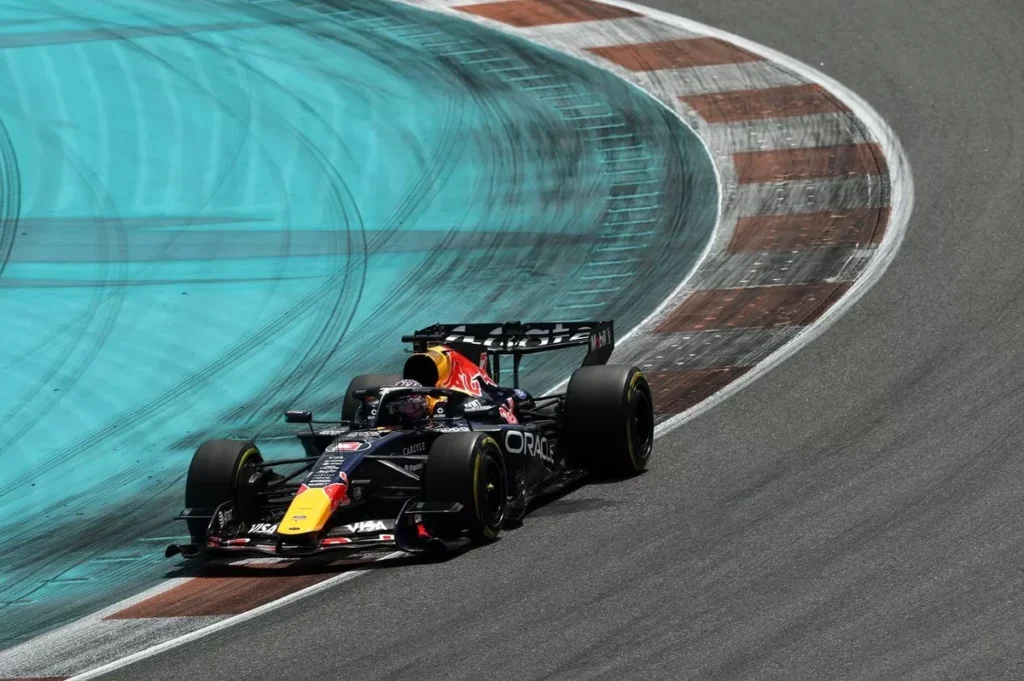
Red Bull Aims to Hit the Weight Limit by the Austrian Grand Prix
The RB22 entered 2026 twelve kilograms over the minimum weight. Miami halved that deficit. A second step is planned for the European season — and it could be the moment Verstappen truly becomes a title contender again.
Red Bull arrived in Miami carrying a problem that had been throttling their 2026 season since the first practice session in Melbourne: a car twelve kilograms above the FIA minimum weight limit. The penalty is not merely symbolic — in Formula 1, excess mass costs roughly 0.025 seconds per kilogram per lap, meaning Red Bull had been racing with an inherent lap time disadvantage approaching three tenths of a second every single lap since the season began. The Miami upgrade package, which featured revised sidepods, a new floor, a new Macarena-style rear wing, and targeted weight reduction components, halved that deficit. And the plan to close the remaining six kilograms is already in motion.
From 12kg to 6kg — and Targeting Zero
Technical director Pierre Wache confirmed the numbers directly after Miami: the RB22 started the season at twelve kilograms over the 768kg minimum. The Miami package brought it to approximately six kilograms over. A further step targeting the European races — with Austria and Great Britain the most likely venues — aims to eliminate the remaining deficit entirely.
“Yes, it delivered what we expected. It’s just the package itself that has delivered. And after we fixed some other issues, that has also brought some extra Max performance that maybe we didn’t expect.”
— Pierre Wache, Red Bull Technical Director
The “other issues” Wache references include a steering system problem that had been generating unpredictable balance behaviour across the first three rounds. Verstappen described the RB22 as “undriveable” after Japan, specifically citing understeer on turn-in and oversteer under acceleration that made the car almost impossible to commit to through slow corners. Hadjar, in unfiltered terms, called the chassis “terrible.” Both problems — the steering defect and the weight penalty — were addressed in the Miami package, and both contributed to what was, in terms of underlying pace, a meaningfully stronger weekend.
Miami — Better Than the Result Suggests
Verstappen finished fifth in Florida. That number undersells significantly. On the opening lap, he was turned around in a multi-car incident involving Russell, Hamilton, and Colapinto, dropping him to the tail of the field and triggering an early, unplanned pit stop. From that point, his progress through the order was systematic and rapid — comfortably the fastest recovery drive of the race. Wache was direct about the gap between the result and the pace.
“I’m for sure disappointed with the result. I think the result in Miami doesn’t show our pace. But it’s good for the team to show that the car has some pace on it and that we are in the mix again.”
— Pierre Wache, Red Bull Technical Director
Verstappen himself described the developments as providing “light at the end of the tunnel” and confirmed the package delivered what he had hoped. It is the first time since the opening round in Australia — where he qualified on the front row before crashing in Q3 and starting 20th — that Red Bull has felt genuinely competitive across a race weekend.
What the Miami Package Actually Changed
- New rotating rear wing (“Macarena wing”) — reduces drag on straights via active aero; rotates 160° in the opposite direction to Ferrari’s variant
- Revised sidepods — more aggressive taper after the kink; redesigned waterslide; cleaner airflow around the bodywork
- New floor — revised bib geometry integrates with sidepod changes; targets more downforce with better downstream stability
- New engine cover — works in combination with sidepod and floor changes
- Front wing and front corner inlet modifications — draw air from higher-pressure source with minimal exit blockage
- Weight reduction components — “look identical but weigh significantly less”; cut excess from 12kg to 6kg above minimum
- Steering system fix — addressed the chronic balance instability reported by both Verstappen and Hadjar across the first three rounds
Canada: A Small Step. Europe: The Real Push.
Mercedes has announced a major upgrade for the Canadian Grand Prix, which places pressure on Red Bull to respond. Wache was candid that the team will bring only incremental changes to Montreal — “just a little step for Canada” — while keeping the larger development budget aimed at the European swing. The Austrian Grand Prix on June 29, just six weeks away, is the earliest realistic target for the full weight elimination. The British Grand Prix on July 6 is the fallback.
The significance of hitting the 768kg minimum cannot be overstated. At six kilograms over, Red Bull is still operating with a lap time deficit of approximately 0.15 seconds per lap — roughly equivalent to being outqualified by a strong midfield team simply due to mass, before aerodynamics and power are even considered. Eliminating that entirely would, in a single step, remove one of the most structurally damaging disadvantages the team has carried since pre-season.
Canada is not the target. Austria might be. And if the correlation holds — if the Miami package’s direction proves as reliable in cooler European conditions as it did in Florida — Red Bull’s second half of 2026 could look very different from its first.
Discover more from f1liveupdates.com
Subscribe to get the latest posts sent to your email.