
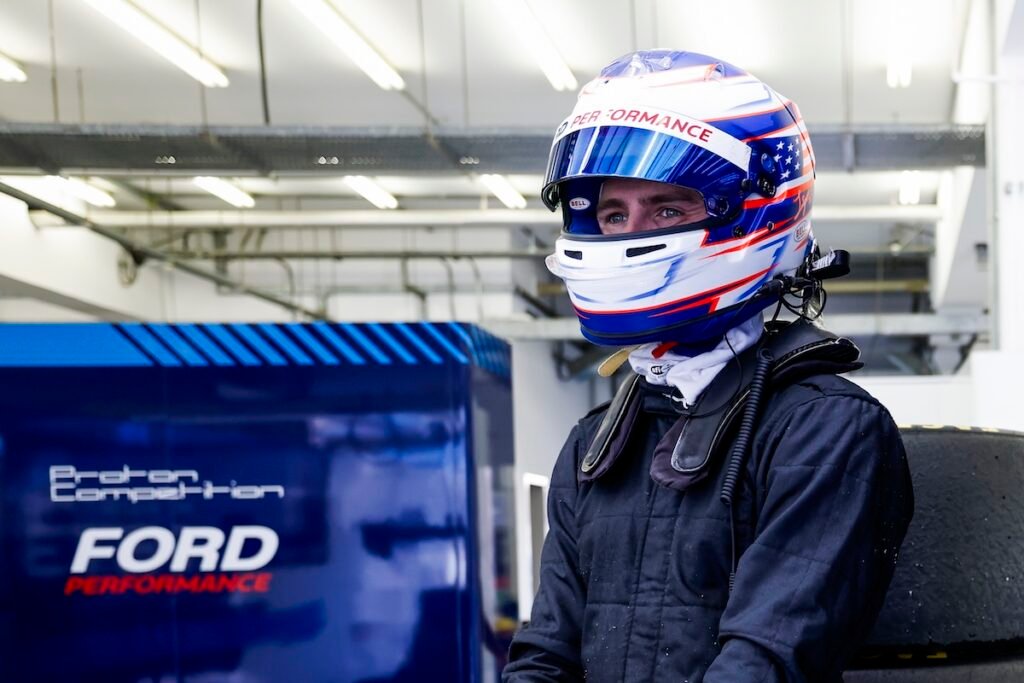
Sargeant Wants Verstappen in Ford Hypercar: “He’s Going to Kick Everyone’s Ass”
As Ford confirms talks with Verstappen about a Le Mans programme, its new factory driver Logan Sargeant has a clear opinion on what would happen if the four-time champion stepped into endurance racing — and he has no doubt about the outcome.
Logan Sargeant spent two years in Formula 1 with Williams without ever being in the same conversation as Max Verstappen. Now racing for Ford in the WEC’s LMGT3 class — and preparing to step up to the Hypercar from 2027 — the American has joined the growing chorus of voices urging a scenario that felt speculative twelve months ago but is now very much on the table: Verstappen, at Le Mans, in a Ford. Sargeant’s verdict on what that would mean for the competition was delivered with a grin and zero hesitation.
“Well, if he is driving, I hope he’s in my car! That’s for sure. In my opinion, Max is the best to ever do it. And he is most likely going to kick everyone’s ass.”
— Logan Sargeant, Ford WEC driver
The Talks Are Real — and Ford Wants Him
This is no longer hypothetical territory. Ford Performance boss Mark Rushbrook confirmed this week at the WEC round in Spa that the American manufacturer has held concrete conversations with Verstappen about a potential Hypercar entry. The timing is significant: Ford’s Hypercar programme begins in 2027, the same year Verstappen’s Red Bull contract runs until. The Le Mans 24 Hours has been on Verstappen’s publicly stated bucket list for years. With the Red Bull-Ford partnership in Formula 1 already established, the infrastructure for a crossover already exists.
“One of the great things about Max is drivers like him don’t come along that often in terms of what he accomplishes on track. But it’s how he accomplishes it. Hearing his feedback on the radio while he’s out on track — the amount of detail he’s able to give to the engineers is so much more valuable than all the data that the engineers have.”
— Mark Rushbrook, Ford Performance Boss
Rushbrook described Verstappen’s technical feedback at the 2026 Red Bull shakedown in Barcelona as extraordinary — noting that after 30, 40 or 50 laps in a brand new car, the level of engineering detail Verstappen provided verbally exceeded what telemetry alone could convey. The implication is clear: Ford does not just want Verstappen for his lap times. It wants him for what he would bring to the development of its Hypercar.
- Red Bull and Ford are already partners in F1’s 2026 power unit regulations
- Le Mans 24h has been on Verstappen’s stated bucket list for years
- Ford’s Hypercar enters WEC in 2027 — aligning with the end of Verstappen’s Red Bull F1 contract
- Verstappen’s endurance building blocks: NLS debut win (2025), Nurburgring 24h entry (May 2026)
- Ford would “rather” see Verstappen in a Ford Mustang GT3 than in his current Mercedes-AMG
- Rushbrook: his technical feedback “more valuable than all the data the engineers have”
Sargeant and the Ford Hypercar Programme
Sargeant’s own path to the Ford Hypercar is well defined. In 2026 he races the Ford Mustang GT3 in the LMGT3 class, sharing the No. 88 Proton Competition entry with Stefano Gattuso and Giammarco Levorato across all eight WEC rounds including Le Mans. From 2027, he graduates to the Hypercar alongside confirmed factory drivers Sebastian Priaulx — son of three-time WTCC champion Andy Priaulx — and Mike Rockenfeller, the Le Mans winner with Audi in 2010. The three were chosen for a specific blend of qualities.
Ford’s programme director Dan Sayers described Sargeant as bringing “a high level of technical sophistication and experience in aerodynamic downforce” that is essential for a programme of this scale. The reference to Sargeant’s F1 background is deliberate: his years at Williams, however difficult in competitive terms, gave him exactly the kind of high-downforce experience that translates directly to Hypercar development. He is not in the WEC purely as a racing driver; he is a key piece of the engineering architecture being built around Ford’s 2027 entry.
The Verstappen-Mercedes Awkwardness
There is one minor complication in the Verstappen-Ford story. For the Nurburgring 24 Hours in May 2026, Verstappen is racing a Mercedes-AMG GT3 — a rival brand to Ford. Rushbrook was asked about this directly and handled it with diplomatic good humour, confirming Ford “would rather” see Verstappen in a Ford Mustang GT3 than a Mercedes-AMG. The remark reflected the reality that at this stage of Verstappen’s Nordschleife programme, he is racing with whatever partner makes the most sense logistically. It does not reflect any contractual conflict with Ford — the F1 partnership operates separately from GT racing arrangements.
What Sargeant’s enthusiasm and Rushbrook’s confirmation together make clear is that Ford’s Hypercar is increasingly the most plausible path for Verstappen if — and it remains if — he steps back from Formula 1 before his contract expires at the end of 2027. A programme that gives him Le Mans, endurance racing’s greatest prize, wrapped in the same brand partnership that defines his day job. The pieces are almost entirely in place. Whether Verstappen chooses to use them is the only question that remains genuinely open.
Discover more from f1liveupdates.com
Subscribe to get the latest posts sent to your email.