Cadillac Chases a Second Per Lap — And Its Biggest Test Awaits in Miami
Three races into its Formula 1 debut, Cadillac has confirmed its operational foundations. Now Sergio Perez is clear-eyed about what comes next: a major upgrade at the team’s first home race, aimed at closing the gap to the midfield.
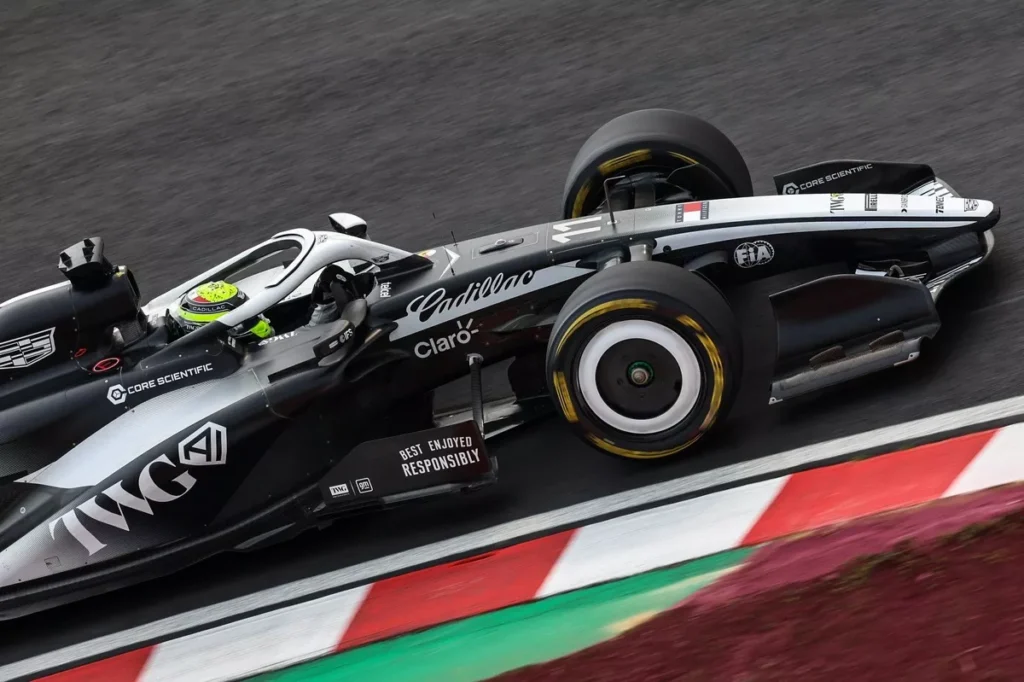
When Cadillac crossed the finish line with both cars at the Japanese Grand Prix — Sergio Perez 17th on the lead lap, Valtteri Bottas 19th — it was, in context, a genuine milestone. The American team completed back-to-back double finishes for the first time and outqualified the struggling Aston Martins, demonstrating that the operational foundations of F1’s newest outfit are solidifying race by race. But Perez, candid as ever, was equally clear about what the season truly needs next: performance, and a lot of it.
The Gap Is Real — And It’s About a Second
Suzuka provided some of the sharpest data yet on exactly where Cadillac stands relative to the field. In qualifying, the team sat 1.2 seconds per lap behind the next-slowest competitive driver — a gap that makes fighting for points an extremely tall order. In the race, Perez’s fastest lap was 1.1 seconds slower than those of Williams and Alpine, the teams immediately above Cadillac in the midfield order. The conclusion Perez drew from those numbers was straightforward.
“I think it’s clear that we need a second now. I really hope that we are bringing a big upgrade for Miami, and I think that will be the biggest test for the team. When I was following Williams and Alpine, I could see that they are not too far away — they’re just able to consistently keep finding pace.”
— Sergio Perez, Cadillac F1
The target is ambitious for any team over a single development window. But Cadillac arrives at this challenge at a moment that gives it the best possible chance: the 2026 season is still young, the regulations are entirely new, and teams are still converging on the optimal design paths. The performance slope is steep in these early months of a new formula, and upgrades can deliver larger gains than they would mid-season in a settled era.
Japan: The Strongest Weekend Yet
Despite the pace gap, the Suzuka weekend was the most complete Cadillac has produced since its first race in Melbourne. Both cars started and finished, energy deployment issues that had plagued qualifying were resolved for race day, and the team described the overall operation as “much cleaner” compared to the chaos of its first two events. Bottas, who started on the hard tyre in a contrarian strategy call, acknowledged the gamble did not fully pay off — the Safety Car deployed too late for his pit stop timing — but highlighted the volume of learning the team extracted.
“We’ve made a lot of progress in a short space of time. We were clearly faster than Aston Martin and our pace is getting stronger. The mood is good as we fully focus on preparations for our first home Grand Prix in Miami.”
— Sergio Perez, Cadillac F1
What the Upgrade Needs to Deliver
Team principal Graeme Lowdon confirmed that a development package is on the way for Miami, building on the revised aerodynamic pieces already introduced in Japan. The scope of what is needed is significant. The gap between Cadillac and the Williams–Alpine tier is not a minor aerodynamic tweak — it is structural performance that will require sustained development over several rounds to close. The Miami upgrade will be an important marker of how quickly the team’s multiple development facilities — spread across Fishers (Indiana), Silverstone, Charlotte (North Carolina), and Germany — can work in concert.
- Approximately 1 second per lap of performance to enter the midfield battle
- More consistent energy deployment across qualifying and race conditions
- Downforce — Perez flagged “we need load” as a key development direction
- Operational refinement as a new team whose staff have not worked together long
- GM’s own power unit still years away (target: 2029) — Ferrari PU remains the current route
Perez also flagged a longer-term target: scoring Cadillac’s first championship points before the summer break in 2026. It is an ambitious bar — Haas, the most recent new entry in 2016, scored points in its debut race. But Haas inherited an established chassis design from Ferrari. Cadillac is building from scratch, with a customer power unit, in a year of maximum regulatory disruption. The fact that it is already outpacing Aston Martin, a team with far more resources and infrastructure, is a data point worth noting.
Miami: Where It Gets Serious
The stakes at Miami are elevated beyond performance. It is the first of Cadillac’s three home races on the 2026 calendar, and the one most loaded with expectation from General Motors’ American fanbase. The team launched at the Super Bowl. Its approval was a political battle that dragged on for years. Miami is where the project needs to show it is not just surviving Formula 1 — but beginning, however tentatively, to compete in it.
Discover more from f1liveupdates.com
Subscribe to get the latest posts sent to your email.