
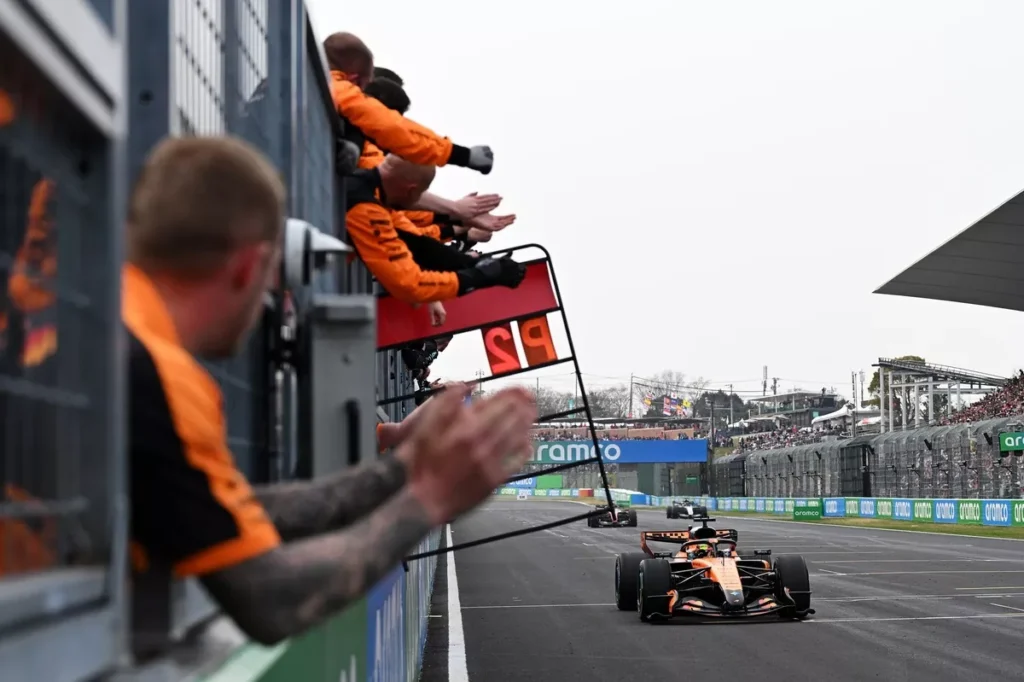
Is McLaren Back in the Game? The Factors Behind Piastri’s Japan Podium
Oscar Piastri led the Japanese Grand Prix and finished second. It surprised even McLaren’s own pitwall — and team principal Andrea Stella was quick to explain why Suzuka was not a sign of things to come everywhere.
Two weeks ago, neither McLaren car made the start of the Chinese Grand Prix. On Sunday in Suzuka, Oscar Piastri led the Japanese Grand Prix from the opening lap, fought off George Russell’s Mercedes for long stretches of the race, and was a credible threat for victory before the Safety Car intervened. The reigning constructors’ champions left Japan with their first podium of 2026 — and a set of very careful questions from their own team principal about what it actually means.
A Performance That Surprised the Pitwall
The praise from Andrea Stella was genuine, but so was his measured tone. McLaren’s team principal acknowledged that the pace Piastri showed — particularly at the end of the first stint, where he was not just keeping Russell behind but pulling away from him — was not something the team had anticipated going into the race.
“We were surprised ourselves, especially at the end of the first stint, where we not only were able to keep Russell behind, but we were also opening the gap. So we thought we should go first to retain the lead, because we wanted to give winning the race a go.”
— Andrea Stella, McLaren Team Principal
Piastri qualified third — just 0.056 seconds off the front row — converted that into the lead at Turn 1 with a stunning start, briefly lost position to Russell on lap eight before immediately reclaiming it, and pitted on lap 18 to protect track position. He was on course for a result none of McLaren’s rivals had anticipated. The Safety Car on lap 22, which handed Antonelli a free stop and the lead, ultimately denied him any chance of the top step. McLaren will never know if it would have been enough.
“We will never know whether, without the Safety Car, it would have been possible or not. I think it would have been possible against Russell, because we saw that Russell was struggling to overtake even Ferrari. I think today McLaren and Ferrari were on a similar pace.”
— Andrea Stella, McLaren Team Principal
Three Factors That Made Suzuka Different
Stella was careful to identify the specific conditions that contributed to McLaren’s strong showing — and to flag that they may not be replicated at every circuit on the calendar.
McLaren has been steadily extracting more from its Mercedes HPP power unit since the season began. Stella told Sky Sports F1 that “mostly we are getting more out of the power unit” — allowing the team to close the gap to the works Mercedes and flex a performance advantage over Ferrari, which uses a different engine supplier.
At both Australia and the China sprint, McLaren suffered more than its rivals from front graining — a phenomenon where tyre degradation causes performance to fall off sharply. Suzuka produced none of that. Stella explicitly flagged this as a significant contributor to the team’s competitiveness: “Here in Suzuka there was no graining. In the previous races, when there is front graining, we seem to be slightly more susceptible to this phenomenon than Ferrari and Mercedes.”
The circuit had been largely resurfaced ahead of this year’s grand prix, providing extremely high tarmac grip levels. Stella acknowledged that high-grip surfaces can partially compensate for chassis deficiencies — a category he was candid about McLaren still falling into: “With this tarmac, the grip is very high. I think it helps if you don’t have great performance from the chassis.”
The Honest Assessment: The Chassis Still Needs Work
Even as McLaren celebrated its first podium of 2026, Stella remained focused on what the data was telling him. Race telemetry overlays showed Ferrari still retaining a cornering advantage — confirming that aerodynamic grip remains a weakness for the MCL40 relative to its rivals. The power unit is stronger, but it cannot fully mask a chassis that Stella estimates needs to find a few tenths per lap to be a consistent win contender.
- Constructors’ standings: 3rd, approximately 90 points behind Mercedes
- First race both cars started and finished: Japanese GP (Round 3)
- Ferrari still retains a corner-speed advantage in race overlays
- McLaren’s power unit described as “more competitive overall” vs Ferrari’s
- Major upgrade package expected at Miami (May 1–3)
“Overall, good news, but it doesn’t change our objective. We have to improve the performance of our chassis.”
— Andrea Stella, McLaren Team Principal
Piastri: The “Best Version” — at Last Given a Stage
Away from the technical narrative, Stella was fulsome in his praise for Piastri’s personal performance. Having failed to start either of the first two grands prix — owing to a crash in Melbourne and a battery failure in China — the Australian arrived at Suzuka with zero race starts and zero points in 2026, yet Stella said the team had seen the strongest version of the 24-year-old that Formula 1 had witnessed since he entered the sport.
“Despite Oscar not having started the two main races at the start of the season, I think we have seen the best version of Oscar, the strongest Oscar since he’s been in Formula 1. Finally, he had an opportunity to demonstrate it, and he did it.”
— Andrea Stella, McLaren Team Principal
Piastri himself called Suzuka one of his finest weekends in Formula 1. For a driver who began the season watching from the garage while rivals accumulated points, that counts for something. His quip after the race — “Turns out if we start this thing, it’s pretty good” — captured the mood perfectly.
McLaren heads into the five-week Miami break with hope restored, a substantial upgrade on the way, and a clearer picture of where the work still needs to be done. Suzuka was not a sign that the reigning champions are back to full strength. But it was a reminder that, when conditions align, they can threaten anyone on the grid.
Discover more from f1liveupdates.com
Subscribe to get the latest posts sent to your email.