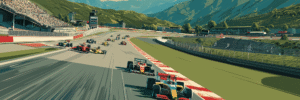

Why Mercedes & Ferrari Failed vs. Red Bull & McLaren 2022–2025: The Inside Story
In exclusive interviews with Motorsport.com and The Race, George Russell (Mercedes) and Charles Leclerc (Ferrari) lifted the lid on the three fatal flaws that left their teams playing catch-up: aerodynamic misunderstandings, strategic blunders, and an inability to adapt.
1. The Aerodynamic Revolution: “We Missed the Boat”
The 2022 regulation overhaul introduced ground-effect aerodynamics. Mercedes and Ferrari misjudged the rules, while Red Bull and McLaren nailed it from the start.
Mercedes: The “Zero-Pod” Disaster
2022’s W13 featured a radical “zero-pod” design. “On paper, it was innovative. In reality, it was a nightmare,” Russell admitted. The result was severe porpoising, forcing the team to abandon the concept mid-season. By 2025, Mercedes was still reacting rather than leading, with cars that were « evolutionary, not revolutionary. »
“We thought we could outsmart the rules. Turns out, we outsmarted ourselves.”
— George Russell
Ferrari: Fast but Flawed
The 2022 SF-75 had speed but lacked stability. “We had the fastest car on the straights and the slowest in sector 2,” Leclerc recalled. Ferrari prioritized power over downforce, a philosophy that failed to yield titles. By 2025, the team struggled to find a balance, oscillating between high drag and low stability.
2. Strategic Blunders: “We Shot Ourselves in the Foot”
Even when pace was present, execution failed.
Mercedes: The 2025 Abu Dhabi GP exemplified their struggles, with Russell finishing 20 seconds behind Leclerc due to poor strategy. Recurring tire window issues plagued them from 2023 to 2025.
Ferrari: Leclerc described 2022 as a « meltdown, » with errors in Monaco, Silverstone, and Hungary handing the title to Verstappen. In 2025, qualifying pace rarely translated to race results due to operational errors.
“We had the tools. We didn’t have the discipline.”
— Charles Leclerc
3. The Adaptation Gap
While Red Bull and McLaren evolved, the giants stagnated.
Mercedes suffered an « identity crisis, » losing its design DNA to chase Red Bull concepts. Ferrari faced a « one-step forward, two-steps back » syndrome, fixing engine issues only to break aerodynamics. Leclerc noted a cultural difference: “At Ferrari, every mistake feels like a crisis. At Red Bull, they treat it as a lesson.”
| Team | 2022–2025 Wins | Titles | Key Strength |
|---|---|---|---|
| Red Bull | 42 | 3 | Adaptive aero + flawless ops |
| McLaren | 21 | 1 | 2024–2025 development surge |
| Mercedes | 8 | 0 | Engine reliability |
| Ferrari | 10 | 0 | Qualifying pace |
Conclusion: A Cautionary Tale
As F1 prepares for 2026, both teams claim to have learned their lessons. Mercedes is « starting over » with a back-to-basics philosophy, while Ferrari’s Fred Vasseur has banned constant project resets. But as Russell warns, « 2026 is our last chance. If we don’t get it right, this era wasn’t just a failure—it was the end. »
“Talent wins races. Culture wins championships. We forgot that.”
— Charles Leclerc
Sources
- Motorsport.com: Exclusive interviews with Russell and Leclerc
- The Race: Technical analysis of the ground-effect era
- RacingNews365: Strategic breakdowns of 2022-2025
- ScuderiaFans: Ferrari internal cultural analysis
- AFP: Statistical overview of the era