
FIA Defends Marshal Safety Protocol as “Appropriately Managed” Despite Controversial Las Vegas Incident
FIA insists marshal deployment at Las Vegas Turn 1 was properly handled under double-waved yellow flags
The Controversial Moment Unfolds
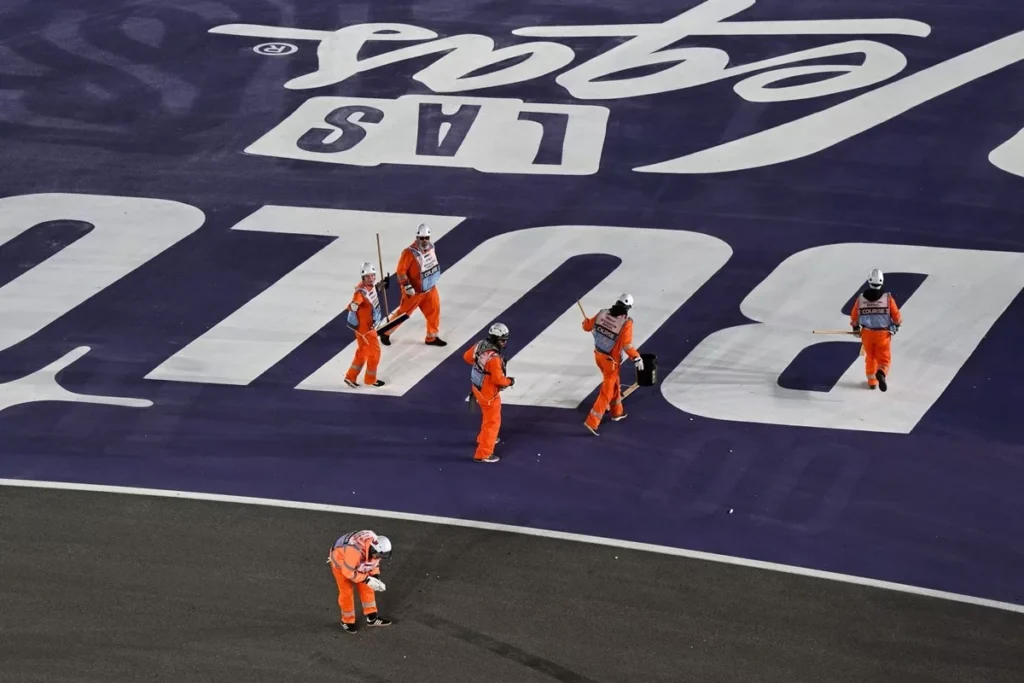
During the opening lap of the Las Vegas Grand Prix, multiple collisions at the first corner left significant debris strewn across the run-off area on the outside of Turn 1. Race control immediately deployed marshals to clear the debris, a standard procedure to ensure the racing surface remains clear for subsequent laps.
However, as the field streamed back towards Turn 1 at the beginning of lap 2, broadcast coverage showed track workers hastily retreating from the area with approaching cars bearing down on their location. The visual spectacle sparked immediate criticism from commentators and former officials, with many questioning whether double-waved yellow flags alone were sufficient to guarantee marshal safety.
The FIA’s Justification
Approached by media outlets after the race, the FIA issued a statement explaining the reasoning behind its decision-making, asserting that the situation remained within acceptable parameters throughout the incident.
The Distinction Between Run-Off and Racing Surface
Central to the FIA’s defense is the critical distinction between marshals operating within run-off areas versus those positioned on or crossing the active racing surface. According to FIA protocols, the mere presence of officials in a run-off zone does not automatically necessitate deployment of a virtual safety car or full safety car.
At Las Vegas, marshals were positioned in the run-off area and were actively retreating to their stations as the approaching traffic drew near. They did not cross onto the active racing surface, and the area remained comprehensively covered by double-waved yellow flags extending backward through the preceding corner.
Conversely, “should a marshal be required to enter or cross the racing surface, the Virtual Safety Car or Safety Car are automatically deployed,” the FIA clarified. At Turn 2 later in the race, when front wing debris landed close to the racing line, race control deployed a virtual safety car precisely because that debris potentially required marshals to cross the active track.
Criticism from Former Race Director Niels Wittich
Niels Wittich, former FIA race director who held the position before Portuguese Rui Marques took over in October 2024, offered sharp criticism of the FIA’s decision-making, arguing the situation violated fundamental safety principles.
Wittich referenced a similar incident in Mexico City two weeks prior, stating he could not understand how such a situation had now happened for the second time in the season.
The Mexico Connection: Pattern or Coincidence?
The Las Vegas incident represents the second controversial marshal exposure situation in consecutive Formula 1 events. Two weeks earlier at Mexico City’s Autodromo Hermanos Rodriguez, two marshals narrowly avoided a collision with Liam Lawson as he exited pit lane while they were retrieving debris.
The back-to-back occurrences have sparked wider discussion about whether fundamental marshal safety protocols require comprehensive review. The FIA has stated it views the two incidents “very differently,” but stakeholders are increasingly questioning whether current procedures adequately protect track officials.
Risk Assessment and Questions Remain
The critical question unanswered is whether race control accurately anticipated the time required for debris clearance at Turn 1, and whether it should have pre-emptively escalated to virtual safety car status once it became apparent that marshals would still be exposed as the field returned.
While the FIA’s reasoning technically satisfies established regulations, the visual evidence and prominent criticism from former race directors suggest that stakeholder confidence in current safety protocols may not be fully restored by regulatory technicalities alone.
The underlying concern centers on the gap between regulatory minimum requirements and practical safety margins. While FIA protocols technically permit operations under double-waved yellows in the described circumstances, the visual evidence of marshals running from track raises questions about whether the protocol leaves insufficient safety buffer for emergency scenarios.
Conclusion
The FIA’s defense of its Las Vegas marshal safety decision rests primarily on technical protocol distinctions: debris location, marshal positioning relative to the racing line, and extended yellow flag zone coverage. While these factors may technically satisfy established regulations, the visual evidence and prominent criticism from former race directors suggest that stakeholder confidence in current safety protocols may not be fully restored by regulatory technicalities alone.
Former race director Wittich’s public condemnation of the incident as “absolutely unacceptable” carries particular weight, as his criticism comes from someone who directly oversaw exactly these types of decisions in previous seasons. His assertion that the situation “must not happen” stands in direct contrast to the FIA’s determination that procedures were “appropriately managed.”
The FIA has committed to conducting “an internal investigation to understand exactly what happened and to identify any areas where procedures can be improved.” The paddock will scrutinize these findings closely to determine whether they result in practical procedural changes or merely regulatory reaffirmation. The fundamental tension remains: formal regulations may technically permit situations that prudent risk management would seek to avoid.
Discover more from f1liveupdates.com
Subscribe to get the latest posts sent to your email.