United States GP technical analysis: tyre wear, Hadjar’s three lost laps and the damaged cars
Lap by lap from our timing data: how fast each compound faded in Austin, why Hadjar lost 2.7 seconds after his stop, and what contact did to Colapinto’s Alpine.
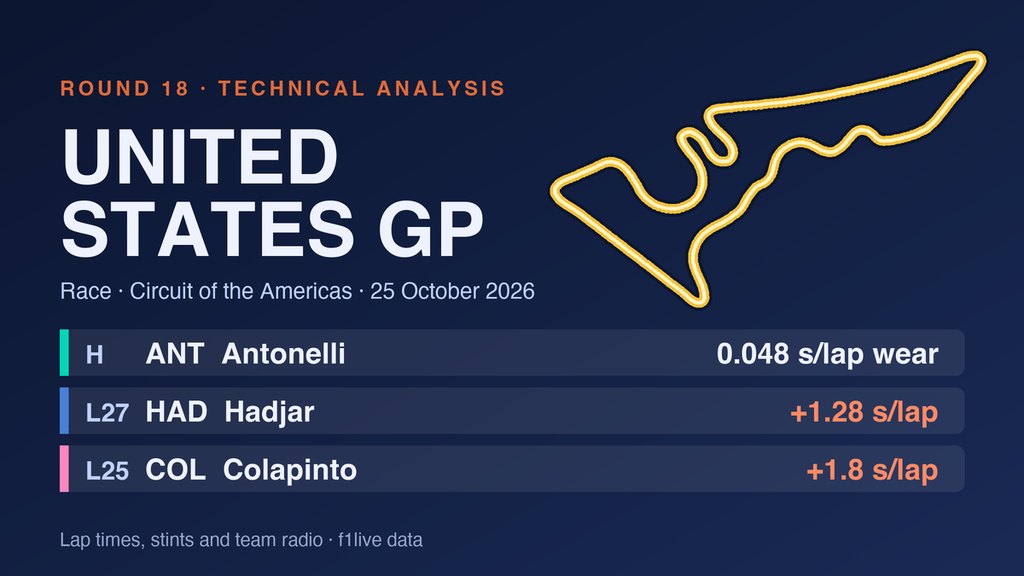
Kimi Antonelli won the United States Grand Prix with the best-managed tyres at the front: his hards lost an estimated 0.048 seconds per lap of age, half of what Lando Norris’s did. Behind him, Isack Hadjar lost about 2.7 seconds in the three laps after his stop, while his team radio was busy with engine-mode calls, and Franco Colapinto never recovered his pace after contact on lap 25.
This analysis uses every lap of the race from our f1live timing data (session 11396): lap and sector times, stints, pit stops, race control messages and the team radio clips published by Formula 1, which we transcribed. Each chart below can be shared on its own.
The race in one picture
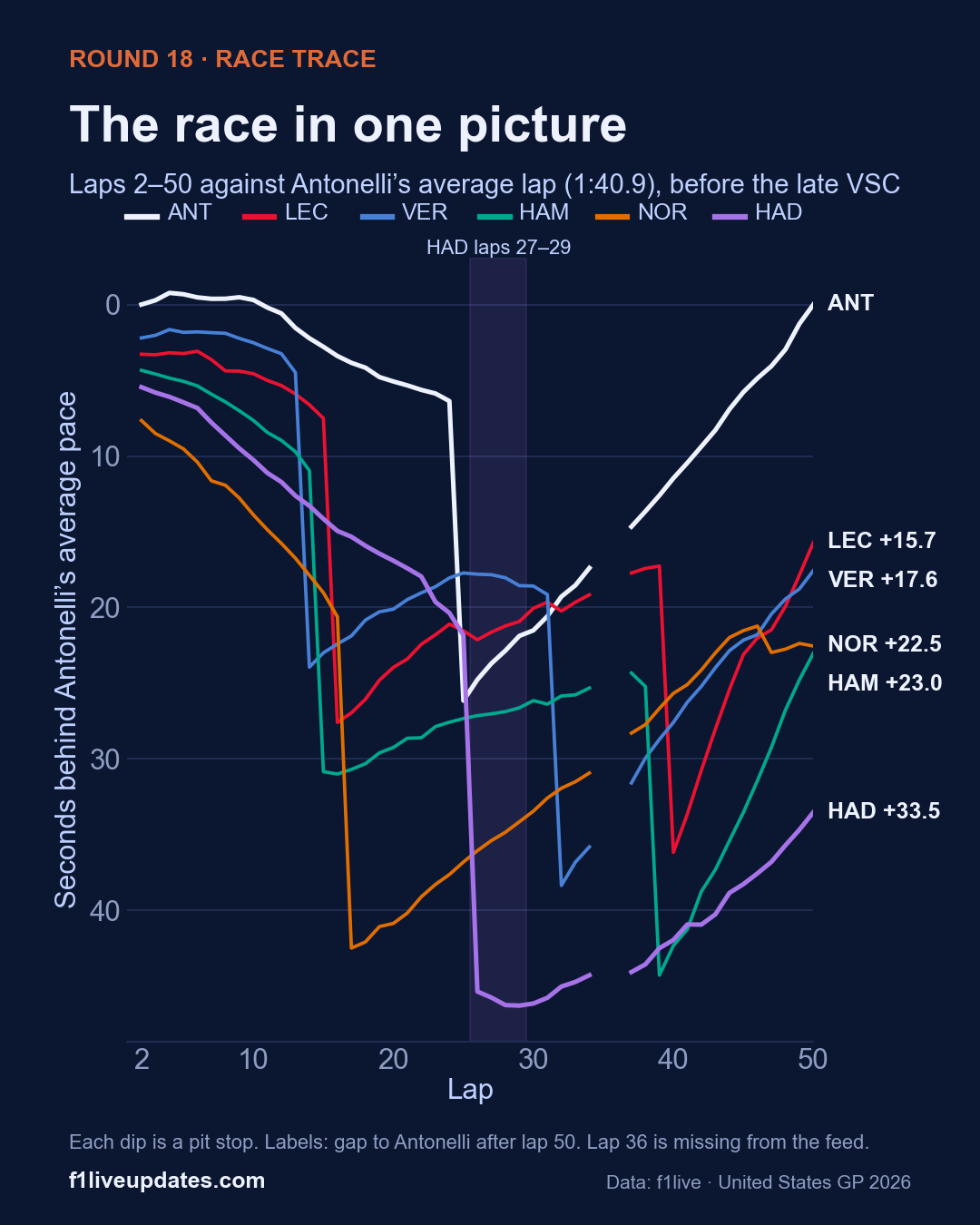
The race trace measures every car against Antonelli’s average lap from lap 3 to lap 50 (1:40.9). The flat stretches are where a driver lost time on the leader’s pace; the dips are pit stops. At the end of lap 50, before the Virtual Safety Car, Leclerc was 15.7s behind, Verstappen 17.6s, Norris 22.5s, Hamilton 23.0s and Hadjar 33.5s.
How fast the tyres faded
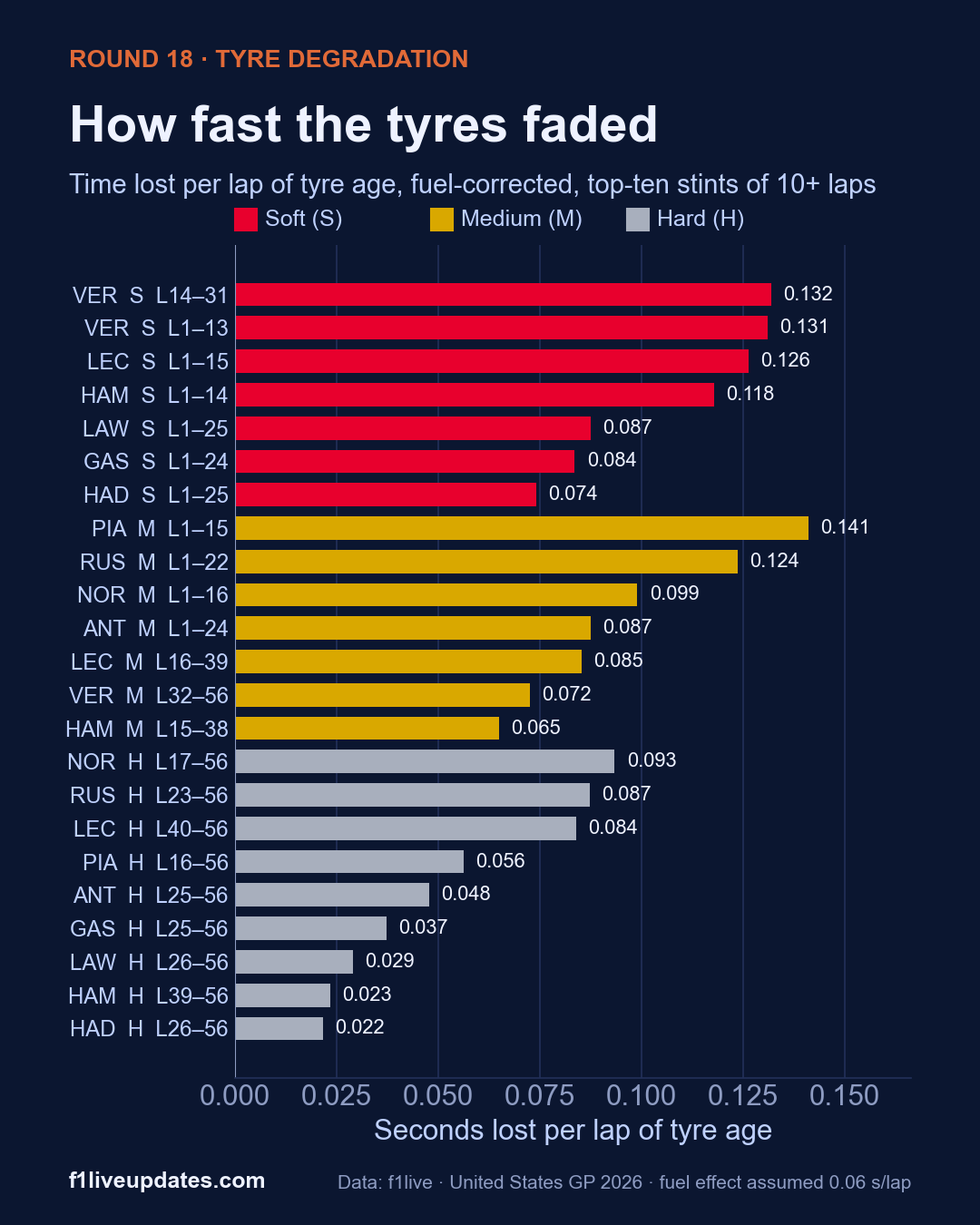
We measured degradation as the time lost per lap of tyre age in each stint of 10 laps or more, without pit, Virtual Safety Car or opening laps, and corrected it for fuel burn with an assumed gain of 0.06s per lap. These are estimates, not team data.
The soft was the hardest tyre to keep alive for the leaders: Verstappen lost 0.131s and 0.132s per lap in his two soft stints, Leclerc 0.126s and Hamilton 0.118s, which explains their early stops (laps 13 to 15). Hadjar kept his soft to 0.074s per lap over 25 laps, the lowest figure on that compound. On the hard, Antonelli (0.048s) and Piastri (0.056s) were the most economical of the front-runners; Norris’s 40-lap hard stint cost 0.093s per lap, and he dropped to 1:41.6–1:42.0 on the last three laps.
One stop or two
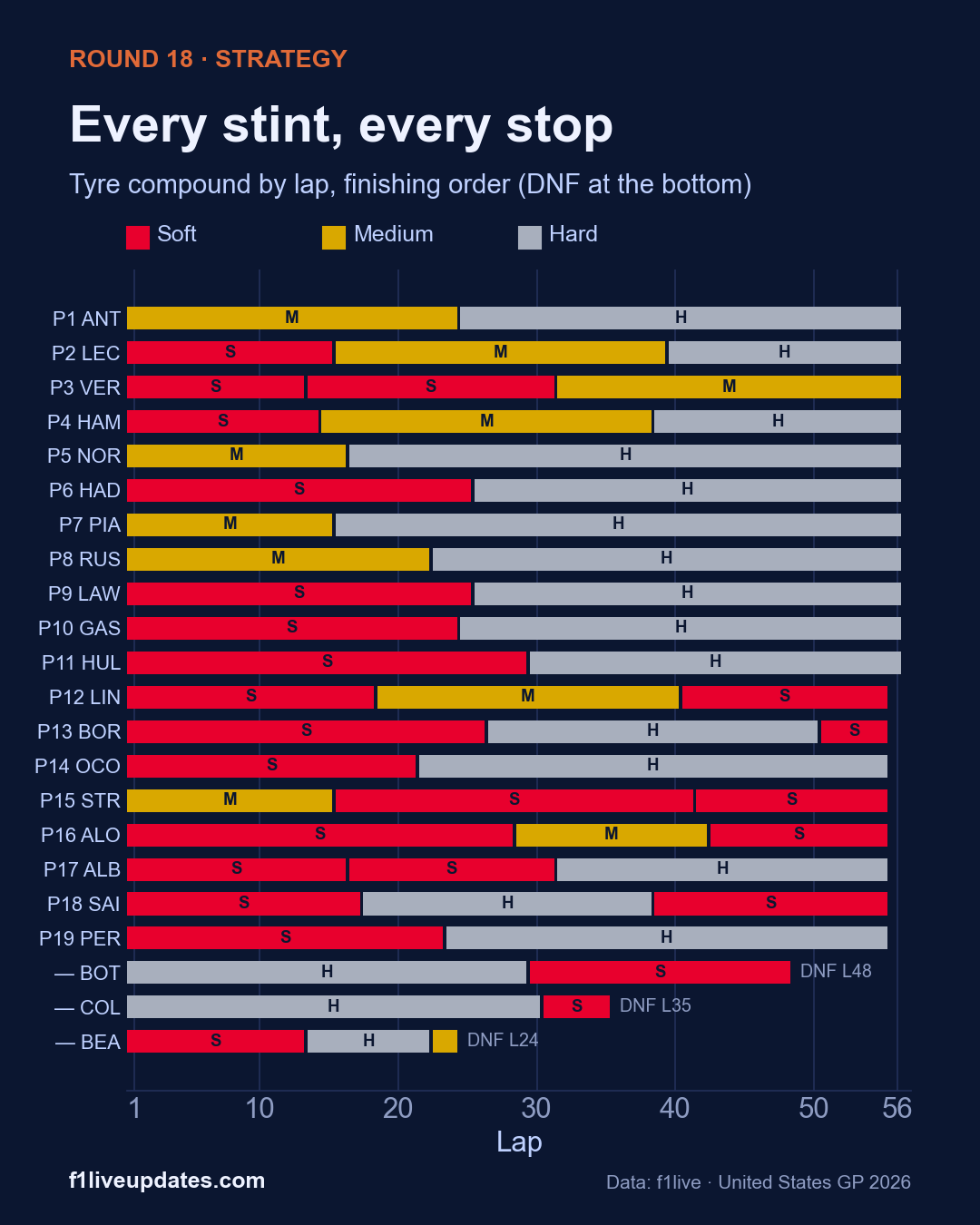
Those numbers decided the strategies. The four front-runners who started on mediums (Antonelli, Norris, Piastri, Russell) all stopped once for hards. The soft starters split: Ferrari and Verstappen stopped twice, Hadjar, Lawson, Gasly and Hülkenberg ran long on softs and stopped once. Verstappen was the only top-ten driver to finish on mediums, after soft-soft-medium.
Hadjar’s three lost laps
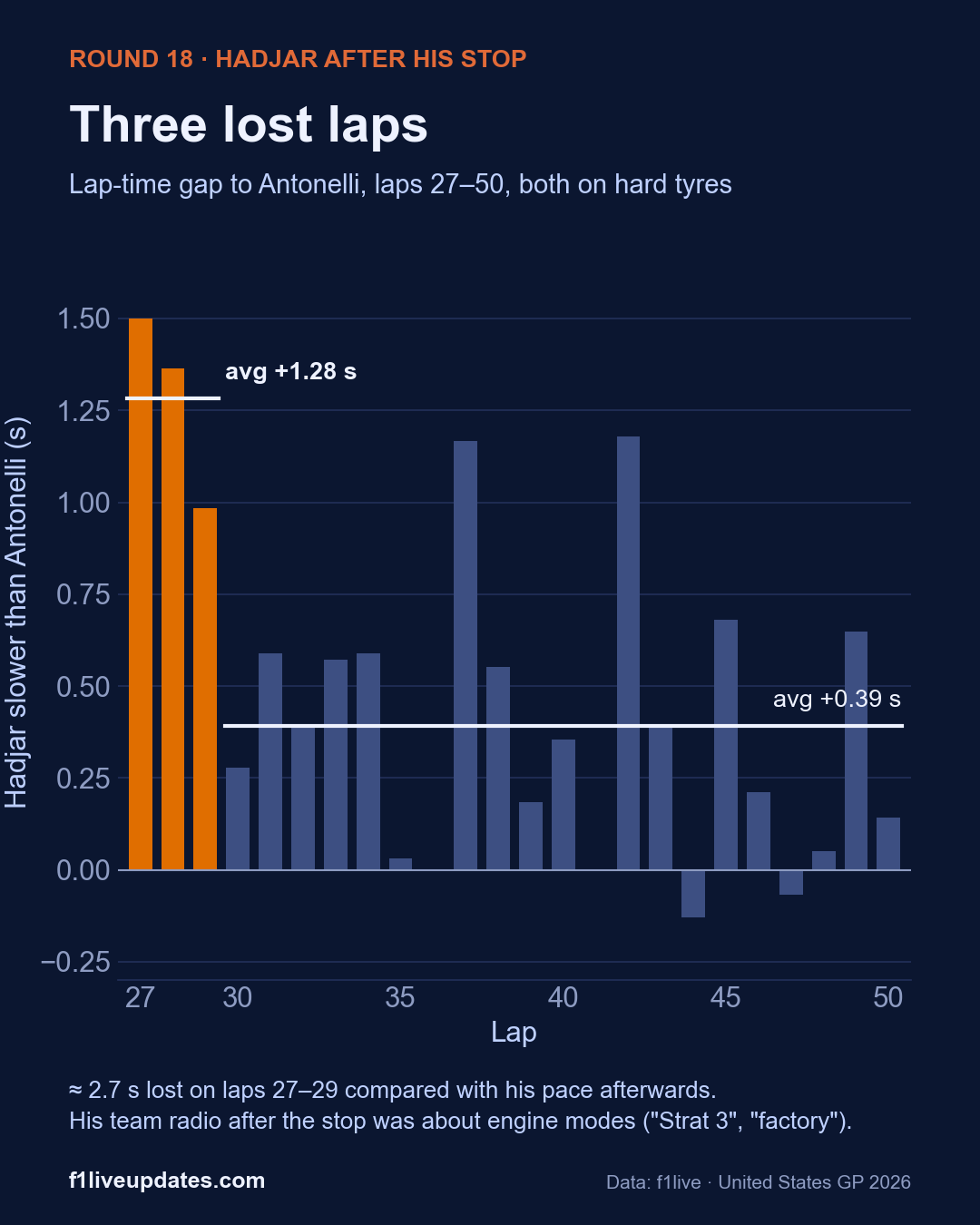
Hadjar pitted on lap 25 from third place and rejoined sixth on new hards. On laps 27, 28 and 29 he was 1.499s, 1.364s and 0.984s slower than Antonelli, who was on hards one lap older: 1.28s per lap on average. From lap 30 to lap 50 the difference fell to 0.39s per lap. Compared with that later pace, the three laps cost him about 2.7 seconds.
The team radio from those laps is about settings, not tyres: Hadjar and his engineer go through engine modes (“Strat 3”, then a call for the “factory” setting and to press boost). That matches a car that was not in the right configuration after the stop. Red Bull has not explained it publicly, so the cause is not confirmed. Hadjar finished 3.852s behind Norris, after taking back seven seconds on him in the last six laps, as Norris’s hards faded. Without the 2.7 seconds, the gap would still have been about one second.
Damage and retirements
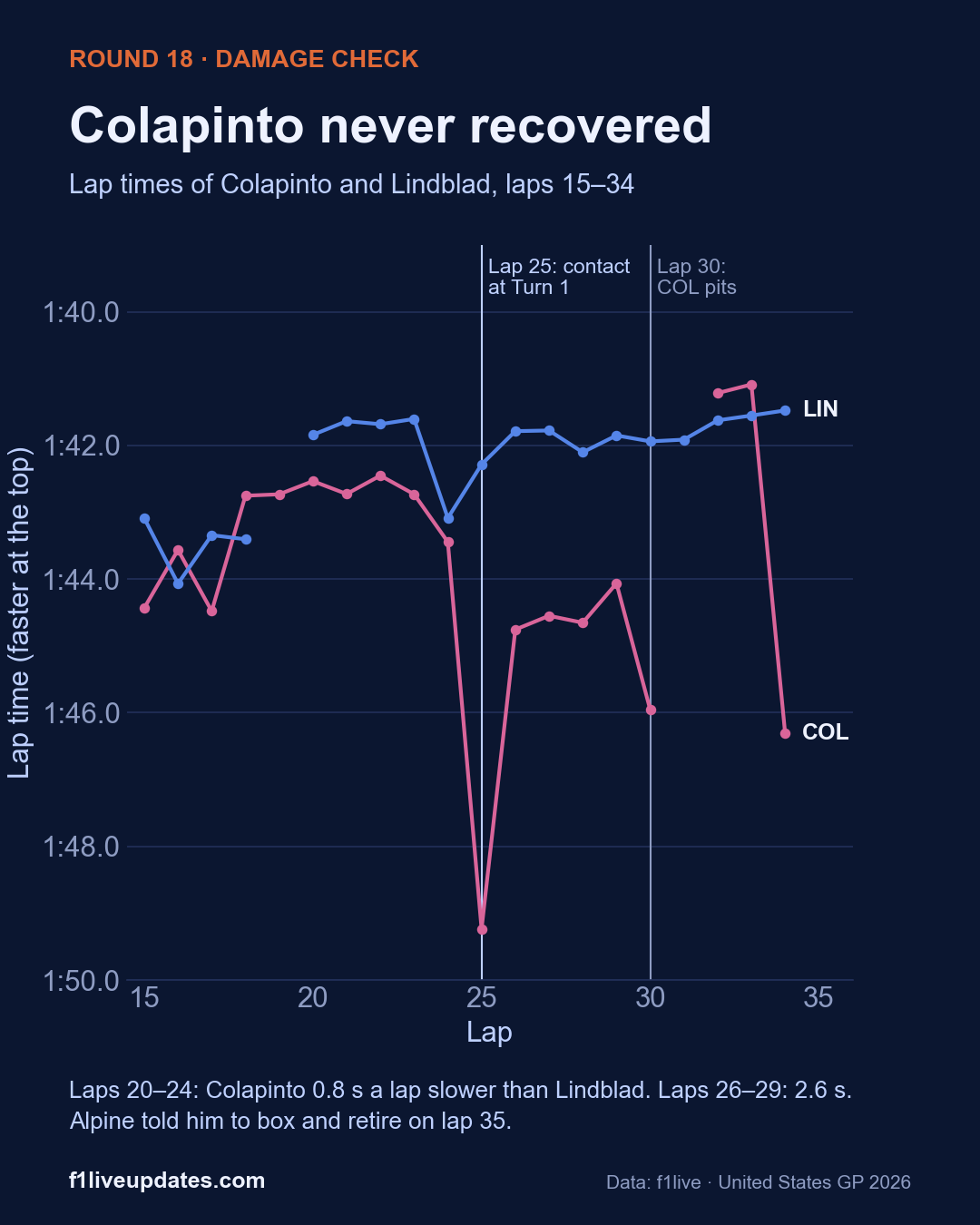
Colapinto. Race Control noted a Turn 1 incident between Colapinto and Lindblad on lap 25 and took no further action. On laps 20 to 24, the Alpine lapped 0.8s slower than the Racing Bull; on laps 26 to 29, it was 2.6s slower, while Lindblad’s pace did not change. Colapinto pitted on lap 30 for softs, set two laps in 1:41.1–1:41.2, then lost five seconds on lap 34. Alpine told him to box and retire on lap 35.
Bearman. His Turn 13 collision with Gasly, early in the race, earned him a ten-second penalty. From lap 8 he was up to 3.5 seconds a lap slower than Gasly, who did not lose pace. The timing data cannot tell damage from tyre wear; Bearman retired after 24 laps.
Bottas. The Cadillac lapped between 1:42.2 and 1:42.9 from lap 38 to lap 48, then Bottas reported a bad noise on the radio and said he thought there was damage. The second Virtual Safety Car came out about 20 seconds later, with marshals at Turn 10, from lap 51 to lap 53.
Sources
Lap and sector times, stints, pit stops, race control and classification: f1live laps, stints, pit stops, race control messages and session results for the United States Grand Prix (session 11396). Lap 36 is missing from the timing feed for most cars and is left out.
Team radio: the clips listed by f1live team radio, published by Formula 1 and transcribed by us. Method: degradation is a linear fit of lap time on tyre age per stint, without pit, VSC and opening laps or laps more than 3% off the stint median, plus an assumed fuel effect of 0.06s per lap.
Discover more from f1liveupdates.com
Subscribe to get the latest posts sent to your email.