Mexico City GP practice analysis: Leclerc tops Friday, Ferrari lead the long runs
Leclerc was fastest in FP1 and FP2 and had the best long run on mediums. Mercedes were slowest through the speed trap, and FP2 had a red flag and a stopped Ferrari.
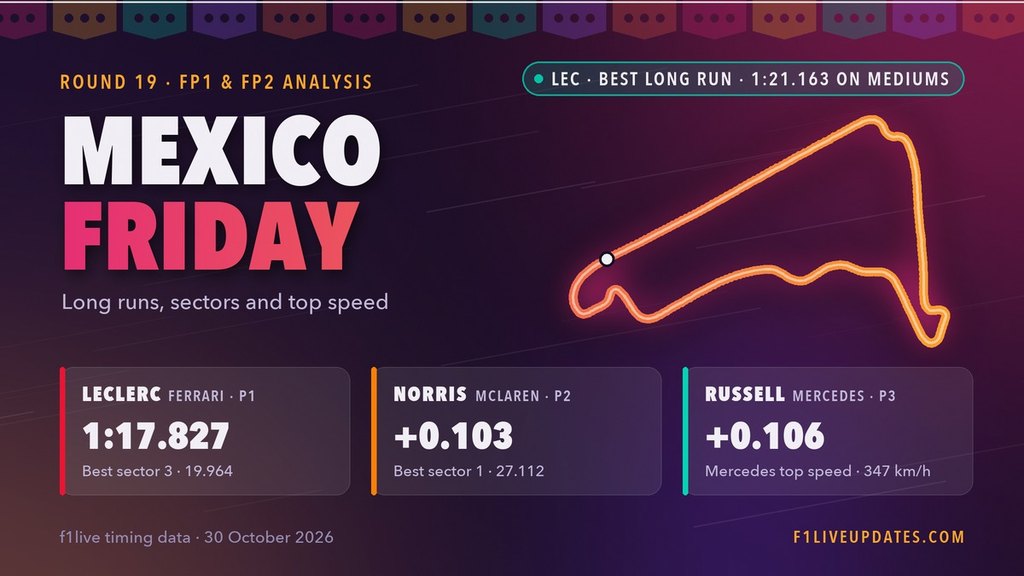
Charles Leclerc topped both practice sessions in Mexico City on Friday: 1:18.128 in FP1, then 1:17.827 in FP2, 0.103 seconds ahead of Lando Norris and 0.106 ahead of George Russell. Ferrari also had the best long run of the day, on medium tyres. Mercedes’ cars were the slowest of the field through the speed trap, and Lewis Hamilton was told to stop his car after a loss of power.
This analysis uses every lap of both sessions from our f1live timing data: lap and sector times, speed traps, stints, pit stops, race control messages and the team radio clips published by Formula 1, which we transcribed. The classification is provisional. Each chart can be shared on its own.
FP1: Leclerc and ten stand-ins
Ten regular drivers handed their cars to reserves and rookies in the first session, so FP1 says little about the order. Leclerc’s 1:18.128 was 0.659 seconds faster than Antonelli. Frederik Vesti, in Russell’s Mercedes, was third, 0.005 ahead of Hamilton, and Ayumu Iwasa was fifth in Verstappen’s Red Bull. Race Control deleted 19 lap times for track limits, seven of them at Turn 1, and deployed a Virtual Safety Car for marshals at Turn 1 about 14 minutes before the end. Freddie Slater’s Audi was investigated after the session for an unsafe condition.
The long runs: Ferrari on mediums
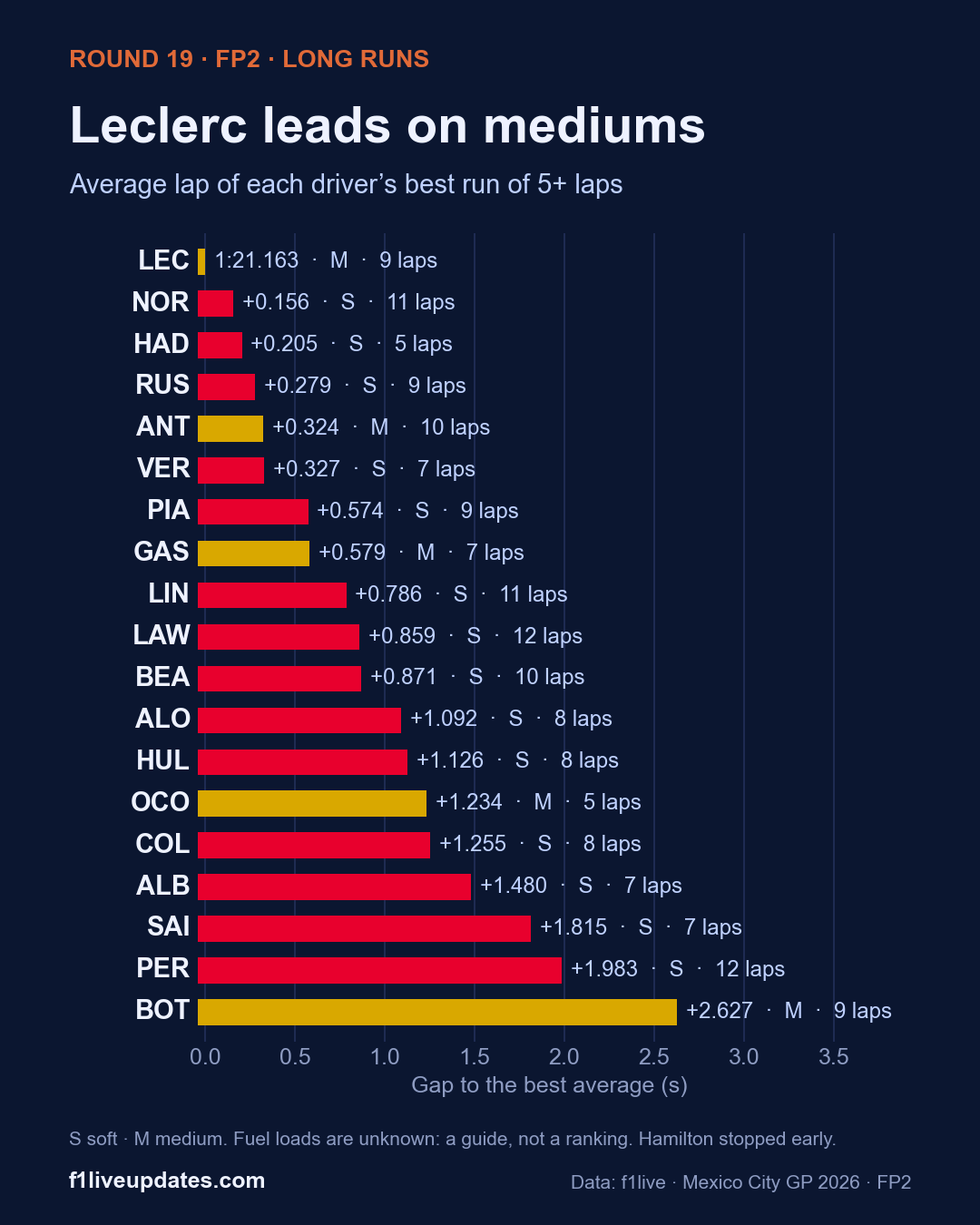
The second half of FP2 was for race preparation. We averaged each driver’s laps on runs of five laps or more, leaving out the out-laps, in-laps and cool-down laps. Leclerc’s nine-lap run on mediums averaged 1:21.163, 0.156 seconds faster than Norris over eleven laps on softs. Hadjar was next, but on a shorter run of five laps, then Russell (+0.279 on softs), Antonelli (+0.324 on mediums) and Verstappen (+0.327 on softs). Piastri and Gasly were more than half a second off. Fuel loads are not published, so these numbers are a guide, not a ranking.
Where the lap time is
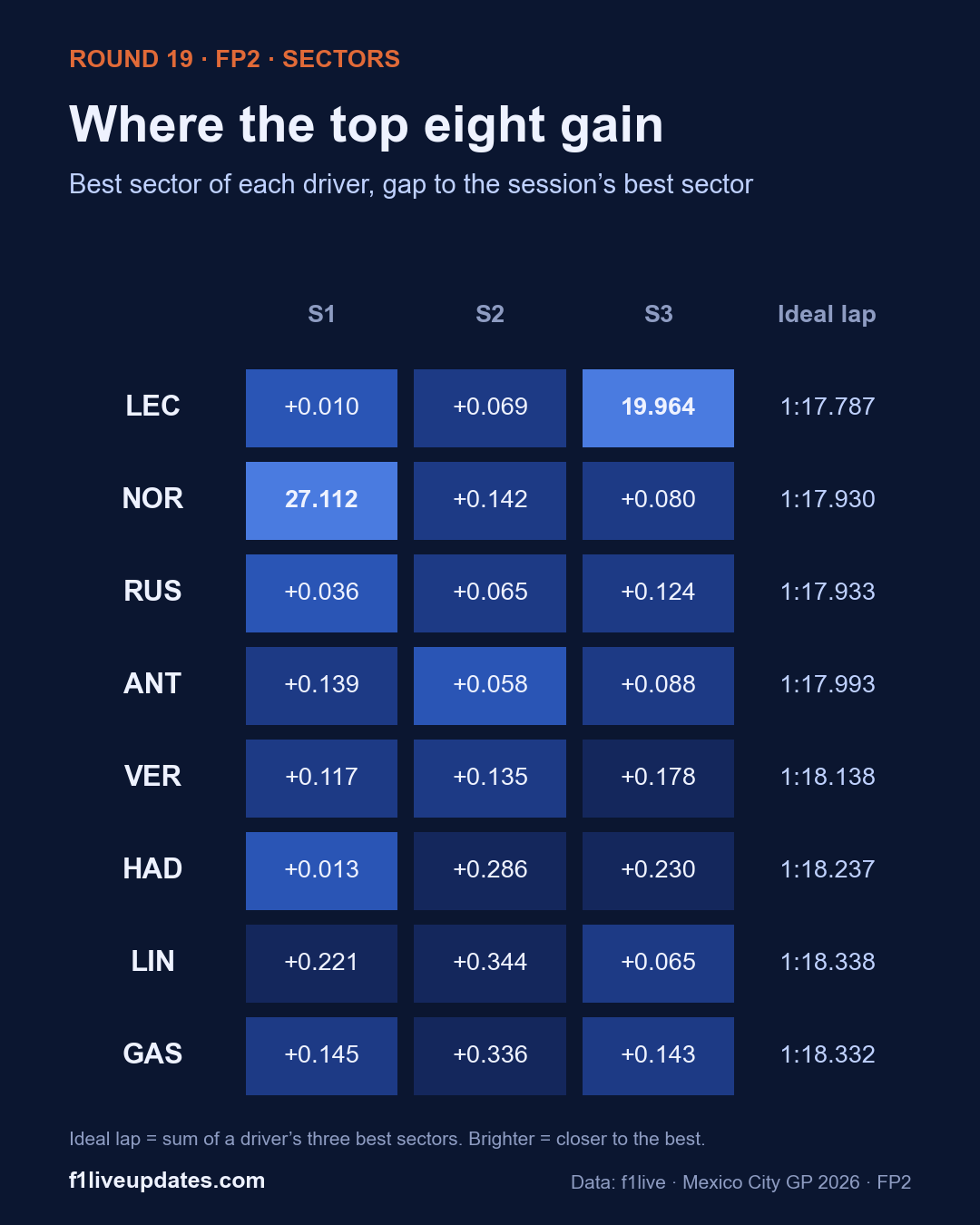
Leclerc’s lap came from the last sector: his 19.964 in sector 3, the stadium section, was the best of the session, while Norris set the best first sector (27.112) and Hamilton the best middle sector (30.632). The sum of Leclerc’s best sectors gives an ideal lap of 1:17.787. Russell was within 0.124 of the best time in every sector, Antonelli lost 0.139 in the first one, and Hadjar matched Leclerc in sector 1 but lost 0.286 in sector 2. Track temperature fell from 37.2°C to 31.4°C during FP2, the conditions Leclerc had named on Thursday as Ferrari’s weak spot in qualifying. It did not stop him on Friday.
Top speed: Mercedes at the bottom
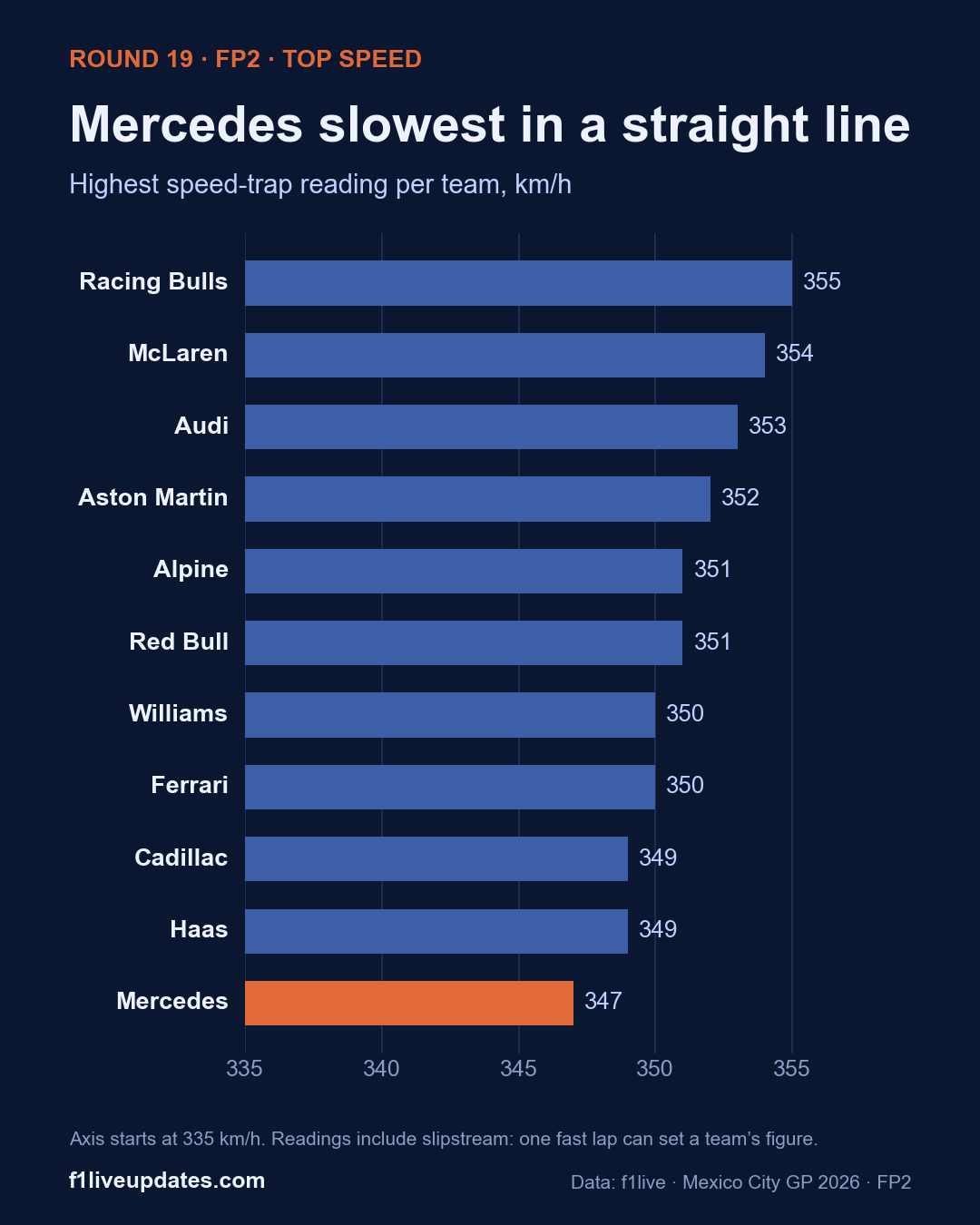
On Thursday, Russell expected turbo lag at altitude to be “a big factor” and named Ferrari as likely to benefit. In FP2, the best speed-trap reading of a Mercedes was 347 km/h, the lowest of the eleven teams and 8 km/h below Lindblad’s 355 km/h in the Racing Bulls. Ferrari reached 350 km/h. Speed-trap figures depend on wing levels and slipstream, so they measure set-up choices as much as engines, and they did not stop Russell and Antonelli finishing third and fourth.
Red flag, VSC and problems
Race Control reported a slippery surface in sector 14 and stopped FP2 with a red flag after 13 minutes, following a Turn 14 incident between Lawson and Verstappen. On the radio, Lawson complained that the other car had driven in on him. The stewards investigate the incident after the session; no decision was published in the race control feed. Later, Hamilton’s team told him to stop the car, and he reported a loss of power. A Virtual Safety Car followed, with marshals at Turn 4, and he finished with 13 laps. Lance Stroll told his team that his car was “broken” and completed 24 laps, Esteban Ocon started without power steering, and Leclerc was shown a black-and-white flag for erratic driving. From FP1 to FP2, Hadjar improved most among the drivers who ran in both sessions (1.308 seconds), Leclerc least (0.301).
Sources
Classification, laps, sectors, speed traps, stints, pit stops, weather and race control: f1live laps, stints, pit stops, weather and race control messages for FP2 (session 11398), and the same endpoints for FP1 (session 11397). Classification provisional.
Team radio: the clips listed by f1live team radio, published by Formula 1 and transcribed by us. Method: long runs are pit-to-pit runs of five laps or more within 5.5% of the driver’s best lap; their tyre comes from the stint data.
Discover more from f1liveupdates.com
Subscribe to get the latest posts sent to your email.