
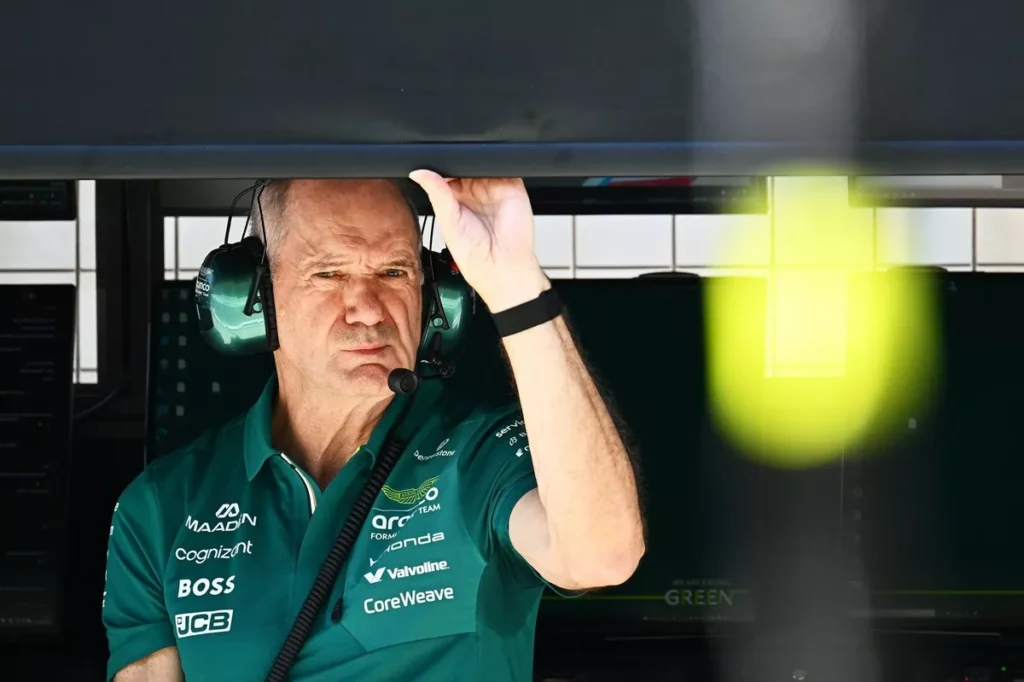
Newey: Despite AI, F1 « Depends Very Heavily on Human Ideas »
The legendary designer opens up about the role of artificial intelligence in modern Formula 1 and why human creativity remains essential
Adrian Newey has been at the forefront of Formula 1 innovation for over four decades. From his early days designing championship-winning cars to his current role at Aston Martin, the British designer has witnessed countless technological revolutions in the sport. Yet, as artificial intelligence becomes increasingly prevalent in motorsport, Newey remains convinced that human creativity will always be the driving force behind success in Formula 1.
The Human Element in a Digital Age
In an exclusive interview, Newey discussed how advanced tools like the CoreWeave AI.R Tunnel, computational fluid dynamics, and driver-in-the-loop simulators have transformed the way teams develop their cars. However, he was quick to emphasize that these innovations are nothing more than tools in the hands of skilled engineers.
This perspective comes from a designer who has contributed to 12 constructors’ championships and 13 drivers’ titles, from Nigel Mansell’s 1992 victory with Williams to Max Verstappen’s fourth consecutive championship with Red Bull in 2024.
The 2026 Challenge
The 2026 season represents the biggest regulatory overhaul in Formula 1 history, with both power unit and chassis regulations changing simultaneously for the first time ever. For Newey and his team at Aston Martin, this presents an unprecedented challenge that requires the kind of creative problem-solving that only human engineers can provide.
« We’re trying to understand the implications of the rule changes, including how the power unit—with its greater electrical side—affects the chassis design and the vehicle dynamics of the car, » Newey stated. « It’s a very complicated equation. »
The integration of a more electrically-focused power unit with chassis design creates complex interdependencies that require innovative thinking. According to Newey, this is where human intuition and conceptualization become indispensable.
AI: A Tool, Not a Replacement
Despite the rapid advancement of artificial intelligence capabilities, Newey remains skeptical about handing over key design processes to automated systems. His position is clear: while AI can enhance analysis and simulation, it cannot replace the fundamental human ability to conceptualize novel solutions.
Newey’s Verdict on AI
« Even with AI advancing as rapidly as it is, we’re a long way off. It depends very heavily on human ideas, and that really is, I suppose, the essence of Formula 1. That ability to conceptualize, to react quickly, to be self-critical. »
This self-critical approach is something Newey believes machines cannot replicate. The ability to evaluate one’s own work, identify weaknesses, and fundamentally redesign concepts based on intuition and experience remains a distinctly human trait.
The Driver’s Role
Newey’s appreciation for human input extends beyond the engineering team to the drivers themselves. Modern Formula 1 cars feature sophisticated driver-in-the-loop simulators that allow engineers to evaluate setups and development directions. However, Newey stresses that these tools still require human feedback.
This human-machine partnership, where drivers provide essential feedback that shapes car development, exemplifies Newey’s philosophy: technology serves to enhance human decision-making, not replace it.
Looking Forward
As Formula 1 enters this new technological era with AI becoming more sophisticated, Newey’s insights serve as a reminder of what makes the sport unique. The complex interplay between human creativity and technological capability continues to define successful Formula 1 teams.
For Newey, the essence of the sport remains unchanged: it takes brilliant human minds to conceptualize groundbreaking designs, to identify problems, and to push the boundaries of what’s possible on the track. AI may be a powerful tool, but in Formula 1, the human element remains irreplaceable.