Leclerc’s Shanghai Blackout: Why the 2026 Power Units Are So Hard to Master
A seemingly perfect lap dissolved in seconds on Shanghai’s back straight. Charles Leclerc’s sprint qualifying misfortune is a window into the extraordinary complexity of 2026’s new hybrid architecture — and why even Ferrari is still learning.
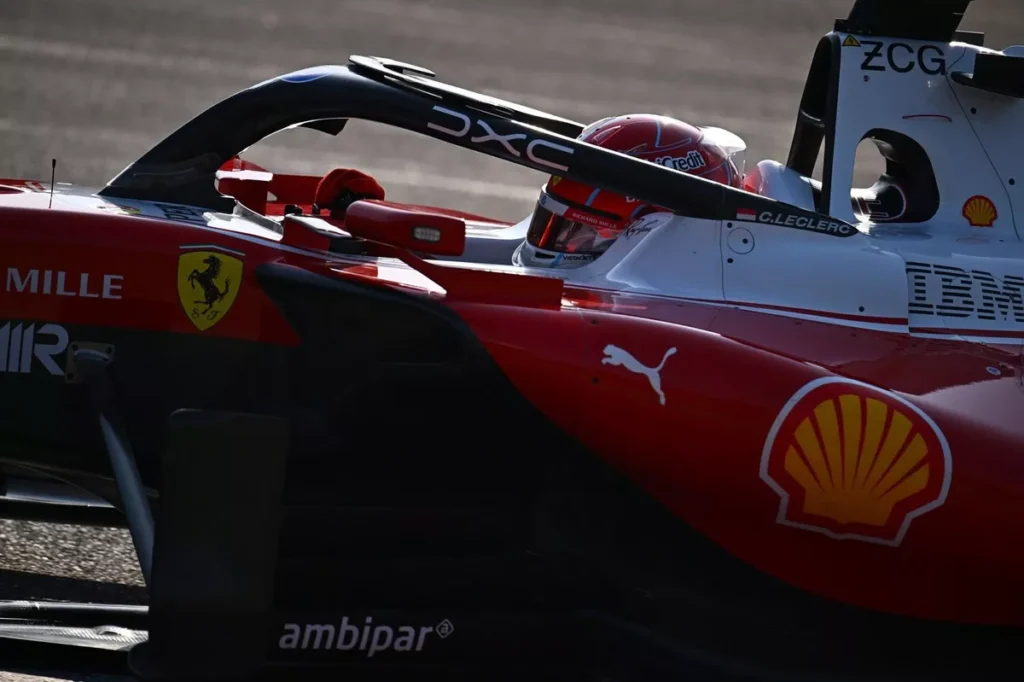
Charles Leclerc had built what looked like a strong final lap in SQ3 at the Chinese Grand Prix. Through the technical sectors, the SF-26 was moving well. Then came the 1.2-kilometre back straight — and the energy simply wasn’t there. In the space of a few seconds, Leclerc lost nearly half a second to his rivals, dropping from a potential fight for third on the grid to sixth. His radio message said it all: « What the hell is happening? I lost like four tenths on the back straight. »
It was a moment of visible frustration, but it was also something more revealing: a glimpse into just how brutally unforgiving the 2026 power units can be when energy deployment goes wrong, even by the smallest margin.
A New Kind of Power Unit — And a New Kind of Problem
The 2026 Formula 1 regulations introduced a fundamentally different hybrid architecture. Gone is the MGU-H — the Motor Generator Unit Heat, which in previous generations managed turbo lag and helped recover exhaust energy. In its place, the regulations demand a 50/50 split between combustion power and electrical power, with the MGU-K carrying roughly three times the output it previously did.
2026 Power Unit — Key change
The removal of the MGU-H means teams can no longer use it to spool the turbocharger or recover thermal energy. The MGU-K now handles the electrical workload almost alone — and its power output has been roughly tripled compared to the previous era. Managing when to harvest and when to deploy has become one of the defining technical challenges of the season.
The consequence is stark: teams must now run sophisticated algorithms to decide, corner by corner and straight by straight, exactly when to release electrical energy and when to recharge — all without sacrificing lap time. An incorrect strategy can cost several tenths of a second. And as Leclerc discovered in Shanghai, even a small variation in driving inputs compared to a previous lap can throw the entire system off.
What Went Wrong for Leclerc in SQ3
The incident didn’t come from nowhere. Among the frontrunning drivers, Leclerc showed the most noticeable variation in energy management between SQ2 and his first attempt in SQ3 — others maintained a far more consistent strategy across segments. That inconsistency had consequences: the system, which learns from previous laps, had calibrated itself based on data that no longer matched how Leclerc was actually driving.
On the back straight, the Monegasque found himself without energy earlier than his rivals, losing the tenths that cost him the chance to fight for the second row. His engineer confirmed that two of the six tenths he was losing to Hamilton in the second sector came specifically from the approach to Turn 8 — one of the most energy-sensitive corners on the circuit.
« Unfortunately when I had a good lap I lost half a second on the back straight for whatever reason on the second lap in SQ3. » — Charles Leclerc, after sprint qualifying
Since it was a sprint weekend, there was no time to return to the pits and recalibrate certain parameters. That compressed format — just one practice session before the sprint qualifying shootout — left Ferrari with almost no opportunity to refine their energy model in real-world conditions at Shanghai.
The Hamilton Contrast
Looking at the two best laps from Leclerc and Hamilton, interesting differences emerge. In the section between Turn 7 and Turn 8, Hamilton anticipates the downshift, keeps engine speed high, and is more careful in applying the throttle before entering Turn 9 — saving energy. This more conservative, precise approach meant Hamilton arrived at the back straight with more electrical reserves available, extracting those critical tenths where Leclerc found nothing.
The implication is significant: the 2026 power units don’t just reward a fast car or a skilled driver. They reward drivers who have deeply internalised the energy management model — and who can reproduce it consistently, lap after lap, segment after segment. Any deviation from the expected driving pattern can cause the system’s algorithm to make suboptimal decisions, with immediate and measurable consequences on the timing sheet.
A Pattern Already Emerging in 2026
Shanghai was not the first time Ferrari found themselves caught out by hybrid parameters. At the end of Australian GP qualifying the previous weekend, Leclerc had explained that both the result and the gap to Mercedes had been affected by an issue related to hybrid management configured with incorrect parameters. Two rounds in, it is becoming clear that this is not a one-off: the challenge of perfectly calibrating energy usage models is a season-long battle, and one that every team is fighting in their own way.
Why 2026 energy management is so difficult
- No MGU-H to buffer turbo response or recover exhaust energy
- MGU-K output roughly tripled — more power means faster depletion
- Algorithms are circuit-specific and sensitive to driving style variation
- Sprint weekends leave almost no time to recalibrate between sessions
- Even minor changes in corner approach can disrupt the entire lap model
Mercedes, meanwhile, appear to have found a clear edge in qualifying trim. Leclerc admitted he is perplexed by the advantage Mercedes currently boasts with its engine and deployment, especially over a single lap. Hamilton reinforced the concern from the other side of Ferrari’s garage: the gap is real, and closing it will require serious work back in Maranello — both on power and on the deployment models themselves.
A More Competitive Race Pace — But Qualifying Remains the Challenge
There is a silver lining for Ferrari. Leclerc noted that while Mercedes appears a step ahead in qualifying, Ferrari is closer over race distances — and he remains hopeful heading into the grand prix. The SF-26 appears strong on chassis fundamentals, and the longer, more varied energy cycles of a race may suit Ferrari’s current power unit mapping better than the maximum-attack, single-lap demands of qualifying.
But the broader lesson from Leclerc’s Shanghai moment is clear: in 2026, the power unit is not simply a source of propulsion. It is an intricate, adaptive system that interacts with every driving input, every braking zone, every throttle application. Getting it right — session after session, lap after lap — is one of the defining technical challenges of this new era. And for now, the teams are still very much learning.
Sources
- Motorsport.com — How Leclerc’s Chinese GP sprint qualifying issue highlights the complexity of 2026 power units
- Crash.net — Leclerc rages over Ferrari team radio after Chinese GP sprint qualifying issue
- F1i.com — Leclerc rages at Ferrari power loss in Shanghai sprint qualifying
- ScuderiaFans.com — Ferrari SF-26 battles oversteer and energy deployment issues in China sprint qualifying
- ScuderiaFans.com — Chinese GP 2026: FIA raises power unit limits as Shanghai offers higher energy recovery
- ESPN — 5 questions hanging over F1’s new regulations ahead of China
- The Race — Nine things we learned from sprint qualifying at F1’s Chinese GP