
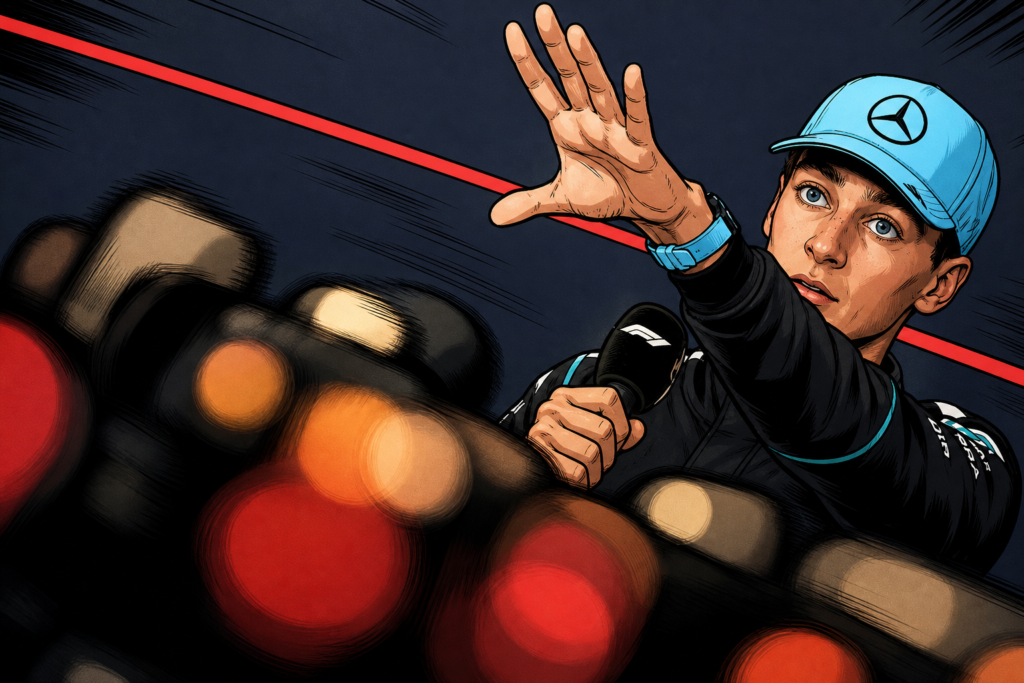
Why Russell Kept Austria Pole — And What Antonelli Got Wrong
George Russell’s Austrian Grand Prix pole survived late yellow flag drama after Max Verstappen’s crash, while Kimi Antonelli’s abandoned lap exposed how quickly one dashboard warning can change a qualifying session.
George Russell kept pole position for the 2026 Austrian Grand Prix because the incident that shaped the end of qualifying was judged as a single yellow flag situation when he passed the relevant section of track. The Mercedes driver lifted, reduced speed and completed the lap, while the stewards decided there was no need for further action.
The controversy came after Max Verstappen crashed at Turn 9 during the final moments of Q3. Russell was still on a flying lap behind him, and the question immediately became simple but explosive: had he done enough under yellow flags to keep the lap legal?
This was not simply a pole won by speed. It was a pole protected by interpretation, instinct and a split-second reading of the rules. F1LiveUpdates editorial view
Why Russell’s lap stood
Under single yellow flags, a driver must slow down, be prepared to change direction and show clear caution. Russell did not need to abandon the lap automatically. That distinction mattered.
Russell lifted through the incident zone and then returned to full commitment once clear of the danger area. Because the flags were not yet double yellows at the moment he passed the key section, the lap was allowed to stand.
The decisive point
A single yellow requires caution. A double yellow effectively kills the lap. Russell treated it as the first scenario — and the officials agreed.
What Antonelli got wrong
Kimi Antonelli made the opposite call. The Mercedes rookie believed the warning he received indicated double yellow flags, which would have meant his lap was effectively over.
Instead of trying to complete the lap cautiously, Antonelli backed out. It was the safer interpretation, but in competitive terms it was costly. While Russell continued and took pole, Antonelli lost the chance to fight for the very front of the grid.
The mistake was not a driving error in the classic sense. It was an information-processing error: Antonelli reacted to what he believed the situation had become, while Russell reacted to what the trackside conditions still allowed.
Why the confusion happened
The confusion came from timing. Verstappen’s crash initially triggered single yellow flags before the situation was later upgraded. In that narrow window, Russell and Antonelli interpreted the same unfolding incident differently.
That is what made the moment so messy. Russell’s lap looked controversial because Verstappen was already in the barriers. Antonelli’s reaction looked logical because the incident clearly appeared serious. But in Formula 1, the legal answer depends on exactly which signal was active at the exact point the car passed.
Key takeaways
- Russell passed the incident under single yellow conditions.
- He lifted enough for the lap to be considered compliant.
- Antonelli believed the situation was double yellow and abandoned his lap.
- The difference came from timing, interpretation and confidence.
- Mercedes kept pole, but lost the chance of an even stronger front-row result.
A small judgement call with a huge grid impact
Russell’s decision gave Mercedes pole position at the Red Bull Ring, ahead of Ferrari’s Charles Leclerc and Lewis Hamilton. Antonelli still qualified fourth, but the contrast between the two Mercedes drivers became the story of the session.
One driver trusted the single-yellow window and completed the lap. The other assumed the lap was gone and backed out. In Austria, that difference was enough to decide pole position.
It was a reminder that qualifying is not only about ultimate pace. Sometimes it is about reading the circuit, the flags and the regulations in real time — while travelling at racing speed and with no room for hesitation.
Sources
Discover more from f1liveupdates.com
Subscribe to get the latest posts sent to your email.