
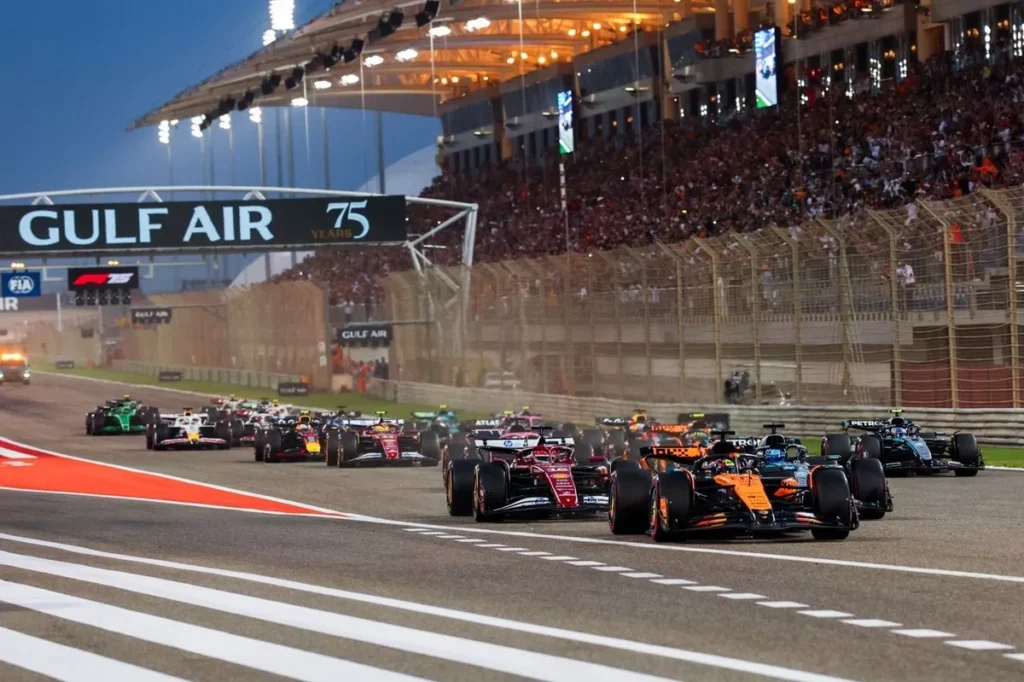
F1 “Working Overtime” to Monitor Middle East as Q1 Revenue Surges 53%
Liberty Media reports record first-quarter revenue of $617 million, but the cancellation of Bahrain and Saudi Arabia casts a shadow over the 2026 calendar. Series chiefs are exploring contingency plans to restore at least one race.
Formula 1’s commercial engine is firing on all cylinders. Liberty Media, the series’ rightsholder, has unveiled a record-breaking first quarter for 2026, with revenue climbing 53% year-on-year to $617 million. Operating income swung from a $28 million loss in Q1 2025 to a $107 million profit, while adjusted OIBDA more than doubled to $172 million.
Yet beneath the headline figures lies a growing uncertainty. The Bahrain and Saudi Arabian Grands Prix were cancelled in April due to the escalating conflict between the United States, Israel, and Iran. Now, F1 CEO Stefano Domenicali and his team are “working overtime” to evaluate whether one of those races can be restored later in the season — and what happens if the situation worsens.
Record Q1 Revenue: The Numbers Behind the Surge
The $617 million revenue figure represents a new Q1 record for Formula 1, surpassing the previous high of $553 million set in 2024. The jump was driven primarily by one extra race being held in the quarter — three events (Australia, China, and Japan) compared to two in Q1 2025 — which amplified income across all three commercial pillars: media rights, race promotion, and sponsorship.
| Metric | Q1 2026 | Q1 2025 | Change |
|---|---|---|---|
| Revenue | $617M | $403M | +53% |
| Operating Income | $107M | ($28M) | +$135M |
| Adjusted OIBDA | $172M | $85M | +102% |
| Races Held | 3 | 2 | +1 |
Hospitality revenue also outpaced expectations, with the Paddock Club nearly sold out for the remainder of the 2026 season and over 65,000 tickets already sold. New sponsorship deals with Standard Chartered, Betway, Salesforce, and Allwyn further bolstered the commercial portfolio, while a renewed agreement with Foxtel in Australia worth a reported $42 million per year anchored broadcast revenue.
The Middle East Crisis: Calendar in Flux
The strong financial start masks a looming challenge. The Bahrain and Saudi Arabian Grands Prix were pulled from their April slots as the conflict in Iran erupted, creating a five-week gap in the calendar between Japan and Miami. F1 has been careful not to label either race as definitively cancelled, leaving the door open for a return.
“We will be thoughtful in our approach, and we will continuously evaluate the calendar this year. It might be possible to reschedule one race toward the end of the season. I think we are evaluating all the various alternatives and trying to make decisions in a timely fashion.” — Derek Chang, CEO of Liberty Media
Chang made clear that the wellbeing of everyone in F1 comes first, but the commercial imperative is undeniable. Saudi Arabia pays one of the highest hosting fees on the calendar, making its return financially significant. A final decision, however, will likely wait until the summer break, when it should be clearer whether tensions have eased into a lasting ceasefire.
Two Realistic Windows for Reinstatement
F1 is weighing two primary options to slot a race back into the calendar. The first and simplest is the weekend of October 2–4, which currently sits empty between the Azerbaijan Grand Prix (September 26) and Singapore (October 11). Inserting Bahrain here would create a triple header before the already demanding US-Mexico-Brazil stretch, but the commercial upside would offset the logistical strain.
The second option is more complex. The current season finale runs Las Vegas (November 21), Qatar (November 29), and Abu Dhabi (December 6). One proposal would shift Abu Dhabi back to December 13 and slot either Bahrain or Saudi Arabia into the December 6 slot. This would create F1’s first-ever quadruple header — an unprecedented physical and logistical test for teams and freight operations.
Abu Dhabi is contractually guaranteed to host the season finale, so any reshuffle would require delicate negotiation. The lead time needed for freight, travel, and promoter coordination means a decision cannot be delayed indefinitely.
The Worst-Case Scenario
F1 must also plan for the possibility that the conflict extends through the end of the year, putting the Qatar and Abu Dhabi rounds at risk. While the series is content to run a 22-race calendar if Bahrain and Saudi Arabia cannot return, dropping below that threshold would likely trigger a search for replacement venues.
Finding suitable circuits in December, during the European winter, is not straightforward. Domenicali has confirmed that backup plans exist but declined to specify whether a double-header in Las Vegas or other leftfield options are under consideration.
“The only thing I can say is that we have plans, hopefully not to be applied, because we really hope that the situation for the world, not only for the racing, will go back to a normal situation. We are aligning with the teams and with the promoters, because that’s something that has a big chain of reaction.” — Stefano Domenicali, F1 President and CEO
Q2: The Reckoning
The true financial impact of the Middle East cancellations will not be visible until Q2 results are released. That quarter will feature only five races compared to nine in Q2 2025, creating a significant revenue shortfall regardless of the strong Q1 performance. The Bahrain and Saudi Arabian events would have fallen squarely into this window, meaning media rights, hospitality, and freight income from those rounds will be entirely absent.
Broadcast: Apple TV’s first season as exclusive US partner delivered higher average viewership with a younger, more female-skewing audience. Sky UK renewed through 2034, Italy through 2032. Digital: F1 TV revenue grew 28% YoY; YouTube content generated nearly 600 million views through Japan, up 46%. Retail: Merchandise sales jumped 125%, driven by the Disney-F1 partnership in Asia-Pacific.
Global Audience Growth
Despite fan complaints about the on-track product under the new 2026 regulations, global television viewership has risen across the opening races. Audiences grew 23% in Australia, 30% in China, and 20% in Japan year-on-year. The Apple TV partnership in the United States is already showing signs of expanding F1’s demographic reach, while the BeIN Sports renewal across Asia until 2030 secures a key growth market.
What Happens Next
The coming months will test F1’s operational agility. A decision on whether to reinstate Bahrain or Saudi Arabia is expected by the summer break at the latest. Until then, Domenicali’s team will continue monitoring the geopolitical landscape while keeping teams and promoters aligned on potential calendar shifts.
For Liberty Media investors, the Q1 results demonstrate that F1’s underlying commercial model remains robust. The question is whether that resilience can withstand the loss of two — or potentially four — Middle Eastern races in a single season.
Sources
- Motorsport.com — F1 “working overtime” to monitor Middle East as Q1 revenue surges
- The Race — F1’s options as it tries to get a race back onto the 2026 calendar
- SportsPro — F1 revenue soars 53% to US$617m in Q1 2026
- TIKR — Formula One Group Stock Beats Q1 Estimates With Revenue Up 59%
- Insider Sport — Formula 1 posts record Q1 revenue in strong 2026 start
- Circuit Summit — F1 Evaluates Calendar Changes Amid Middle East Uncertainty
Discover more from f1liveupdates.com
Subscribe to get the latest posts sent to your email.
Test, message – Thank you!