
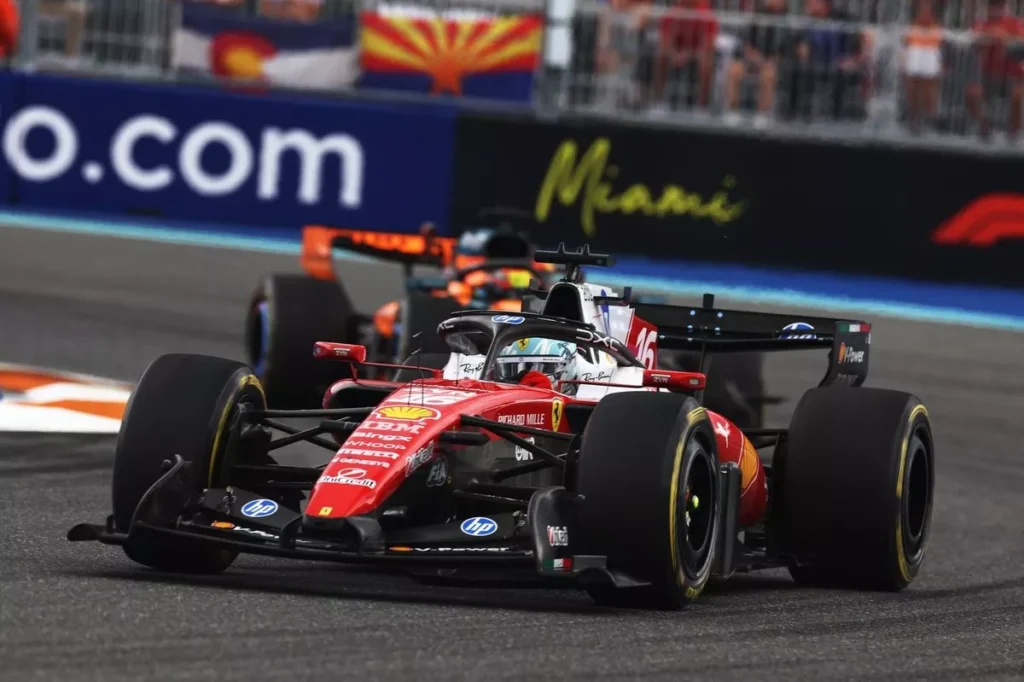
Steiner Explains Why Ferrari Has No Easy Fix After McLaren’s Miami Surge
Ferrari arrived in Florida as Mercedes’ closest challenger. It left behind McLaren in the pecking order, with Hamilton sixth and Leclerc eighth after a penalty. Guenther Steiner identifies why a quick solution is unlikely — and Karun Chandhok issues a pointed warning.
Miami was supposed to be Ferrari’s chance to consolidate second place in the constructors’ championship and tighten the gap to Mercedes. The team arrived with a significant upgrade package — eleven new parts listed with the FIA, the most of any team — and the expectation that Florida’s layout, which rewards aerodynamic grip and traction, would suit the SF-26. Instead, by the end of Sunday’s grand prix, McLaren had leapfrogged them in the race results with Norris second and Piastri third, Hamilton finished a distant sixth, and Leclerc was classified eighth after a 20-second penalty for a spin that saw him cut a chicane. Guenther Steiner, watching from outside the paddock, has a clear reading of why Ferrari cannot simply engineer its way to a quick solution.
The Miami GP That Wasn’t
The contrast between what Ferrari brought to Miami and what it produced from those parts is striking. Eleven upgrades — a new floor, revised aerodynamic surfaces, updated brake cooling — and the result was a team that looked slower relative to the field than it had in Japan. The SF-26’s updates are understood to be working as intended in the data; the problem, as Steiner frames it, is that Ferrari’s remaining weaknesses are not concentrated in a single identifiable area that one major package can address.
Steiner: “The Last Little Bit Is Always Missing”
Speaking on The Red Flags Podcast, Steiner offered an unusually empathetic analysis of Ferrari’s position — framed through his experience watching teams try to cross the threshold from “fast but not quite” to “genuinely dominant.”
“There’s always something. The last little bit is missing. I would wish nothing better for them to get over that hurdle and to stay there — because maybe when you get that feeling, you carry everything.”
— Guenther Steiner, The Red Flags Podcast
The core of Steiner’s analysis is structural: Ferrari’s gap to Mercedes is not attributable to one large, fixable problem. It is the accumulation of several smaller deficiencies across different areas of the car — none of which is catastrophic in isolation, but which together add up to a car that is consistently a step behind when it matters most. When one area improves, another reveals itself. When the car performs well aerodynamically, the power unit becomes the limiting factor. When tyre management is addressed, setup balance shifts the problem elsewhere.
Where the Weaknesses Are
Ferrari is understood to be down on power unit performance relative to Mercedes — partly linked to Mercedes’ interpretation of engine compression ratio rules, a loophole that will be closed after the Canadian Grand Prix. Ferrari may benefit from ADUO provisions if the gap is confirmed at between 2% and 4% below the benchmark.
Leclerc himself has described “huge gains” available in the SF-26’s aerodynamic efficiency. Ferrari retains a corner speed advantage over McLaren in most conditions, but the absolute level of downforce at the car’s peak operating window is below where the team wants it to be.
Inconsistent tyre performance across race stints has been a recurring theme. The SF-26 can be fast in qualifying and early race conditions, but the degradation curve is not as predictable as Ferrari needs for the strategy calls that define results in 2026’s complex energy-management racing.
Leclerc’s 20-second penalty in Miami — for cutting a chicane after a spin — and similar moments throughout the season have cost Ferrari points at the worst possible junctures. Individually explicable; cumulatively expensive in a tight constructors’ battle.
Chandhok’s Warning: “There Should Be Concern at Maranello”
Sky Sports F1 analyst Karun Chandhok was more pointed than Steiner about what the Miami results mean for Ferrari’s trajectory. Where Steiner offered explanation, Chandhok offered warning.
“If that is the big Ferrari upgrade for this early part of the season, then McLaren and Mercedes won’t be worried. Miami should have been the weekend which propelled them in front. I feel like they’ve slipped behind. For me, there should be a little bit of concern at Maranello and Ferrari. They’ve got to think about whether there’s further performance to be optimised or unlocked from this update — because otherwise they will get dropped behind when McLaren add the bits we believe are coming to Canada and Mercedes get their big upgrade.”
— Karun Chandhok, Sky Sports F1
The concern Chandhok articulates is about trajectory rather than absolute pace. Ferrari is not slow — it is the best team on the grid after Mercedes in raw constructors’ points. But both McLaren and Mercedes are now bringing further upgrades to Canada, while Ferrari will need to demonstrate that its Miami package has more performance to unlock before the European swing begins to define the championship. Leclerc himself said before Miami that he sees “huge gains” available from the power unit, chassis, aerodynamics, and tyre management simultaneously. Whether that optimism translates into lap time is the question Canada and the first European rounds will answer.
Steiner’s broader point stands regardless of what Canada produces. Ferrari’s challenge is not the kind that one upgrade package can resolve, because it is not the kind that one upgrade package caused. It is the convergence of smaller gaps in multiple domains — exactly the kind of problem that requires methodical, sustained development over many races, rather than a single silver-bullet fix. The question is whether the team can close all of them fast enough while Mercedes and McLaren continue to develop simultaneously.
Discover more from f1liveupdates.com
Subscribe to get the latest posts sent to your email.