
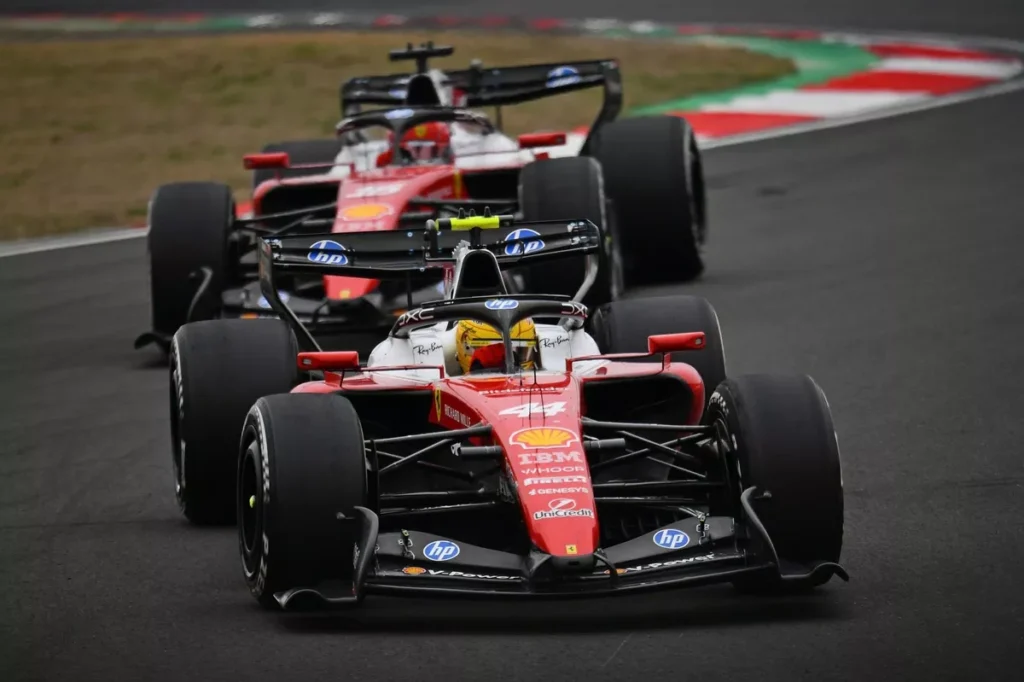
Ferrari Pushes Energy Recovery to the Limit: How Its Strategy Will Change at Suzuka
Ferrari arrives at Suzuka with refined Macarena wing aerodynamics, new energy distribution maps and a 6–7kg weight reduction still to complete. Here is what Maranello has prepared for a circuit that could finally narrow the gap to Mercedes.
FERRARI
SF — 26
After two race weekends in which Mercedes has been simply dominant — winning both in Melbourne and Shanghai with comfortable 1-2s — Ferrari arrives at Suzuka carrying two things: a significant amount of technical work completed at Maranello over the break, and a genuine reason for optimism about the circuit ahead.
Suzuka is, by nature, a different challenge from the opening rounds of the season. Its fast, flowing sector one, the demanding 130R and the sustained high-speed load through its corners place a premium on aerodynamic balance and downforce efficiency — precisely the areas where the SF-26 has shown its most competitive qualities. Energy management remains the central unknown. But Ferrari has been working hard on that front too.
The Macarena Wing — What It Is and Why It Matters
The most visible element of Ferrari’s development work for Suzuka is the return of its innovative movable rear wing, nicknamed the “Macarena” by the paddock — a reference to its rotating flaps, which open and close along the straights in a way that somewhat resembles the famous dance. The system debuted in a single free practice session in Shanghai but was withdrawn before qualifying and the race after drivers Charles Leclerc and Lewis Hamilton reported aerodynamic instability in the braking zones.
The core problem identified in China was a timing mismatch: the rear wing’s flaps were closing too slowly relative to the front wing’s active aerodynamics, creating an imbalance at the moment of braking that destabilised the car. Hamilton’s spin in practice was a direct consequence. Ferrari’s engineers spent the time between Shanghai and Suzuka building simulations based on that data, and the wing is now expected to return — refined, with new actuator timing calibrations.
The “Macarena Wing” — How It Works
- Two rotating flaps on the rear wing open along straights to reduce drag — similar in function to DRS, but more sophisticated and continuously variable
- Energy harvesting mode: When the flaps close in braking zones, the increased downforce transfers more load to the rear, helping the MGU-K recover more electrical energy from deceleration
- Actuator redesign: The central actuator (which created drag) has been replaced by two side-mounted actuators in the endplates — reducing drag while improving control authority
- The China problem: The rear flaps closed more slowly than the front active wing adjusted, creating a rear-biased aerodynamic balance under braking — generating instability that compromised both Leclerc and Hamilton
- Why Suzuka suits it: The circuit’s mix of high-speed technical sections and two long straights (pit straight and back straight) creates ideal conditions for a variable-drag rear wing — open for speed, closed for downforce and energy recovery
- Weight penalty: The two new actuators add mass. The SF-26 already needs to shed 6–7kg to approach the minimum weight limit, making the trade-off carefully managed
Energy Distribution: Rethinking the Lap
Beyond the wing, Ferrari has been reworking its energy deployment maps for Suzuka’s specific demands. In the 2026 regulations, managing how and where to deploy and recover electrical energy is as important as mechanical speed. Suzuka is classified as a Class B circuit in terms of energy demand — meaning medium requirements, unlike the energy-intensive Melbourne which taxed every manufacturer.
This is significant for Ferrari. In Australia and China, the SF-26’s primary deficit to Mercedes occurred on the long straights — where the Silver Arrows’ power unit could exploit greater ICE output to simultaneously drive the car and recharge the battery more aggressively. On Mercedes’ power philosophy — known as “super clipping” — the engine generates electricity by partially burning fuel at the top of straights, accepting a modest speed reduction but banking energy for the next deployment phase. Ferrari’s unit achieves the same objective but with greater speed penalties on the straights, which is where the gap to the W17 materialised.
“It is no secret that Ferrari is very competitive in technical, twisty sections, while it struggles on long straights where Mercedes can exploit greater high-end power from its internal combustion engine to help recharge electrical energy.”
— Motorsport.com analysis, March 2026
Suzuka’s back straight is long, but the ratio of high-speed corners to straights is significantly more favourable to Ferrari than Shanghai’s back section. According to simulations from Maranello, the gap to Mercedes at Suzuka could be reduced to approximately three tenths of a second per lap — a meaningful improvement from the roughly four-and-a-half tenths Ferrari lost per lap in China.
Ferrari vs Mercedes at Suzuka — The Technical Picture
SF-26 vs W17 — Suzuka Circuit Profile
What Comes After Suzuka: The Miami Package
Ferrari is clear-eyed that Suzuka does not represent a full reset of the competitive order. The Macarena wing’s development continues — the version planned for Japan is still a first-generation iteration, and a more sophisticated concept allowing differentiated closing timing per corner is being evaluated for later in the season. The aerodynamic benefits when open are confirmed; it is the closed-wing behaviour — particularly through high-speed corners — that still requires optimisation.
Ferrari’s Short-Term Development Roadmap
- Suzuka (now): Refined Macarena wing timing calibration, new energy maps, front flap adjustments for balance — first real test of Japan-specific setup philosophy
- Monza filming day (April): Ferrari expected to test Miami-targeted updates during the break — including weight reduction components ahead of European spring
- Miami (May 4): First major upgrade package — significant aerodynamic and weight reduction improvements. Likely the most meaningful step of the early season
- Future Macarena wing evolution: A version with per-corner differentiated closing timing is in development — would give Ferrari far greater flexibility in energy harvesting and drag management per circuit
- Weight target: SF-26 currently 6–7kg above the regulatory minimum. Every kilogram saved is approximately 0.03s per lap in qualifying — a priority task running in parallel with aerodynamic development
“The aerodynamic benefits are clear when the wing is open, while those when it is closed can still be improved. But these advantages must outweigh the drawbacks: with two actuators mounted in the side plates, there is an inevitable increase in weight.”
— Motorsport.com technical analysis, March 2026
For now, Suzuka represents Ferrari’s best opportunity since the start of the season to genuinely close the window on Mercedes. If the Macarena wing’s balance issues have been resolved — and Maranello is cautiously optimistic on that front — and if the energy remap delivers the gains the simulations suggest, Leclerc and Hamilton could be fighting for a front-row position in qualifying rather than the second row. A three-tenth-per-lap gap is still significant. But it is a gap within which strategy, circuit characteristics and a fortunate safety car can make the difference.
The Prancing Horse has rarely been better prepared for a weekend. Whether the preparation translates into performance at one of the sport’s most demanding circuits remains to be seen.
Sources
- Motorsport.com — Ferrari pushes energy recovery to the limit: How its strategy will change at Suzuka
- Autosport — Ferrari’s revolutionary “Macarena wing” will return in Japan
- ScuderiaFans — Ferrari maximizes energy harvesting at Suzuka: SF-26 strategies take centre stage
- ScuderiaFans — Ferrari targets Suzuka breakthrough: SF-26 chassis efficiency can topple Mercedes dominance
Discover more from f1liveupdates.com
Subscribe to get the latest posts sent to your email.