
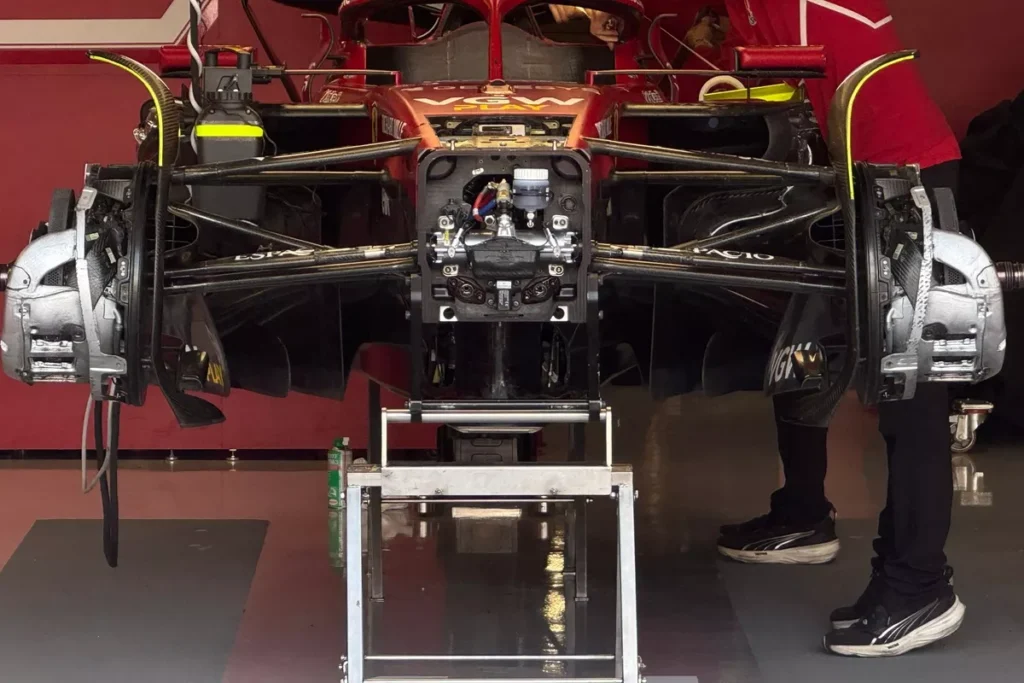
Why 2026 Regulations Are Changing the Game for F1 Brakes
With more flexible rules and dramatically increased energy recovery capability, the way Formula One cars stop—and how drivers manage that process—will be fundamentally different this year.
The MGU-K Revolution
At the heart of the braking transformation lies a massive increase in MGU-K (Motor Generator Unit – Kinetic) power. Currently, F1 cars use a 120-kilowatt MGU-K, but from 2026, this increases nearly threefold to 350 kilowatts (approximately 469 horsepower).
This dramatic power increase means the MGU-K can harvest significantly more energy during braking events, fundamentally changing the balance between regenerative braking (using the MGU-K to slow the car while generating electricity) and mechanical braking (using traditional brake discs and pads).
The energy recovery capacity doubles from approximately 4 megajoules per lap to 8.5 megajoules per lap. This means drivers can recover twice as much energy through braking, throttle lift-off at the end of straights, and even in corners where only partial power is applied.
« This is my 15th season in Formula 1, so I went through different changes in the shape of brakes, cars, tyres, different wheels. This is honestly one of the most challenging [regulation changes] for us. »Andrea Algeri, Brembo F1 Customer Manager
More Open Regulations Create Design Freedom
Beyond the MGU-K power increase, the 2026 regulations provide teams with significantly more flexibility in brake design—a departure from the tightly prescribed specifications of recent years.
For brake calipers, teams now have much greater design freedom. Previously, each caliper could have up to six pistons. Under 2026 regulations, calipers may be equipped with anywhere from two to eight pistons, and up to four pads. The mounting system has also been revised, allowing up to three attachment points rather than the previous restrictions.
Previous Regulations
- Up to 6 pistons per caliper
- Tight design specifications
- Limited mounting options
- 120kW MGU-K power
2026 Regulations
- 2-8 pistons per caliper
- Flexible design freedom
- Up to 3 attachment points
- 350kW MGU-K power
This flexibility enables teams to tailor their brake systems more precisely to their overall car concept, energy recovery strategy, and circuit-specific demands.
The rear braking system must be capable of delivering 2,500 Newton-meters of braking torque to each rear wheel without assistance from the power unit. This torque target must be achieved with a maximum caliper pressure of 150 bar, while hydraulic pressure in the rear braking system may not exceed 1.2 times the pressure applied by the driver.
Rethinking Circuit Brake Ratings
The increased regenerative braking capability forces a complete reconsideration of how circuits are rated for brake duty.
Circuit Rating Inversion
« We have to rethink the rating regarding the braking duty of the circuit, because this now is more related to energy recovery. A light duty track in terms of torque, like Monaco or Singapore, will become quite strong for the brakes because you have a lot of time to recover energy and at a certain point the battery will be full, and then you have to use the brakes. » – Andrea Algeri
This inversion of traditional thinking represents one of the most significant strategic changes. Circuits with frequent braking zones—traditionally considered « heavy » on brakes—may become lighter on mechanical brake usage because the MGU-K handles much of the deceleration. Conversely, circuits with fewer but more sustained braking zones may stress mechanical brakes more heavily as batteries reach full charge and cannot accept additional regenerative braking energy.
High-speed circuits like Monza present particular challenges. While speeds are high and braking events are significant, the reduced number of corners means fewer opportunities for energy recovery, potentially placing more demand on mechanical brakes.
The Temperature Management Challenge
Perhaps the most critical technical challenge created by increased regenerative braking is maintaining proper brake temperatures.
If the MGU-K handles most of the braking duty, mechanical brakes receive less use and can cool down excessively—a dangerous situation. Cold brakes are significantly less effective, and a driver pressing the brake pedal when temperatures are low could face dramatically increased incident risk.
Temperature Management Risks
- Overcooling: Excessive MGU-K reliance can cool brakes below operating temperature
- Battery saturation: Full batteries force sudden mechanical brake engagement
- Cold brake incidents: Low temperatures reduce braking effectiveness dramatically
- Circuit variability: Some corners may not use rear brakes at all
« In 2026, the MGU-K will provide 350 kW (approximately 475 hp) of braking power. Some circuits may have corners requiring only medium or low braking power, at or below 250 kW, » explained recent technical analysis. « Teams will aim to regenerate as much energy as possible, but this reduces mechanical brake use. If a heavy braking zone occurs later in the lap, the brakes may be too cold, creating a risk of underperformance or failure. »
The brake-by-wire system—which electronically controls the balance between regenerative and mechanical braking—becomes even more critical in 2026. The system must continuously monitor brake temperatures and adjust the split between MGU-K and mechanical braking to keep discs and pads within optimal operating temperature ranges.
Smaller, Lighter Brake Designs
The 2026 regulations also reduce the minimum car weight from 800 kilograms to 768 kilograms—a 32-kilogram reduction despite larger batteries. This aggressive weight target forces teams to find savings wherever possible, including brake systems.
« The teams are looking for the best trade-off, » Algeri noted. « Not going far bigger than the current season, because if they use the largest dimensions allowed, it could be too heavy. And on the other side, different teams have a different view of the energy recovery strategy. »
The expectation is that teams will pursue more extreme choices for rear brake discs, aiming primarily to save weight wherever possible, assuming that in most cases braking on the rear axle will be generally reduced due to MGU-K regeneration. However, designs must still consider scenarios where mechanical brake stress remains high—particularly when batteries are fully charged and cannot accept additional energy.
Bigger is no longer automatically better. Teams must balance weight savings against the need for adequate thermal mass and braking capacity in worst-case scenarios.
Strategic Implications: Lift and Coast
The increased regenerative braking capability creates new strategic options—and necessities—for drivers.
« We will likely see an element of ‘lift and coast’ so the drivers can recover energy and use it for longer acceleration periods at a higher power. »
Drivers may lift off the throttle earlier before braking zones to maximize energy recovery through throttle lift-off and regenerative braking. This « lift and coast » technique allows the MGU-K to harvest energy over a longer distance at lower power levels, potentially more efficiently than harvesting only during the brief, high-power braking event itself.
New Strategic Dimensions
If one driver is lifting into braking zones to harvest energy while another is not, drivers from significantly behind could suddenly find themselves alongside or even ahead entering the corner. The driver who maintained speed has a one-time advantage, but the driver who harvested energy may have electrical power available to deploy on corner exit.
Understanding when to harvest aggressively versus when to prioritize track position becomes a crucial driver skill—one that teams must also manage through real-time strategy calls.
Software as Important as Hardware
Brembo’s technical analysis emphasizes that 2026 will be « a software as much as a hardware race. » The brake-by-wire system’s algorithms for managing the split between regenerative and mechanical braking become absolutely critical.
Critical Software Requirements
- Monitor brake temperatures in real-time across all four corners
- Predict future brake temperature based on upcoming corners
- Adjust regenerative/mechanical braking split to maintain optimal temperatures
- Maximize energy recovery while preventing overcooling
- Adapt to battery state of charge continuously
- Respond to driver inputs and race strategy requirements
The team that develops the most sophisticated brake management software—capable of optimizing energy recovery while maintaining brake performance across all scenarios—will gain significant lap time advantages.
Active Aerodynamics Add Another Layer
The 2026 regulations also introduce active aerodynamics, allowing front and rear wing elements to adjust between corner and straight configurations. This adds another variable affecting braking.
When wings open on straights to reduce drag, cars reach higher top speeds, which means they arrive at braking zones with more kinetic energy to dissipate. However, the higher speeds also mean the MGU-K can harvest more energy during deceleration—at speeds above 220 miles per hour, the MGU-K continues deploying or harvesting its maximum 350 kilowatts.
The interplay between active aerodynamics, energy recovery, and brake management creates unprecedented complexity in optimizing lap time. Teams must consider how wing settings on straights affect brake and energy recovery performance in subsequent corners.
Different Teams, Different Philosophies
Algeri noted that « different teams have a different view of the energy recovery strategy, » suggesting that 2026 may see genuine philosophical differences in how teams approach the brake/energy recovery challenge.
Some teams may prioritize aggressive energy harvesting, accepting the challenges of managing cold brakes in exchange for maximum electrical power availability. Others may take a more conservative approach, using mechanical brakes more consistently to maintain temperature even when energy recovery would be possible.
These philosophical differences could manifest in different brake disc sizes, caliper configurations, and brake-by-wire software strategies. The variety of approaches may create interesting performance trade-offs between qualifying (where maximum energy deployment matters most) and race conditions (where consistency and reliability are crucial).
The 2014 Parallel
The 2026 braking changes represent the most significant transformation since 2014, when F1 introduced hybrid power units with regenerative braking and brake-by-wire systems for the first time.
« The 2026 regulations arguably represent the most significant change in F1 braking technology since the start of the hybrid era in 2014, » Brembo stated in their technical analysis. « The introduction of hybrid power brought regenerative braking and brake-by-wire, making the rear braking system far more complex. »
The 2014 changes were primarily technological—learning to integrate regenerative and dissipative braking. By comparison, teams are now well-prepared on that technological front. The 2026 challenge is more strategic: understanding how to make the most of the new rules will take time, and not every team may find the optimal solution immediately.
In 2014, Mercedes mastered the hybrid systems better than rivals, contributing significantly to their championship dominance. The team that best solves the 2026 braking/energy recovery challenge could gain similar advantages.
The Learning Curve
The complexity of the new braking systems means a steep learning curve for teams, drivers, and even brake suppliers.
Teams must understand how different energy recovery strategies affect brake temperatures, which circuits require more conservative mechanical brake usage, how to optimize brake-by-wire algorithms for each circuit, when drivers should prioritize energy recovery versus mechanical braking, and how battery state of charge affects optimal brake management.
Drivers must learn new braking techniques incorporating lift and coast strategies, how to modulate brake pedal pressure with knowledge of regenerative/mechanical split, when to prioritize energy harvesting versus immediate performance, and how to manage races where energy recovery creates new strategic options.
The teams that climb this learning curve fastest in 2026 testing and early races could establish significant performance advantages that persist throughout the season—similar to how regulation changes in 2014 and 2022 created early leader advantages that proved difficult to overturn.
Conclusion: A Fundamental Transformation
The 2026 braking regulations transform one of Formula One’s most basic functions—stopping the car—into a complex strategic and technical challenge.
The nearly threefold increase in MGU-K power, combined with more flexible regulations and aggressive weight targets, forces teams to completely rethink brake design, energy recovery strategies, and brake-by-wire software.
Traditional assumptions about circuit brake ratings are inverted. Temperature management becomes a critical challenge. Software development rivals hardware development in importance. Different teams may pursue genuinely different philosophical approaches.
For fans, the changes create new strategic dimensions to watch. Lift and coast techniques may create unexpected passing opportunities. Energy management strategies may prove as important as tire strategies. The driver who best masters the brake/energy recovery balance gains crucial advantages.
As Andrea Algeri noted, this represents one of the most challenging regulation changes in Formula One history. The teams, drivers, and brake suppliers who solve the 2026 braking puzzle will be rewarded with significant competitive advantages in the sport’s new era.