
Mercedes’ Strange Abu Dhabi Test Device Explained: What It Is and Why It Matters
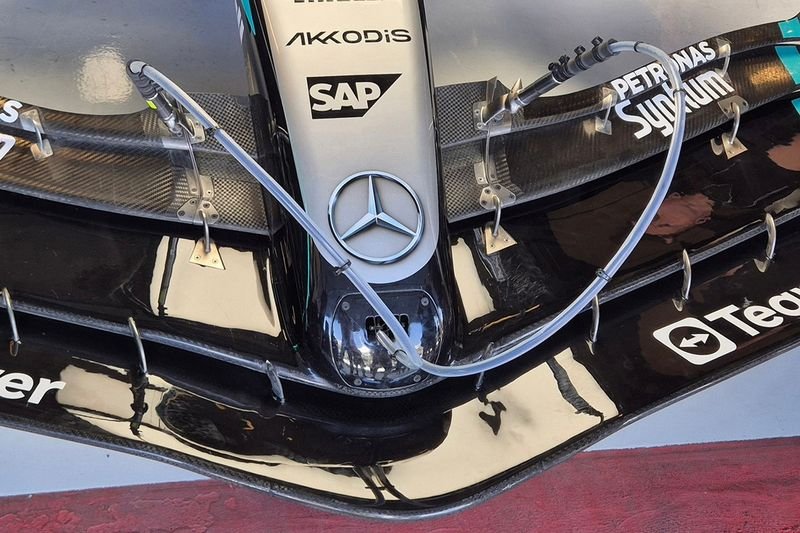
Photographs and commentary from media outlets have since clarified the nature and purpose of this equipment, which appeared as a visible, somewhat crude actuation mechanism on the front wing.
Post-Season Testing Context
Each year after the final Grand Prix, Formula 1 teams participate in a short test session at the Yas Marina Circuit designed primarily to assist tyre supplier Pirelli in developing compounds for the upcoming season. In 2025, these tests also served as a critical opportunity to explore technical concepts for the sweeping 2026 regulations, which introduce active aerodynamics as a major new technical feature.
Teams use “mule” cars — modified versions of their current season machines — with adjustments such as significantly reduced downforce levels to approximate the behaviour expected under the 2026 aerodynamic and chassis rules.
What the Device Was
The distinctive apparatus on the Mercedes mule car was a prototype active front wing system. It consisted of visible tubing and a basic actuation mechanism that allowed the front wing to change its configuration dynamically during a lap — notably to reduce drag on straights and alter downforce levels.
- Designed to simulate 2026 « Straight Line Mode » logic.
- Replaces the traditional static wings used under current regulations.
- Described as « rudimentary » compared to the integrated systems expected in 2026.
Why Mercedes Did This
There were two principal objectives behind Mercedes’ active front wing prototype:
1. Data Collection for 2026 Preparations: Running the active aerodynamic system allowed Mercedes and Pirelli to gather valuable real-world data on how reduced downforce and variable wing configurations affect tyre behaviour at race pace.
2. Simulating Rule Changes Ahead of Time: The 2026 regulations will give teams far greater freedom with active aero systems. By experimenting with a front wing that can shift between high and low downforce states, Mercedes could begin understanding how to balance vehicle dynamics under new rules.
Pirelli’s competition director, Mario Isola, noted that this kind of testing helps compare tyre loads and speeds between cars with and without the active systems — a key input for developing the new 18-inch tyre range.
Broader Implications
The appearance of active aerodynamic prototypes in Abu Dhabi marks a visible sign of Formula 1’s technical transition for 2026. Under the new regulations, aerodynamic components are expected to actively adjust during a lap — a departure from the traditional static wing profiles. This shift may influence car design, overtaking dynamics, and tyre performance once the new rules take effect.
Conclusion
The unusual device on the Mercedes at the Abu Dhabi test was not a permanent race-ready component, but a prototype active front wing system. While rudimentary in design, it provided a practical demonstration of how Mercedes is preparing for one of the most significant technical shifts in recent Formula 1 history.
Sources
- Motorsport.com: “Quel est cet étrange dispositif sur la Mercedes au test d’Abu Dhabi ?”
- GrandPrix.com: “Wolff cools 2026 hype as Mercedes tests wing”
- PlanetF1.com: “First look: Mercedes rudimentary active front wing on track”
- Crash.net: “Mercedes run unusual front wing design for 2026 on mule car”
- The Race: “First look at movable front wing prototype”