Carlos Sainz: The Team Savior?
Carlos Sainz’s arrival at Williams for 2025 marked a significant moment for the historic Grove-based team. After finishing ninth in the 2024 Constructors’ Championship with just 17 points, Williams surged to fifth place in 2025 with 137 points—their highest tally since 2016. This remarkable transformation didn’t happen by accident.
The Williams Turnaround
Forced to leave Ferrari after the team signed Lewis Hamilton, Sainz had his pick of midfield options. He chose Williams, convinced by team principal James Vowles’s honest assessment of the team’s current state and long-term vision. While other teams may have offered more competitive immediate prospects, Sainz saw something in Williams’s rebuilding project that aligned with his own career trajectory.
2025 has exceeded my expectations in terms of car performance and what the team is capable of doing. I’m very comfortable and calm with the decision.
A Pattern of Team Improvement
The Williams resurgence fits a consistent pattern throughout Sainz’s career. Every team he has joined—Toro Rosso, Renault, McLaren, Ferrari, and now Williams—has improved in his first season at the wheel. This isn’t coincidence; it’s testament to Sainz’s unique ability to accelerate team development.
James Vowles, who orchestrated Sainz’s signing, has been effusive about what the Spaniard brings beyond pure lap time. « It’s been better than I expected, » the Williams team principal admitted. « There’s some elements to him I didn’t know until he came here. »
Vowles’s Discovery
« When you put pressure on him, he gets better. He needs pressure to effectively perform in a better way, and I didn’t know that about him, but that’s a great trait to have as a driver. »
The Analytical Approach
What sets Sainz apart is his exceptionally detailed approach to car development and feedback. Vowles highlighted this as a rare quality among drivers: « The level of detail feedback, when he’s able to go to another level of detail that’s very rare for a driver to have. »
This analytical mindset manifests in how Sainz approaches adaptation. In the early season, when results weren’t coming, he systematically experimented with different setups and driving techniques.
I’m trying so many different things with my set-up and my driving that for sure, you see progress. Sometimes I try something, but I go backwards, and that then makes me go forwards, because I know which direction I don’t need to go in.
The Challenging Start
Sainz’s 2025 season didn’t begin smoothly. He crashed out of the season opener in Australia on lap one in wet conditions, caught out by the Williams-Mercedes power delivery. Through the first 16 races, while teammate Alex Albon racked up 70 points and established himself as one of the season’s surprise performers, Sainz managed just 16 points.
The contrast was stark. Albon scored points in three of the first seven races, including multiple top-five finishes, while Sainz struggled with adaptation, mechanical issues, and misfortune. At one point, Sainz went six consecutive race weekends without scoring on Sunday, creating questions about whether the four-time race winner had lost his touch.
The Breakthrough in Baku
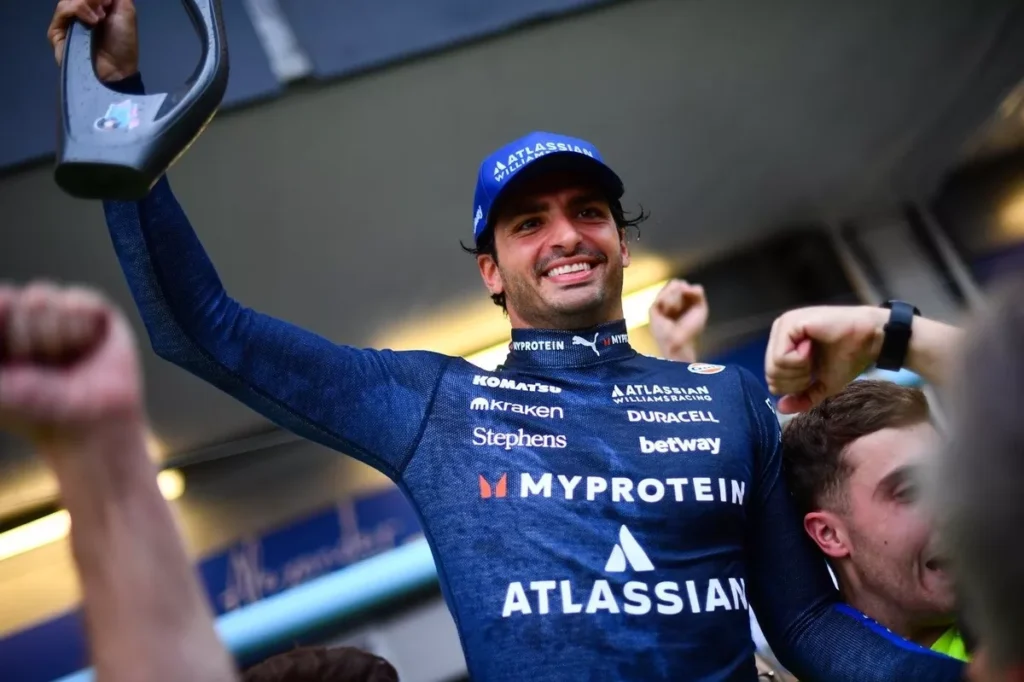
Everything changed in Azerbaijan. Qualifying on the front row—Williams’s highest grid position in over four years—Sainz converted the opportunity into a brilliant third-place finish. It was Williams’s first podium since George Russell’s rain-affected result at the 2021 Belgian Grand Prix, and only their second rostrum in eight years.
Honestly, I cannot describe how happy I am or how good this feels. It tastes even better than the first-ever podium that I did. We’ve been fighting hard all year and, finally today, we just proved that when we have the speed.
The Baku result represented more than just a good weekend. It validated the months of analytical work, the systematic experimentation with setups and driving styles, and the patience required to extract performance from a car significantly less competitive than the Ferrari he had piloted the previous four years.
The Second-Half Surge
The Azerbaijan breakthrough triggered a remarkable run of form. Across the final eight races, Sainz scored 48 points—more than tripling his first-16-race total. For comparison, Albon managed just three points over the same period as their fortunes completely reversed.
Sainz added a second podium in Qatar, a result that proved crucial in securing Williams’s fifth-place championship finish. He also qualified third in Las Vegas, demonstrating consistent competitiveness at the front of the midfield battle.
Beyond Lap Time: The Intangible Contributions
Sainz’s value to Williams extends far beyond his personal results. His experience as a four-time race winner and former Ferrari driver brings credibility and standards that elevate the entire operation.
Albon, who previously raced alongside Max Verstappen at Red Bull and worked within that organization, recognized immediately what Sainz brought to the team. The Spaniard’s attention to detail, his analytical feedback, and his methodical approach to problem-solving all contributed to raising Williams’s collective game.
Vowles on Sainz’s Impact
« Carlos is the last individual in this team, full stop, that has won a grand prix, and he knows what it is to be performing at the very pinnacle of the sport. We have a duty and a responsibility towards him to make sure we adapt the car, as he’s becoming more comfortable in our car and our environment, to make sure we’re pulling together. »
The Development Impact
Williams made a strategic decision early in 2025 to halt development of the FW47 and focus resources on the 2026 car under new regulations. This meant Sainz and Albon raced essentially the same package all season, with improvements coming from better understanding the car rather than physical upgrades.
Despite this limitation, Williams became faster through 2025—not through parts but through improved simulation tools, communication, ways of working, and setup optimization. Sainz’s analytical feedback played a crucial role in this process.
The « Life Project » Commitment
In a letter to Williams staff at season’s end, Sainz described his role at the team as his « life project »—a telling phrase that reveals his long-term commitment despite the inevitable frustrations of midfield racing.
As we close out a remarkable first season together, I want to express my sincere gratitude to each and every one of you for the incredible welcome I have received since day one at Grove. I knew I was joining a very special team, but our first year together has exceeded all my expectations.
The letter highlighted what Sainz values most: collective achievement rather than individual glory. He credited the fifth-place championship finish and the podiums in Baku and Qatar as « a direct result of your efforts and our teamwork. »
The Historical Achievement
Sainz’s Azerbaijan podium made him only the second driver ever to finish on the rostrum with McLaren, Ferrari, and Williams. The other? Four-time World Champion Alain Prost.
This historical footnote, while just a statistical curiosity, speaks to Sainz’s versatility and longevity. He has succeeded with multiple teams across different competitive contexts, adapting his approach to extract maximum performance from varying machinery.
Looking to 2026
Williams’s decision to sacrifice 2025 development for 2026 preparation positions the team to potentially make a significant leap under new regulations. With Sainz now fully integrated and the organization having learned from his analytical feedback, the 2026 season represents a genuine opportunity.
The new regulations’ emphasis on electrical power, active aerodynamics, and sustainable fuels creates uncertainty about the competitive order. Teams that dominated in 2025 might struggle in 2026, while those who struggled could leap forward.
Conclusion
Carlos Sainz may not fit the traditional mold of a Formula 1 star. He won’t dominate headlines or generate viral moments through aggressive racing or controversial statements. His strengths lie elsewhere—in the methodical accumulation of performance gains, the patient work of car development, and the analytical feedback that helps teams understand their machinery better.
But for a team like Williams, working to rebuild itself into championship contention after years of struggle, Sainz represents exactly what they need: a driver who knows what winning looks like, understands how to get there systematically, and commits to the long-term process required.
His 2025 season confirmed what previous teams discovered: Carlos Sainz makes organizations better. Whether he ultimately leads Williams back to race wins and championships remains to be seen. But the trajectory established in year one suggests the potential is there—if Williams can capitalize on the foundation Sainz is helping them build.
Sources
- Autoweek — « 2025 F1 Team Preview: It’s Carlos Sainz to the Rescue at Williams » February 3, 2025
- Sky Sports F1 — « Carlos Sainz: Williams driver says team his ‘life project' » September 24, 2025
- The Race — « The biggest impact Sainz had on Williams and Albon » December 18, 2025
- Motorsport.com — « Williams has exceeded 2025 expectations for Carlos Sainz » August 16, 2025
- PlanetF1.com — « Carlos Sainz writes special Williams letter after ‘remarkable’ F1 2025 season » December 21, 2025
- Formula1.com — « END OF YEAR REPORT: Williams’ best and worst moments from 2025 » December 2025
- Motorsport.com — « F1 2025 recap: Carlos Sainz shines despite move to the midfield » December 2025
- The Race — « What’s behind ‘world class’ Sainz’s low-key Williams start » April 1, 2025
- Motorsport Week — « How Carlos Sainz turned his debut Williams F1 season around » December 16, 2025
- Formula1.com — « EXCLUSIVE: Carlos Sainz on his first season as a Williams driver » December 20, 2025