
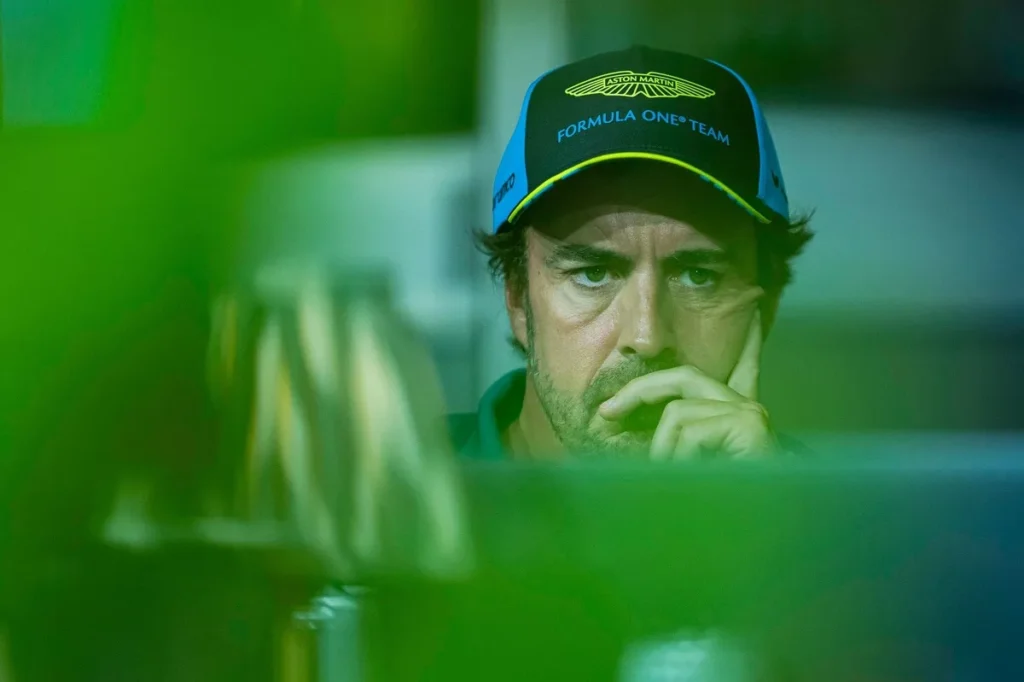
Bortoleto Defends Alonso’s Career Choices: « It’s Not a Skill, It’s Luck »
Sauber rookie Gabriel Bortoleto mounts a passionate defense of his mentor Fernando Alonso, firmly rejecting suggestions that the two-time world champion made poor career decisions following his championship years.
The Eternal Alonso Debate
The question has lingered throughout Fernando Alonso’s career like an unanswerable riddle: Did the Spanish driver’s relatively modest championship record result from poor career choices, or was he simply a victim of misfortune? With only two world titles to his name despite being widely regarded as one of the sport’s greatest talents, Alonso’s career trajectory has sparked endless debate among Formula One fans and pundits.
For Gabriel Bortoleto, who is managed by Alonso’s A14 management firm and whose career was rescued by the Spaniard’s intervention, the answer is clear. Alonso’s career arc wasn’t shaped by bad decisions but by the unpredictable nature of Formula One itself.
« This is not a skill. It’s not a skill! You can expect, you can think about it, you can predict. But you never know. »
Gabriel Bortoleto
Bortoleto’s emphatic statement came during media interactions ahead of the Mexican Grand Prix, where he was asked about Alonso’s team choices throughout his career. The young Brazilian’s defense centered on a compelling argument: even the most informed decision-making cannot account for Formula One’s countless variables.
« Wasn’t it Mercedes that won for eight years in a row? And then they got to the new regulations, and they got a completely wrong car. So how can you choose? You cannot choose, » Bortoleto explained, highlighting the sport’s fundamental unpredictability.
A Career Marked by Near Misses
Alonso’s Formula One journey began in 2001 with Minardi before his breakout performances with Renault led to consecutive world championships in 2005 and 2006. He was just 24 years old when he secured his second title, appearing destined for a career that would match or exceed the achievements of legends like Michael Schumacher.
What followed, however, was a series of moves that, in hindsight, seemed to consistently place him in the wrong team at the wrong time. His 2007 switch to McLaren lasted just one tumultuous season, marked by internal conflict with teammate Lewis Hamilton and a championship loss decided by a single point. Alonso’s decision to return to Renault for 2008-2009 coincided with the team’s decline in competitiveness.
Alonso’s Championship Near-Misses
2007: Lost to Kimi Räikkönen by 1 point at McLaren
2010: Lost to Sebastian Vettel by 4 points at Ferrari
2012: Lost to Sebastian Vettel by 3 points at Ferrari
His subsequent move to Ferrari in 2010 appeared more promising, and indeed came tantalizingly close to delivering additional championships. Alonso finished second in the drivers’ standings in both 2010 and 2012, losing the former by just four points and the latter by three. Yet Ferrari’s inability to provide consistently championship-winning machinery ultimately led to frustration and Alonso’s departure at the end of 2014.
Perhaps the most criticized decision came in 2015, when Alonso returned to McLaren just as the team embarked on a partnership with Honda. What should have been a dream combination of one of F1’s most successful teams and a legendary manufacturer instead became three years of misery, with the McLaren-Honda package proving hopelessly uncompetitive.
Bortoleto’s Perspective on Unpredictability
Bortoleto’s defense of his mentor centers on the fundamental unpredictability of Formula One. The Brazilian rookie argues that even the most informed decision-making cannot account for the countless variables that determine a team’s success or failure.
« You can just expect a good team to be doing well or not, » Bortoleto explained. « I think he chose very good teams. I think he went to… He didn’t go to a team that was completely off. He was always in that top three, top four range. It’s just that he didn’t get the luck he needed. That’s my view. »
« If even Mercedes, with its vast resources and proven excellence, could misjudge regulatory changes so drastically, how could any driver be expected to predict such outcomes? »
The Sauber driver’s point about Mercedes illustrates his argument effectively. The Silver Arrows dominated Formula One for eight consecutive seasons from 2014 to 2021, appearing unbeatable. Yet when new technical regulations arrived in 2022, Mercedes produced a car that struggled significantly, taking nearly two full seasons to return to genuine competitiveness.
Should Alonso Have More Titles?
When asked whether Alonso deserved more world championships, Bortoleto’s response was unequivocal: « Definitely, yes. I think he is one of the greatest of all time, in my view. Unfortunately, that’s how Formula 1 works. You need to be in the right place, in the right time. I think there are many talented drivers that have not been able to be world champions. »
This perspective touches on one of Formula One’s uncomfortable truths: championship success depends as much on circumstance as on talent. While every world champion undoubtedly possesses exceptional ability, the sport’s structure means that even generational talents can find themselves without competitive machinery.
« Some drivers that were world champions… I’m not saying they don’t deserve it. All of them deserve it because if you are a world champion in Formula 1, you are a very good driver, » Bortoleto clarified, careful not to diminish the achievements of others. « But, you know, it’s not a very fair comparison. »
The Historical Context
Alonso’s career choices must be understood within their historical context. His 2007 move to McLaren made perfect sense at the time; the team had just come off a championship-challenging season and appeared poised for success. That the partnership imploded due to interpersonal dynamics was not something any analysis of team performance could have predicted.
Similarly, Ferrari from 2010-2014 looked like a natural destination for a driver of Alonso’s caliber. The Scuderia had the resources, the history, and the ambition to provide championship-winning machinery. That they consistently fell just short—often due to operational mistakes or marginal performance deficits rather than fundamental car design flaws—could not have been foreseen.
Even the McLaren-Honda reunion, widely derided in retrospect, appeared logical based on both parties’ historical success. McLaren and Honda had dominated Formula One in the late 1980s and early 1990s. The partnership’s catastrophic failure resulted from Honda’s inability to produce a competitive power unit under the hybrid era regulations—a technical failure rather than a strategic miscalculation by Alonso.
A14 Management and Bortoleto’s Career
The relationship between Alonso and Bortoleto adds another dimension to this discussion. Alonso’s A14 management firm stepped in at a crucial moment when Bortoleto’s racing career hung in the balance. In 2022, the young Brazilian struggled to secure a Formula Three seat, unaware of how difficult it would be to find a competitive drive.
« We had so many issues in 2022, » Bortoleto recalled. « We were not being followed by anyone at the time. It was just me and my father and I didn’t have an opportunity to go to F3 at the time. We didn’t know how difficult it was to get a seat in F3. »
« He saved my career in the sense of maybe without him I wouldn’t have been in the team I was in Formula 3. »
Gabriel Bortoleto on Fernando Alonso
Alonso’s intervention proved decisive. Through connections established when Bortoleto raced for Alonso’s FA Racing team in Formula Regional, A14 secured him a seat with Trident for the 2023 Formula Three season. Bortoleto promptly won the championship in his rookie year, then repeated the feat in Formula Two in 2024, joining an exclusive club with Charles Leclerc, George Russell, and Oscar Piastri as the only drivers to win both championships in consecutive years.
The Mentor-Protégé Relationship
Despite both now competing in Formula One—Alonso with Aston Martin, Bortoleto with Sauber—their relationship remains strong, though necessarily more distant due to the demands of the championship.
« We have a very good relationship with each other, » Bortoleto said. « I think it’s mainly a professional relationship. Always when we talk, it’s mainly about racing. When I see him on track, if I have any questions, he always helped me in F3 and F2. I can say I’m very grateful for all the advice he has given me the last two years. »
The credibility that comes with Alonso’s backing carries significant weight in the Formula One paddock. « It’s a strong name to have behind you, » Bortoleto noted. « When you have Fernando Alonso managing you, it’s a bit different because they know it’s someone like him trusting you can be a future talent. »
Alonso’s reputation as a fierce competitor and his legendary work ethic have influenced Bortoleto’s approach to racing. The key advice the Spaniard has imparted is straightforward but profound: « Just to extract everything you have from every situation. » This philosophy—maximizing performance regardless of circumstance—defined much of Alonso’s own career and appears to have resonated with his protégé.
Bortoleto’s Own Formula One Journey
The Brazilian’s debut Formula One season has been challenging, typical for a rookie at a team struggling near the back of the grid. Competing for Sauber alongside experienced teammate Nico Hülkenberg, Bortoleto has shown flashes of potential while grappling with the immense learning curve that Formula One presents.
His performance at the Mexican Grand Prix, where his comments about Alonso were made, illustrated both his potential and the difficulties he faces. Starting 16th after a challenging qualifying session, Bortoleto fought his way to tenth place, securing a valuable point for his team through an aggressive and well-executed race drive.
« At some point I had tried so many times I said ‘whatever happens, happens, if we crash, we crash, but at least I need to go for it’, » Bortoleto explained of his late-race battle. « So it worked out very well. It was a tough fight with him, but he was clean, I was clean, and everything was cool. »
The Broader Implications
Bortoleto’s defense of Alonso speaks to larger questions about how Formula One evaluates driver greatness and the role of circumstance in championship success. The sport’s unique structure, where driver skill intersects with team performance, equipment quality, and simple luck, makes direct comparisons between drivers from different eras or teams inherently problematic.
Alonso’s career demonstrates that even drivers widely considered among the sport’s elite can find themselves without the machinery to compete for championships. His performances in uncompetitive cars—dragging the 2012 Ferrari to within three points of the championship, or regularly outperforming the McLaren-Honda package—showcased his exceptional talent but yielded no additional titles.
« Could anyone have predicted Mercedes’ hybrid-era dominance in 2013? Could Alonso have foreseen the McLaren-Honda partnership’s spectacular failure? The answer, objectively, is no. »
The counterargument, of course, is that part of a driver’s skill lies in positioning themselves within the right team at the right time. Lewis Hamilton’s 2013 move from McLaren to Mercedes, for instance, appeared risky at the time but proved prescient as Mercedes dominated the hybrid era. Sebastian Vettel’s time at Red Bull during their championship years represented perfect alignment between driver and team.
Yet Bortoleto’s point about unpredictability holds considerable weight. While patterns and indicators exist, Formula One’s technical complexity and competitive dynamics make certainty impossible.
The View from 2025
From the vantage point of 2025, with Alonso now 44 years old and still competing at the highest level with Aston Martin, his career can be viewed more holistically. He remains one of Formula One’s most complete drivers, respected by peers and rivals alike for his racecraft, technical feedback, and relentless competitiveness.
His two world championships, while fewer than his talent might have warranted, represent genuine achievements against strong competition. His longevity—24 years after his debut—speaks to his enduring abilities and passion for the sport. And his willingness to mentor young drivers like Bortoleto suggests a generosity of spirit not always associated with Formula One’s fiercest competitors.
For Bortoleto, defending his mentor’s career choices serves multiple purposes. It demonstrates loyalty to someone who provided crucial support at a pivotal moment. It shows an understanding of Formula One’s complexities that should serve him well as his own career progresses. And it challenges the overly simplistic narrative that Alonso’s relatively modest championship haul resulted primarily from poor decision-making.
Conclusion
The debate over Fernando Alonso’s career choices will likely continue long after he finally retires from Formula One. Whether he made mistakes, suffered from bad luck, or simply faced impossible-to-predict circumstances probably involves elements of all three.
What Gabriel Bortoleto’s perspective offers is a reminder that Formula One success depends on an intricate interplay of factors, many beyond any individual’s control. Alonso consistently chose teams with strong reputations and apparent potential. That these moves failed to yield additional championships speaks more to Formula One’s inherent unpredictability than to any fundamental flaw in his judgment.
« It’s not a skill, » Bortoleto insists, and perhaps he’s right. Predicting which team will deliver championship-winning machinery requires not just analytical ability but genuine clairvoyance—a skill even Formula One’s greatest drivers do not possess.
As Bortoleto navigates his own Formula One career, the lessons from Alonso’s journey may prove invaluable. Understanding that even perfect decisions can yield imperfect outcomes, that luck plays a role alongside skill, and that sustained excellence matters even without championship success—these insights may help the young Brazilian forge his own path in the sport’s unforgiving environment.
Whether Alonso deserves more world championships remains an open question. What seems beyond debate, however, is that his career represents far more than the sum of his titles. And as his protégé argues convincingly, the absence of additional championships reflects Formula One’s complex realities rather than any failing on Alonso’s part.