
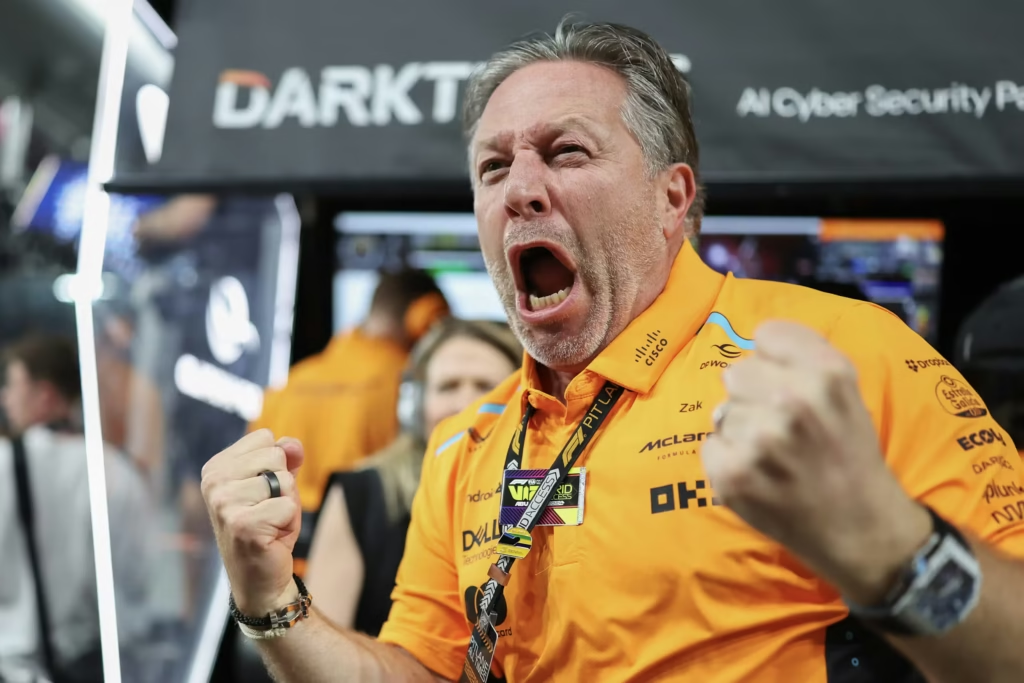
Zak Brown Embraces F1 Political Warfare: « We Try to Destabilize Other Teams »
McLaren CEO makes remarkably candid admission about Formula One’s off-track battles, revealing that destabilization is an intentional strategy—complete with Andrea Stella’s colorful « poison biscuits » terminology.
« We are trying to, in our sport, destabilize other teams. So we’re not just trying to make our team as strong as possible. »Zak Brown, McLaren CEO
The Admission
Speaking to TalkSPORT, Brown delivered one of the most honest assessments of Formula One’s political dimension in recent memory.
« I mean, you’re fighting hard, which I think is one of the things that Drive to Survive shows so well is our sport, the competition off the field is as great as it is on the field, and it’s very political, » Brown explained. « I’m not an expert in other sports, but we are trying to, in our sport, destabilize other teams. So we’re not just trying to make our team as strong as possible. »
This acknowledgment—that McLaren doesn’t merely focus on internal improvement but actively seeks to undermine competitors—represents a rare moment of transparency in a sport where such tactics are typically understood but never explicitly stated.
Brown’s comments come at a moment of triumph for McLaren, which dominated the 2025 season by winning 14 of 24 grands prix and securing both the Constructors’ and Drivers’ Championships for the first time since 1998.
« Poison Biscuits »
Brown revealed that McLaren Team Principal Andrea Stella has a colorful term for these destabilization efforts: « poison biscuits. »
Andrea Stella’s « Poison Biscuits » Philosophy
« Andrea, our team principal, calls it poison biscuits because you are trying… and you see it with the drivers, right? They talk trash to each other, and that’s all mental to try and kind of get in each other’s heads and we do that at every level. » – Zak Brown
The metaphor is apt: just as a poison biscuit looks appealing but contains danger, these political maneuvers in Formula One often involve presenting attractive opportunities or narratives to rivals that ultimately work against their interests.
The phrase suggests that McLaren’s approach extends across all organizational levels—from driver psychology to technical regulations to personnel recruitment. It’s a comprehensive strategy of competitive disruption.
Multi-Level Warfare
Brown’s acknowledgment that destabilization happens « at every level » reveals the comprehensive nature of Formula One’s political battles.
- Driver Psychology: Mental games through media to undermine rivals’ confidence
- Regulatory Battles: Lobbying FIA for favorable technical interpretations
- Personnel Poaching: Recruiting key staff from rival teams
- Media Narratives: Shaping public perception and triggering scrutiny
- Budget Cap Gamesmanship: Political battles over expense classifications
- Commercial Positioning: Competing for sponsors and partnerships
At the driver level, psychological warfare is obvious. Drivers regularly engage in verbal sparring through media, making subtle or not-so-subtle comments designed to undermine rivals’ confidence. Brown explicitly referenced this: « You see it with the drivers, right? They talk trash to each other, and that’s all mental to try and kind of get in each other’s heads. »
« Myself and the leadership team need to create an environment that gets people to not be interested in those phone calls. Because I can’t stop those phone calls from happening. »Zak Brown on protecting McLaren personnel from rival poaching
Drive to Survive’s Impact
Brown’s reference to Netflix’s Drive to Survive is significant. The documentary series, which has dramatically increased Formula One’s global popularity, particularly in the United States, has exposed F1’s political dimension to a mainstream audience.
Drive to Survive Revelation
« I think is one of the things that Drive to Survive shows so well is our sport, the competition off the field is as great as it is on the field. » – Zak Brown
The series has made heroes and villains of team principals, documented personnel movements, showcased regulatory disputes, and generally pulled back the curtain on F1’s political machinations. Brown’s acknowledgment suggests that rather than resenting this exposure, McLaren recognizes that F1’s political drama is part of its appeal.
This represents a sophisticated understanding of modern sports entertainment: fans don’t just want to see cars go fast; they want to understand the strategic chess match happening behind the scenes.
Timing and Context
Brown’s frank admission comes at an interesting moment. McLaren just completed one of the most dominant seasons in recent Formula One history, wrapping up the Constructors’ Championship with six races to spare—equaling Red Bull’s 2023 record for the earliest the teams’ title has ever been won.
Lando Norris secured the Drivers’ Championship in the season finale at Abu Dhabi, defeating four-time champion Max Verstappen by just two points to become McLaren’s first Drivers’ Champion since Lewis Hamilton in 2008.
From this position of strength, Brown can afford to be candid. When you’re winning, admitting to political maneuvering comes across as confidence rather than desperation. Had McLaren been struggling, similar comments might have been perceived as making excuses or deflecting from poor performance.
« With new rules, someone’s going to get it more right than you anticipated. Someone’s going to get it more wrong. So there’s general risk there. »
The « Papaya Rules » Philosophy
Brown’s political frankness contrasts interestingly with McLaren’s stated driver management philosophy. Throughout 2025, McLaren maintained their « papaya rules »—a policy of treating drivers Lando Norris and Oscar Piastri with complete equality, giving both equal opportunities to win races and the championship.
Internal Approach
Complete equality between drivers. Both Norris and Piastri given equal opportunities. Fairness and transparency prioritized. « Papaya rules » maintained despite criticism.
External Approach
Active destabilization of rivals. Political warfare « at every level. » « Poison biscuits » strategy. Comprehensive competitive disruption.
The contrast is revealing: internally, McLaren prizes fairness and equality between drivers. Externally, they actively work to destabilize rivals through political maneuvering. It suggests a sophisticated understanding that different competitive dimensions require different approaches.
Historical Precedent
Brown’s candid admission has historical precedent in Formula One, though such frankness is rare.
Ron Dennis, Brown’s predecessor at McLaren, was legendary for his political maneuvering but rarely acknowledged it so directly. Dennis orchestrated regulatory changes, personnel movements, and strategic partnerships with surgical precision, but typically maintained a facade of focusing purely on McLaren’s internal performance.
Bernie Ecclestone, F1’s former commercial supremo, was famously open about political machinations. Christian Horner at Red Bull has demonstrated political savvy but typically frames these battles as defending Red Bull’s interests rather than actively destabilizing rivals.
Brown’s admission stands out because he explicitly acknowledges destabilization as an intentional strategy rather than presenting political battles as defensive responses to rivals’ actions.
The 2026 Challenge
Brown’s political frankness takes on additional significance given the massive regulation changes coming in 2026. The sport faces one of its largest technical resets in history, with completely new power unit regulations, chassis rules, and aerodynamic concepts.
McLaren’s 2026 Defensive Challenge
After poaching Rob Marshall from Red Bull, McLaren now faces the challenge of retaining key staff as rivals undoubtedly study McLaren’s 2025-winning formula. Brown must simultaneously destabilize rivals while insulating McLaren from similar attacks.
In this environment of uncertainty, political maneuvering becomes even more critical. Teams will be lobbying for technical clarifications, questioning rivals’ solutions, and attempting to shape regulatory interpretations to favor their own concepts.
The Brown-Stella Partnership
Brown’s comments also illuminate the partnership between himself and Team Principal Andrea Stella. Brown serves as CEO of McLaren Racing, handling commercial, strategic, and political matters. Stella focuses on technical and operational leadership.
Stella’s « poison biscuits » terminology, as revealed by Brown, suggests both leaders think strategically about destabilization. It’s not just Brown engaging in political warfare while Stella focuses purely on engineering; both recognize political maneuvering as essential to Formula One success.
Looking Forward
As Formula One heads into the 2026 regulatory reset, Brown’s acknowledgment of political warfare provides useful context for the battles ahead. When teams object to rivals’ technical solutions, lobby for regulatory changes, or attempt to poach personnel, observers can understand these actions as part of F1’s accepted competitive landscape.
Brown has essentially legitimized discussion of tactics that previously existed in a gray area of public acknowledgment. By stating openly that McLaren works to destabilize rivals, he’s made it harder for others to claim shock or offense when McLaren engages in such behavior.
The psychological impact of Brown’s statement should not be underestimated. Rival teams now know explicitly that McLaren views destabilization as a core competitive strategy. This knowledge itself becomes a form of pressure.
Conclusion
Zak Brown’s frank admission that McLaren actively works to destabilize rival teams represents a remarkable moment of transparency in Formula One. By openly acknowledging political warfare as an intentional strategy—complete with Andrea Stella’s colorful « poison biscuits » terminology—Brown has pulled back the curtain on competitive tactics that most team principals prefer to leave unspoken.
Coming from a position of strength after McLaren’s dominant 2025 season, Brown’s candor reflects confidence rather than desperation. His reference to Drive to Survive suggests sophisticated understanding of modern F1 fandom: today’s fans appreciate the sport’s political complexity rather than being alienated by it.
As Formula One heads into the massive uncertainty of 2026’s regulatory reset, Brown’s comments provide context for the political battles ahead. Teams will lobby for favorable interpretations, question rivals’ technical solutions, and attempt to destabilize competitors through personnel poaching and media narratives.
By acknowledging these realities explicitly, Brown has legitimized discussion of Formula One’s political dimension while potentially gaining psychological advantages over rivals who must now consciously defend against McLaren’s destabilization efforts.
In a sport where perception and psychology matter as much as engineering and driving skill, Brown’s admission may itself be a form of political warfare—a « poison biscuit » disguised as transparent honesty. And that, perhaps, is the most sophisticated aspect of his strategy.