Lift to Go Faster, Blink and Get Disqualified: F1’s New Qualifying Gamble
Mercedes’ counterintuitive throttle-lift trick is legal, worth real lap time, and about to spread across the grid. But copying it carries a sting: get the timing wrong by a fraction, and the lap isn’t slow — it’s illegal.
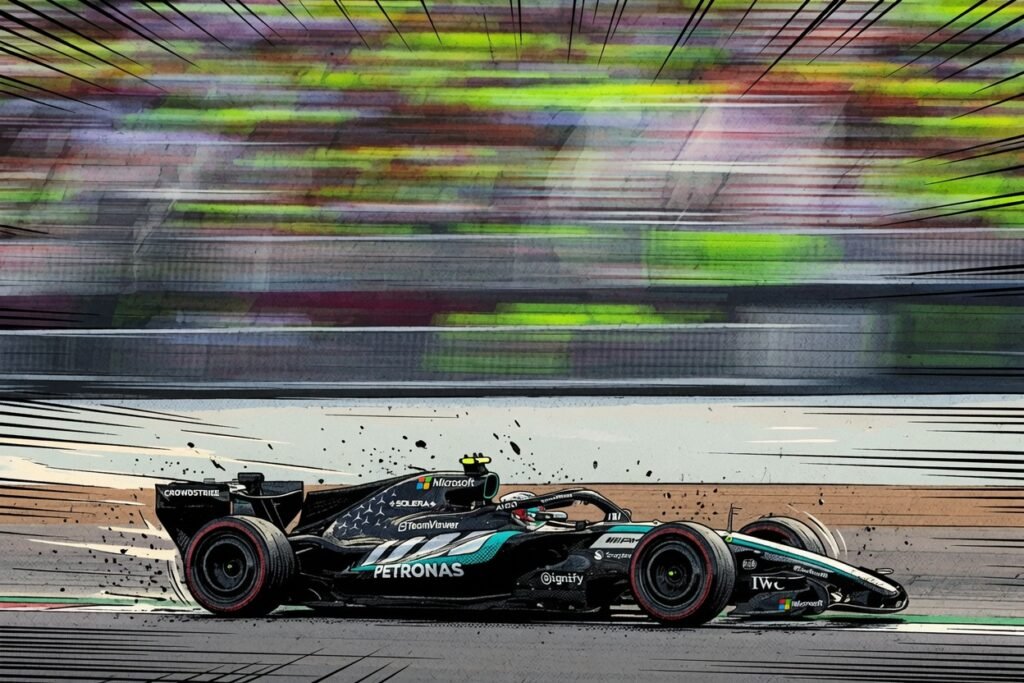
It looked, at first glance, like a mistake. Kimi Antonelli and George Russell, on flying laps at Silverstone, visibly backing off the throttle metres before the timing line — with Antonelli going on to miss Sprint pole by just 0.011 seconds, a margin he’d conceivably have erased by staying flat. But there was no mistake. As The Race first revealed, the lifts were the visible tip of a meticulously rehearsed exploit that let both Mercedes drivers deploy maximum electrical power earlier on the straight than anyone else. The FIA has confirmed it’s legal, the lap time benefit is real, and rival teams are now certain to copy it. What they’ll discover, as The Race has since detailed, is that the trick comes with an unusually brutal failure mode: get it wrong, and you don’t lose lap time — you lose the lap entirely.
The rule, the loophole, and the resurrection
The trick lives inside 2026’s energy deployment rules. As battery energy depletes toward the end of a straight, the regulations impose a “ramp down” rate: electrical power must bleed away gradually, at no more than 50kW per second, rather than cutting off in a sudden cliff. Mercedes’ exploit is in reaching the timing line at the full 350kW allowance for as long as physically possible before that ramp-down obligation bites — a gain worth roughly 0.05 seconds, delivered as a higher top speed arriving earlier on the straight.
This is actually the trick’s second life. Earlier in the season, Mercedes and Red Bull achieved the same effect through a different exemption: shutting down the MGU-K entirely under an “emergency” provision, which bypassed the ramp-down at the cost of losing battery power for 60 seconds — no real penalty when it happened at the end of a lap. The FIA clamped down on that route on safety grounds, seemingly killing the idea. Mercedes’ Silverstone innovation resurrected it through a cleaner door: the regulations also waive the ramp-down requirement when the driver fully lifts off the throttle. Lift before the battery empties, and the power can cut instantly — legally.
How the trick works
- Run the full 350kW deployment allowance for as long as possible on the final straight.
- Lift fully off the throttle just before the battery reaches zero — triggering a legal exemption from the 50kW/s ramp-down rule.
- Net result: 7-8km/h more speed earlier on the straight, worth around 0.05s despite crossing the line slower.
- Mercedes cued its drivers with an audio tone in their ears at a designated battery level above 0%.
The telemetry that gave it away
The Silverstone data tells the story with unusual clarity. Comparing Antonelli’s Sprint Qualifying lap with Hamilton’s pole effort, the Mercedes exits Club with a 7-8km/h advantage generated by the extra deployment — an edge that shrinks the moment Antonelli lifts, with Hamilton, flat to the line, crossing it 5km/h faster. Antonelli entered the final sector 0.125 seconds behind, closed to within 0.002 seconds at one point, and lost pole by 0.011. The arithmetic is the whole strategy in miniature: sacrifice the last metres of the lap to make the whole straight faster, and accept that the margin lives or dies on where, exactly, the lift happens.
In Q3 I also had to lift off, and with these power units it’s always a bit complicated because sometimes you have to drive in a way that doesn’t feel completely natural. Sometimes you have to get back on the throttle later, so through the fast corners you carry more speed and only open the throttle afterwards. — Kimi Antonelli, Mercedes driver
Why copying it is a genuine gamble
Programming a power unit to hold 350kW is the easy half. The hard half is human: the lift point isn’t a fixed spot on the track, because it depends entirely on the battery’s real-time state of charge — which varies lap to lap with how the energy was spent earlier. Mercedes’ solution was to pipe an audio tone into its drivers’ ears at a predetermined battery threshold, the signal to lift immediately. Russell and Antonelli spent extensive simulator time before the British GP drilling the technique, then committed to it across both qualifying sessions only once they trusted the execution.
The consequence of mistiming is what elevates this from clever to genuinely high-stakes. Lift too early, and you’ve thrown away lap time for nothing. But lift too late — let the battery hit zero while still on throttle — and the MGU-K cuts abruptly, breaching the ramp-down regulations. That’s not a slow lap; that’s a non-compliant car, with deletion from the qualifying result and a likely back-of-grid start as the realistic outcome. For a midfield team chasing a tenth, that trade might look appealing. For a front-runner protecting a championship, it’s a calculated risk every single flying lap.
Where it spreads next
With the mechanism now public and the FIA’s blessing confirmed — power must simply not have dropped by more than 50kW in any second before the lift — adoption is a matter of when, not if. The technique’s value is track-dependent: Silverstone suited it because the run from Club to the line is short and the final chicane already offers natural opportunities to conserve energy for one last burst. The Hungaroring, among upcoming venues, is seen as another circuit where the gains could be meaningful. Expect audio cues, dashboard battery warnings and a great deal of simulator homework across the grid before Spa — and expect, sooner or later, someone to get the timing wrong in the most expensive way possible.
- The FIA confirmed to The Race that the tactic is fully compliant as executed by Mercedes at Silverstone.
- The earlier MGU-K shutdown version of the trick was banned on safety grounds, as the unit stayed disabled for around a minute.
- Mercedes is so far the only team to have deployed the lift-off version in competitive sessions.
- The Belgian Grand Prix, July 17-19, is the first opportunity for rivals to respond in kind.
There’s something quintessentially 2026 about the whole affair: a rule written to make racing safer and more predictable, mined for an exemption that rewards drivers for the most counterintuitive act in motorsport — lifting off to go faster. Mercedes has shown the grid the door and the FIA has confirmed it’s unlocked. What every team copying it must now decide is how close to the cliff edge they’re willing to send their drivers, several times a Saturday, for five hundredths of a second.
Discover more from f1liveupdates.com
Subscribe to get the latest posts sent to your email.